

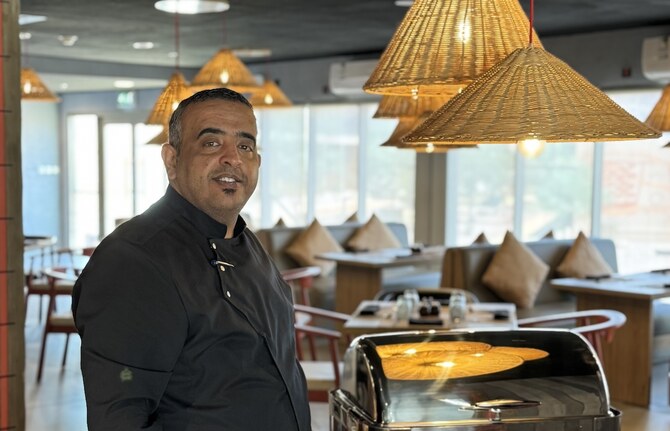

DUBAI: Jordan-born Mustafa Diab is the executive chef at AlUla’s Cloud7 Hotel & Residences.
Diab dedicated a significant portion of his 20-year career to the Four Seasons Hotel, an experience that exposed him to a wide range of cuisines. He has also successfully launched numerous restaurant branches.
Here, he talks to Arab News about his love for good beef and his preferred management style.
When you started out, what was your most common mistake?
I like to challenge myself. So, when I started my career, I would take everything on my shoulders, on my own. Not because I didn’t want anyone to share with me, but because I wanted to prove to myself that I could take it. Later on, though, I realized that collaboration and delegation are the keys to success.

Charchood restuarant. (Supplied)
What’s your top tip for amateurs?
Master the basics. And be patient with the process. Don’t rush. You have to understand the ingredients — whether they match or not. That is the most important thing. Then after that, you have to fix the flavors and pay great attention to the seasoning. Taste as you go. Also, stay curious. Experiment and don’t be afraid of mistakes.
What one ingredient can instantly improve any dish?
Salt. We have so many kinds of salt, but you need to know exactly when to use which kind of salts. If I want to do homemade pickling, I use sea salt — rough sea salt, not fine sea salt. To finish off a platter of protein — fish, meat, lamb, or chicken — I prefer flaky salt. Recently, I sourced Himalayan sea-salt bricks, and I can even present my beef dishes on top of it — when it’s hot, it takes flavor from the stone itself. Wow! And I got some smaller bricks that I can grate on my meat dishes.
When you go out to eat, do you find yourself critiquing the food?
It’s hard not to notice the details when you work in the same industry, but I try my best to approach it with an open mind. As long as there is consistency, quality and good presentation, then it’s fine.
What’s your favorite cuisine?
I’m a very simple person. I just grab very simple stuff — comfortable, tasty, nicely presented with a good quality. That’s enough for me. For example, a well-seasoned piece of chicken, or a well-seasoned piece of fish with green vegetables, and I’ll be happy.
What’s your go-to dish if you have to cook something quickly at home?
I just grab a piece of pita bread. I slice an avocado — I love avocado — with some chopped onion, chopped coriander, chopped tomato, a drizzle of olive oil, with a squeeze of lemon juice, and that will be amazing for me.
What customer behavior most annoys you?
Nothing will annoy me. But let’s call it a challenge when they dismiss or don’t appreciate the effort that went into a dish. Because, you know, every dish we cook, we cook with love — it has potential, it has thought behind it, it has so many ideas in there. So, if the dish was well presented and there was nothing wrong with it, and the guest’s feedback is that it’s not good, that’s a challenge for me. If there’s something wrong with a dish, we all accept that. But when there is nothing wrong, that’s a challenge for me.
What’s your favorite dish to cook and why?
All cuts of beef. Especially the toughest cuts. If you don’t eat beef, don’t be a chef. If you like your beef when it’s done more than medium-well, think about it, please. To feel it and to appreciate the way the farmers bred this beef, you should eat it medium-well, not well-done. When you eat it well done, there’s no difference between Black Angus and Wagyu.
As a head chef, what are you like?
I try to treat people the way I want to be treated, so I treat my staff with respect. That’s a common language wherever you go in the world. When you respect your staff, they will, for sure, pay that respect back. Sometimes I’m firm when it comes to the quality and consistency, because when you cook, you should pay full attention to what you are doing. But I’m calm in the kitchen. I’m not shouting and screaming.
RECIPE

Chef Mustafa’s lamb mansaf
INGREDIENTS:
350g lamb on the bone; 1000g water; 10g black lime; 2g cardamom; 2g bay leaves; 1g black peppercorn; 30g salt; 150g short grain rice; 10g halved almonds; 10g pine nuts; 5g parsley (chopped); 30g ghee; 20g samen balady (local ghee); 1g turmeric
For the yoghurt sauce (mansaf laban): 600g laban; 200g labneh; 200g dry yoghurt (jameed)
INSTRUCTIONS:
1. Wash the lamb under running water with salt for 10 minutes. Ensure all the blood is out of the lamb.
2. Boil with the bay leaves, cardamom, black lime and black peppercorn until 80 percent cooked.
3. Take the lamb meat out of the stock and put aside. Put the yoghurt sauce ingredients in a pan and mix on a simmering heat until boiling. Add the lamb to the yoghurt sauce and continue to cook on low heat.
4. Wash the rice and allow to soak for 20 minutes.
5. Strain the rice. Place the ghee in a pot on a low heat. Add the rice, salt and turmeric. Add boiling water, and allow to cook on low heat for 10 minutes.
6. Serve. See picture for plating suggestion.


