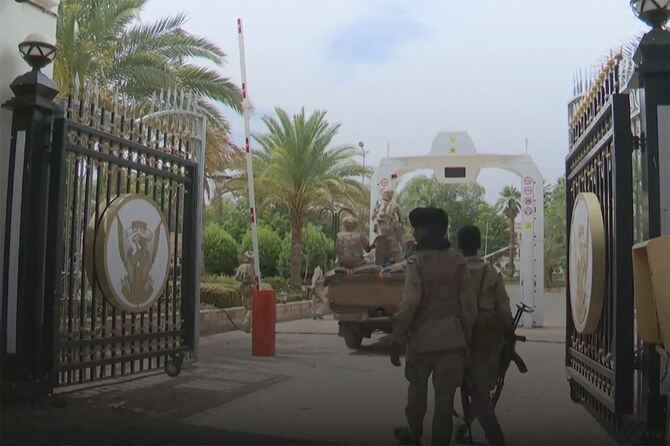

DUBAI/CAIRO: The Sudanese army seized full control of the presidential palace in downtown Khartoum on Friday, it said in a statement, in what would be a major gain in a two-year-old conflict with a rival armed group that has threatened to partition the country.
The paramilitary Rapid Support Forces (RSF) said hours later that it remained in the vicinity of the palace, and that it had launched an attack that had killed dozens of army soldiers inside.
Army sources said the fighters were about 400 meters away. They said the army’s forces had suffered a drone attack that killed several soldiers as well as three journalists from state television.
The army had long been on the back foot but has recently been making gains and has retaken territory from the RSF in the center of the country.
Meanwhile the RSF has consolidated control in the west, hardening battle lines and moving the country toward de facto partition. The RSF is working to set up a parallel government in areas it controls, although that is not expected to receive widespread international recognition.
The RSF rapidly seized the presidential palace in Khartoum, along with the rest of the city, after war broke out in April 2023 over the paramilitary’s integration into the armed forces.
The army shared videos of soldiers cheering on the palace grounds, its glass windows shattered and walls pockmarked with bullet holes. Images showed the cladding of the recently constructed palace torn off by explosions.
Many Sudanese welcomed the army’s statement that it had control of the palace.
“The liberation of the palace is the best news I’ve heard since the start of the war, because it means the start of the army controlling the rest of Khartoum,” said 55-year-old Khartoum resident Mohamed Ibrahim.
“We want to be safe again and live without fear or hunger,” he said.
Late on Thursday the RSF said it had seized a key base from the army in North Darfur, a region in the west of the country.
The conflict has led to what the UN calls the world’s largest humanitarian crisis, spreading famine in several locations and disease across the country of 50 million people.
Both sides have been accused of war crimes, while the RSF has also been charged with genocide. Both sides deny the charges.
GUNFIRE IN KHARTOUM
Intermittent gunfire was heard in Khartoum on Friday and bloody fighting was expected as the army seeks to corner the RSF, which still occupies swathes of the territory to the south of the palace.
“We are moving forward along all fighting axes until victory is complete by cleansing every inch of our country from the filth of this militia and its collaborators,” the army statement said.
RSF leader Mohamed Hamdan Dagalo, known as Hemedti, had instructed troops earlier this week to maintain control at the palace.
Although the RSF still has positions in Khartoum, its foothold there is more tenuous than at any point since the conflict began and the trajectory suggests the RSF will be pushed out completely, said Ahmed Soliman, senior research fellow at Chatham House.
The army is likely to continue the war in the west, he added, leaving Sudan facing “a contested, partitioned reality.”
The war erupted two years ago as the country was planning a transition to democratic rule.
The army and RSF had joined forces after ousting Omar Al-Bashir from power in 2019 and later to oust civilian leadership.
But they had long been at odds, as Bashir developed Hemedti and the RSF, which has its roots in Darfur’s janjaweed militias, as a counterweight to the army, led by career officer Abdel Fattah Al-Burhan.