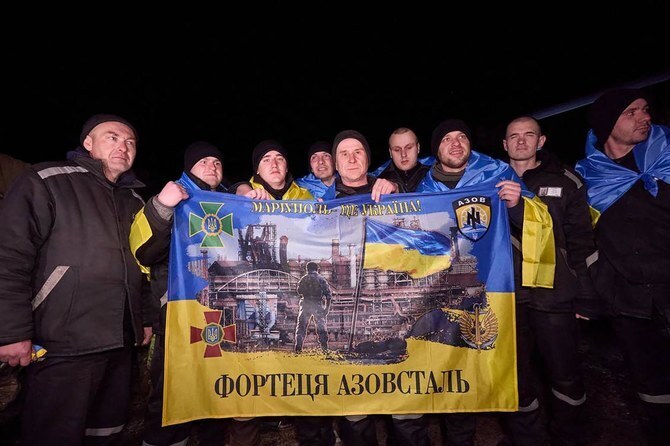
WARSAW: Four Ukrainian men taken captive by Russia at the start of its invasion gave emotional statements in court this week as they faced massive sentences for “seizure of power” and terrorism, Russian media reported Thursday.
Two of the four left the Ukrainian army years before Moscow launched its full-scale attack in 2022, while another had never taken up arms, according to the Mediazona news outlet.
On top of taking thousands of Ukrainian troops captive since launching its 2022 attack, Moscow has also taken an unknown number of civilians into Russia from occupied Ukrainian territory.
“I have never served in the Ukrainian army, I served in the Soviet army, more than 30 years ago,” Oleg Zharkov, whom prosecutors want to jail for 19.5 years, told the court, according to a transcript published by the Mediazona website Thursday.
“It’s no secret that in any military unit not only soldiers work but electricians, plumbers, handymen... People like me.”
The four spoke at a military court in Russia’s Rostov-on-Don late Wednesday, most of whom were captured during the 2022 siege of Mariupol.
All of them served in Ukraine’s Azov battalion — banned in Russia — at various points in time, some of whom worked in civilian roles supporting the army such as cooks or plumbers.
They are among 24 accused of taking part in a terrorist organization and trying to overthrow Russian authorities — despite not living in Russian territory before their arrest. Two of the other 20 were exchanged in prisoner swaps, while one died in custody last year.
Oleksandr Mukhin, facing 22 years, served in the Azov battalion for a year between 2017 and 2018.
“I’m a former serviceman, let’s start from that,” he said. He was working as a security guard when Moscow attacked.
He said he was taken from his home in Mariupol in March 2022 by “some people, beaten, put a sack on my head and taken away.”
“On Russophobia... How can I criticize someone for speaking Russian when I’m a Russian speaker?“
Soldier Mykyta Tymonin said he had seen torture in custody.
“Sitting in Rostov, you do not feel that there is a war between Russia and Ukraine, and in Ukraine people feel it: many people die, children. Many families are forced to go abroad,” he said.
Anatoliy Grytsyk said he had been a soldier his whole professional life and served in Bosnia, Kuwait and Kosovo.
He said his wife had been “shot in the street in front of him.”
“I cannot tell people what I feel, what I went through, what your country did to mine,” he said.
“God forbid you ever feel this.”

Captive Ukrainians address Russian court in emotional statements
https://arab.news/zvr44
Captive Ukrainians address Russian court in emotional statements
- Moscow has also taken an unknown number of civilians into Russia from occupied Ukrainian territory
- “I have never served in the Ukrainian army, I served in the Soviet army, more than 30 years ago,” Oleg Zharkov, whom prosecutors want to jail for 19.5 years, told the court
Only 4% women on ballot as Bangladesh prepares for post-Hasina vote
- Women PMs have ruled Bangladesh for over half of its independent history
- For 2026 vote, only 20 out of 51 political parties nominated female candidates
DHAKA: As Bangladesh prepares for the first election since the ouster of its long-serving ex-prime minister Sheikh Hasina, only 4 percent of the registered candidates are women, as more than half of the political parties did not field female candidates.
The vote on Feb. 12 will bring in new leadership after an 18-month rule of the caretaker administration that took control following the student-led uprising that ended 15 years in power of Hasina’s Awami League party.
Nearly 128 million Bangladeshis will head to the polls, but while more than 62 million of them are women, the percentage of female candidates in the race is incomparably lower, despite last year’s consensus reached by political parties to have at least 5 percent women on their lists.
According to the Election Commission, among 1,981 candidates only 81 are women, in a country that in its 54 years of independence had for 32 years been led by women prime ministers — Hasina and her late rival Khaleda Zia.
According to Dr. Rasheda Rawnak Khan from the Department of Anthropology at Dhaka University, women’s political participation was neither reflected by the rule of Hasina nor Zia.
“Bangladesh has had women rulers, not women’s rule,” Khan told Arab News. “The structure of party politics in Bangladesh is deeply patriarchal.”
Only 20 out of 51 political parties nominated female candidates for the 2026 vote. Percentage-wise, the Bangladesh Socialist Party was leading with nine women, or 34 percent of its candidates.
The election’s main contender, the Bangladesh Nationalist Party, whose former leader Zia in 1991 became the second woman prime minister of a predominantly Muslim nation — after Pakistan’s Benazir Bhutto — was the party that last year put forward the 5 percent quota for women.
For the upcoming vote, however, it ended up nominating only 10 women, or 3.5 percent of its 288 candidates.
The second-largest party, Jamaat-e-Islami, has not nominated a single woman.
The 4 percent participation is lower than in the previous election in 2024, when it was slightly above 5 percent, but there was no decreasing trend. In 2019, the rate was 5.9 percent, and 4 percent in 2014.
“We have not seen any independent women’s political movement or institutional activities earlier, from where women could now participate in the election independently,” Khan said.
“Real political participation is different and difficult as well in this patriarchal society, where we need to establish internal party democracy, protection from political violence, ensure direct election, and cultural shifts around female leadership.”
While the 2024 student-led uprising featured a prominent presence of women activists, Election Commission data shows that this has not translated into their political participation, with very few women contesting the upcoming polls.
“In the student movement, women were recruited because they were useful, presentable for rallies and protests both on campus and in the field of political legitimacy. Women were kept at the forefront for exhibiting some sort of ‘inclusive’ images to the media and the people,” Khan said.
“To become a candidate in the general election, one needs to have a powerful mentor, money, muscle power, control over party people, activists, and locals. Within the male-dominated networks, it’s very difficult for women to get all these things.”


