POKROVSK REGION, Ukraine: A dire shortage of infantry troops and supply routes coming under Russian drone attacks are conspiring against Ukrainian forces in Pokrovsk, where decisive battles in the nearly three-year war are playing out — and time is running short.
Ukrainian troops are losing ground around the crucial supply hub, which lies at the confluence of multiple highways leading to key cities in the eastern Donetsk region as well as an important railway station.
Moscow is set on capturing as much territory as possible as the Trump administration is pushing for negotiations to end the war and recently froze foreign aid to Ukraine, a move that has shocked Ukrainian officials already apprehensive about the intentions of the new US president, their most important ally. Military aid has not stopped, Ukrainian President Volodymyr Zelensky has said.
Ukrainian soldiers in Pokrovsk said that Russian forces switched tactics in recent weeks, attacking their flanks instead of going head-on to form a pincer movement around the city. With Russians in control of dominant heights, Ukrainian supply routes are now within their range. Heavy fog in recent days prevented Ukrainian soldiers from effectively using surveillance drones, allowing Russians to consolidate and take more territory.
Meanwhile, Ukrainian commanders say they do not have enough reserves to sustain defense lines and that new infantry units are failing to execute operations. Many pin hopes on Mykhailo Drapatyi, a respected commander recently appointed by Ukrainian President Volodymyr Zelensky as ground forces chief, to shift the dynamic and counterattack.
“The war is won by logistics. If there is no logistics, there is no infantry, because there is no way to supply it,” said the deputy commander of the Da Vinci Wolves battalion, known by the call sign Afer.
“(Russians) have learned this and are doing it quite well.”
Poor weather at the worst time
A combination of factors led Kyiv to effectively lose the settlement of Velyka Novosilka this past week, their most significant gain since seizing the city of Kurakhove in the Donetsk region in January.
Scattered groups of Ukrainian soldiers are still present in Velyka Novosilka’s southern sector, Ukrainian commanders said, prompting criticism from some military experts who questioned why the higher command did not order a full withdrawal.
The road-junction village is 15 kilometers (9 miles) from the neighboring Dnipropetrovsk region, where authorities have begun digging fortifications for the first time since Russia’s full-scale invasion in February 2022, anticipating further Russian advances.
Russia amassed a large number of infantry around Velyka Novosilka, soldiers there said. As heavy fog set in in recent days, Ukrainian drones “barely worked” to conduct surveillance, one commander near Pokrovsk told The Associated Press. Long-range and medium-range surveillance was impossible, he said. He spoke on condition of anonymity in order to speak freely about sensitive military matters.
“Because of this, the enemy was amassing forces … taking up positions, digging in. They were very good at it,” he said.
It was at that fateful moment that Russian forces launched a massive attack: Up to 10 columns of armored vehicles, each with up to 10 units, moved out from various directions.
Ukrainian logistics in peril
Key logistics routes along asphalted roads and highways are under direct threat from Russian drones as a result of Moscow’s recent gains, further straining Ukrainian troops.
Russian forces now occupy key dominant heights around the Pokrovsk region, which allows them to use drones up to 30 kilometers (18 miles) deep into Ukrainian front lines.
The Pokrovsk-Pavlohrad-Dnipro highway is “already under the control of Russian drones,” said the commander at Pokrovsk’s flanks. Russian forces are less than 4 kilometers ( 2 1/2 miles) away and are affecting Ukrainian traffic, he said. “Now the road is only 10 percent of its former capacity,” he said.
Another paved highway, the Myrnohrad-Kostyantynivka road, is also under Russian fire, he said.
This also means that in poor weather, military vehicles, including armored personnel carriers, tanks and pickup trucks, have to trudge through the open fields to deliver fuel, food and ammunition, as well as evacuate the wounded.
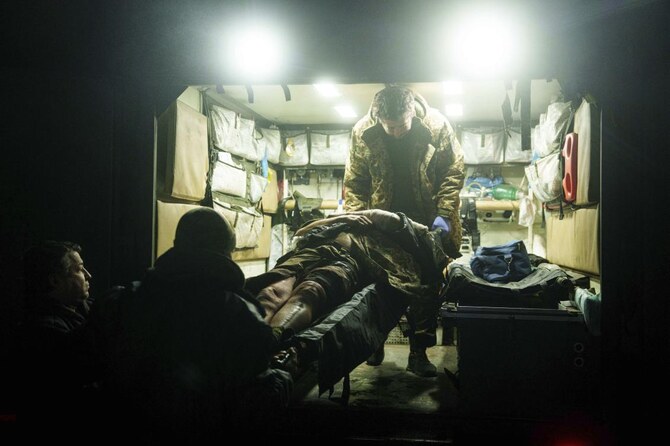
In a first-aid station near Pokrovsk, a paramedic with the call sign Marik said evacuating wounded soldiers once took hours, now it takes days.
“Everything is visible (by enemy drones) and it is very difficult,” he said.
New recruits are unprepared
Ukrainian soldiers in Pokrovsk said shortages of fighting troops are “catastrophic” and challenges are compounded by newly created infantry units that are poorly trained and inexperienced, putting more pressure on battle-hardened brigades having to step in to stabilize the front line.
Afer, the deputy commander, complained that new recruits are “constantly extending the front line because they leave their positions, they do not hold them, they do not control them, they do not monitor them. We do almost all the work for them.”
“Because of this, having initially a 2-kilometer area of responsibility, you end up with 8-9 kilometers per battalion, which is a lot and we don’t have enough resources,” Afer said. Drones are especially hard to come by for his battalion, he said, adding they only have half of what they need.
“It’s not because they have lower quality infantry, but because they are completely unprepared for modern warfare,” he said of the new recruits.
His battalion has almost no reserves, forcing infantry units to hold front-line positions for weeks at a time. For every one of his soldiers, Russians have 20, he said, emphasizing how outnumbered they are.
Back at the first-aid station, a wounded soldier with the call sign Fish was recovering from a leg wound sustained after he tried to evacuate a fallen comrade. He had moved him from a dugout to load him into a vehicle when the Russian mortar shell exploded nearby.
“We are fighting back as much as we can, as best as we can,” he said.


![]()


Ukrainian troops lose ground with fewer fighters and exposed supply lines
Short Url
https://arab.news/4mdap
Ukrainian troops lose ground with fewer fighters and exposed supply lines
- Moscow is set on capturing as much territory as possible as the Trump administration is pushing for negotiations to end the war
- Ukrainian soldiers in Pokrovsk said that Russian forces switched tactics in recent weeks, attacking their flanks instead of going head-on


Japan’s Takaichi aims for blizzard of votes in rare winter election
- Polls suggest big gains for Sanae Takaichi’s LDP-Ishin coalition
- Japan’s first female leader seeks to capitalize on youth appeal
TOKYO: Japanese voters trudged through snow on Sunday to cast their ballots in an election predicted to hand Prime Minister Sanae Takaichi a resounding win, though record dumps in some parts of the country snarled traffic and could dent turnout.
The conservative coalition of Takaichi, the nation’s first female leader, is on track to win around 300 of the 465 seats in the lower house of parliament, according to multiple opinion polls, a large gain from the 233 it is defending.
Outside a polling station in a small town in the central prefecture of Niigata, where snow piled up more than 2 meters (7 feet) in places, teacher Kazushige Cho, 54, said he was determined to vote for Takaichi’s Liberal Democratic Party despite the conditions.
“She’s shown strong leadership and pushes various policies forward,” he said. “I think things could turn out quite well.”
Takaichi rides ‘Sanakatsu’ wave among young voters
Takaichi, 64, who became prime minister in October after being selected LDP leader, called the rare winter election to try to ride a wave of personal popularity.
With a straight-talking style and an image as a hard worker that have won her support, Takaichi has accelerated military spending to counter China, angering Beijing, and pushed for a sales-tax cut that has rattled financial markets.
“If Takaichi wins big, she will have more political room to follow through on key commitments, including on consumption-tax cuts,” said Seiji Inada, managing director at FGS Global, a consultancy. “Markets could react in the following days, and the yen could come under renewed pressure.”
Her promise to suspend the 8 percent sales tax on food for two years to help households cope with rising prices has spooked investors concerned about how the nation with the heaviest debt burden among advanced economies will fund the plan.
Niigata resident Mineko Mori, 74, padding through the snow with her dog early on Sunday, said she worried that Takaichi’s tax cuts could saddle future generations with an even bigger burden.
Mori planned to vote for Sanseito, a small far-right party that broke through in a 2025 upper house ballot with promises to crack down on badly behaved foreigners and control immigration.
But younger voters are among the most supportive of Takaichi, with one recent poll finding more than 90 percent of those under 30 favored her.
The prime minister has sparked an unlikely youth-led craze called “sanakatsu,” roughly translated as “Sanae-mania,” with the products she uses, such as her handbag and the pink pen she scribbles notes with in parliament, in high demand.
That young cohort, however, is less likely to vote than the older generations that have long been the bedrock of LDP support.
On Thursday, Takaichi received the endorsement of US President Donald Trump, a signal that may appeal to right-leaning voters.
If the coalition of Takaichi’s LDP with the Japan Innovation Party, known as Ishin, wins a supermajority of 310 seats, she could override the upper chamber, where the coalition does not have a majority.
If the polls have it all wrong and Takaichi loses control of the lower house, she has vowed to step down.
Whiteout could boost organized voting blocs
With up to 70 cm (28 inches) of snow forecast in northern regions, some voters will battle blizzard conditions to pass their verdict on her administration. It is only the third postwar election held in February, with elections typically called during milder months.
Even the capital Tokyo was given a rare covering of snow, causing some minor traffic disruptions.
Nationwide, 37 train lines and 58 ferry routes were halted and 54 flights canceled as of Sunday morning, according to the transport ministry.
Turnout in recent lower house elections has hovered around the mid-50 percent range. Any slump on Sunday could amplify the influence of organized voting blocs.
One of those is Komeito, which last year quit its coalition with the LDP and has merged into a centrist group with the main opposition Constitutional Democratic Party of Japan. Komeito has close ties to the lay-Buddhist Soka Gakkai group, which claims at least 8 million members nationwide.
Voters will pick lawmakers in 289 single-seat constituencies, with the rest decided by proportional-representation votes for parties. Polls close at 8 p.m. (1100 GMT), when broadcasters are expected to issue projections based on their exit polls.
The conservative coalition of Takaichi, the nation’s first female leader, is on track to win around 300 of the 465 seats in the lower house of parliament, according to multiple opinion polls, a large gain from the 233 it is defending.
Outside a polling station in a small town in the central prefecture of Niigata, where snow piled up more than 2 meters (7 feet) in places, teacher Kazushige Cho, 54, said he was determined to vote for Takaichi’s Liberal Democratic Party despite the conditions.
“She’s shown strong leadership and pushes various policies forward,” he said. “I think things could turn out quite well.”
Takaichi rides ‘Sanakatsu’ wave among young voters
Takaichi, 64, who became prime minister in October after being selected LDP leader, called the rare winter election to try to ride a wave of personal popularity.
With a straight-talking style and an image as a hard worker that have won her support, Takaichi has accelerated military spending to counter China, angering Beijing, and pushed for a sales-tax cut that has rattled financial markets.
“If Takaichi wins big, she will have more political room to follow through on key commitments, including on consumption-tax cuts,” said Seiji Inada, managing director at FGS Global, a consultancy. “Markets could react in the following days, and the yen could come under renewed pressure.”
Her promise to suspend the 8 percent sales tax on food for two years to help households cope with rising prices has spooked investors concerned about how the nation with the heaviest debt burden among advanced economies will fund the plan.
Niigata resident Mineko Mori, 74, padding through the snow with her dog early on Sunday, said she worried that Takaichi’s tax cuts could saddle future generations with an even bigger burden.
Mori planned to vote for Sanseito, a small far-right party that broke through in a 2025 upper house ballot with promises to crack down on badly behaved foreigners and control immigration.
But younger voters are among the most supportive of Takaichi, with one recent poll finding more than 90 percent of those under 30 favored her.
The prime minister has sparked an unlikely youth-led craze called “sanakatsu,” roughly translated as “Sanae-mania,” with the products she uses, such as her handbag and the pink pen she scribbles notes with in parliament, in high demand.
That young cohort, however, is less likely to vote than the older generations that have long been the bedrock of LDP support.
On Thursday, Takaichi received the endorsement of US President Donald Trump, a signal that may appeal to right-leaning voters.
If the coalition of Takaichi’s LDP with the Japan Innovation Party, known as Ishin, wins a supermajority of 310 seats, she could override the upper chamber, where the coalition does not have a majority.
If the polls have it all wrong and Takaichi loses control of the lower house, she has vowed to step down.
Whiteout could boost organized voting blocs
With up to 70 cm (28 inches) of snow forecast in northern regions, some voters will battle blizzard conditions to pass their verdict on her administration. It is only the third postwar election held in February, with elections typically called during milder months.
Even the capital Tokyo was given a rare covering of snow, causing some minor traffic disruptions.
Nationwide, 37 train lines and 58 ferry routes were halted and 54 flights canceled as of Sunday morning, according to the transport ministry.
Turnout in recent lower house elections has hovered around the mid-50 percent range. Any slump on Sunday could amplify the influence of organized voting blocs.
One of those is Komeito, which last year quit its coalition with the LDP and has merged into a centrist group with the main opposition Constitutional Democratic Party of Japan. Komeito has close ties to the lay-Buddhist Soka Gakkai group, which claims at least 8 million members nationwide.
Voters will pick lawmakers in 289 single-seat constituencies, with the rest decided by proportional-representation votes for parties. Polls close at 8 p.m. (1100 GMT), when broadcasters are expected to issue projections based on their exit polls.
Latest updates


Recommended


© 2026 SAUDI RESEARCH & PUBLISHING COMPANY, All Rights Reserved And subject to Terms of Use Agreement.