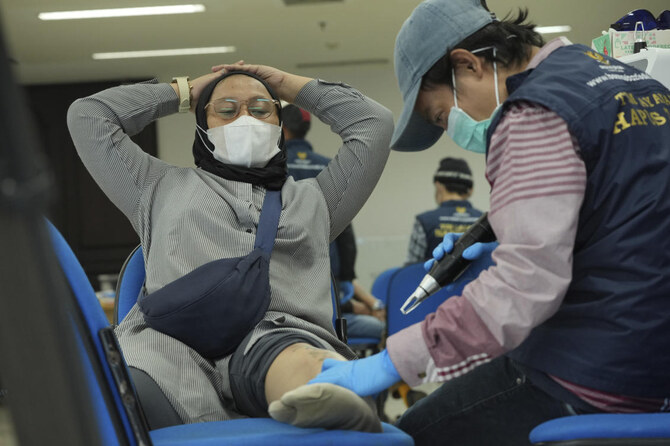
JAKARTA, Indonesia: Teguh Islean Septura groans in pain as each staccato rat-a-tat-tat of the laser fires an intense beam at the elaborate tattoos on his arm. But the former musician’s determination to “repent” in the holy month of Ramadan is enough to keep him going.
The 30-year-old guitarist got his back, arms and legs tattooed to “look cool” when he was performing in a band. But these days Septura has a newfound zeal for Islam, including the conviction that Muslims should not alter the body that God gave them.
“As humans, sometimes we make mistakes. Now I want to improve myself by moving closer to God,” Seputra said, as a health worker aimed the white laser wand at Septura’s skin, blasting the red, green and black pigments with its penetrating light. “God gave me clean skin and I ruined it, that’s what I regret now.”
Septura is among a growing number of people in Indonesia’s capital who have signed up for free tattoo removal services offered by Amil Zakat National Agency, an Islamic charity organization, during Ramadan to give practicing Muslims an opportunity to “repent.”
Launched in 2019, the tattoo removal program is now held every Ramadan, a month of fasting, increased worship, religious reflection and good deeds. Some 700 people have signed up for the services this year, and in total nearly 3,000 people have taken part.
“We want to pave the way for people who want to hijrah (to move closer to God), including those who want to remove their tattoos” said Mohammad Asep Wahyudi, a coordinator of the event. He added that many people cannot afford to remove their tattoos or know where and how they can do so safely.
Laser removal, which takes repeated treatment and may not be completely successful, could cost thousands of dollars for tattoos as extensive as Septura’s.
Tattooing remains strongly associated with gangs and criminality in some Asian cultures. In addition to the religious prohibitions in Muslim-majority Indonesia, ideas about tattoos also reveal oppressive attitudes toward women, who if tattooed can be labeled as promiscuous or disreputable and not worth marrying.
Sri Indrayati, 52, said she tattooed the name of her first daughter on her hand shortly after she gave birth to her at the age of 22. She said she regretted it when her two grandchildren kept asking her to erase it because it looked like dirty, thick marker writing.
“When I take my grandson to school, (the children) whisper to each other: ‘look at that grandma, she has a tattoo!” she said.
Another woman, Evalia Zadora, got a tattoo of a large star on her back and the words “Hope, Love and Rock & Roll” on her upper chest as a teen to gain acceptance into a gang. She wants to remove them now to move closer to God and out of consideration for her family.
“Bad image (against people with tattoos) is not a big deal for me, but it affected my husband and son,” said Zadora, 36. “They are not comfortable with my tattoos and I respect their feelings, so I want to remove it.


Muslims with tattoo regrets flock to free removal service during Ramadan
https://arab.news/rjs4q
Muslims with tattoo regrets flock to free removal service during Ramadan

- A growing number of people in Indonesia’s capital have signed up for free tattoo removal services offered by Amil Zakat National Agency
- Launched in 2019, the tattoo removal program is now held every Ramadan, a month of fasting, increased worship, religious reflection and good deeds


Lufthansa adds more flights to Asia, Africa as Middle East war reshapes air travel
- Airlines across Europe have been redirecting capacity after suspending services in the Middle East
- Lufthansa said the move also helps meet demand on long-haul routes that Middle Eastern carriers cannot currently serve
LONDON: Lufthansa said on Friday it was shifting capacity from 10 canceled Middle Eastern destinations to routes such as Singapore and Bangkok as it contends with disruption from the US-Israeli war on Iran.
Airlines across Europe, including budget carrier Wizz Air , have been redirecting capacity after suspending services in the Middle East.
Lufthansa said the move also helps meet demand on long-haul routes that Middle Eastern carriers cannot currently serve.
Airline stocks have slumped this week as US and Israeli airstrikes on Iran — and retaliatory strikes by Iran across the Middle East — have disrupted long-haul flights and sent oil prices soaring.
“The war in the Middle East proves once again how exposed air traffic is and how vulnerable it remains,” Lufthansa CEO Carsten Spohr said in a statement. He added the outlook was uncertain, particularly for jet fuel costs.
The schedule changes came as the German group reported better-than-expected 2025 results, saying stricter financial management and fleet renewal had helped contain costs and lift profits. Its shares rose as much as 4 percent, before reversing to trade down 1.2 percent at 1246 GMT.
The company said demand on routes to and from Asia and Africa had risen strongly since the conflict began on Saturday, and it would stick with its focus on expanding long-haul services. Spohr said new flights to Asia would launch in days.
Lufthansa did say how many services it had canceled because of the conflict.
While carriers face costs for rescheduling and rerouting, the biggest impact for those outside the Middle East is expected from surging fuel prices. Brent crude futures have jumped more than 20 percent this week.
Spohr said Lufthansa was well hedged in the short term. The group hedges fuel up to 24 months ahead and was 85 percent hedged as of December 31, according to its annual report.
RESILIENCE
European carriers, including Lufthansa, benefited from slightly lower fuel bills in 2025. Lufthansa’s fuel bill fell 7 percent, helping support earnings as passenger demand stayed firm.
“Last year we were able to significantly increase the Group’s operating profit and achieved the highest revenue in our history. Our results demonstrate the resilience and stability of the Group,” Spohr said.
Lufthansa reported an adjusted operating profit of 2 billion euros ($2.3 billion), compared with 1.9 billion euros forecast in a company-compiled analyst poll and up from 1.6 billion euros in 2024. The group also posted an operating margin of 4.9 percent, up from 4.4 percent a year earlier.
Lufthansa aims to lift operating margins to 8 percent-10 percent between 2028 and 2030 from 4.4 percent in 2024, but strikes by workers, including the most recent on February 12, have made it harder to boost profitability.
Bernstein analyst Alex Irving said ongoing weakness in the passenger airline segment persisted, but that strong performances in Cargo and Lufthansa Technik helped lift profits.
The carrier said the outlook for 2026 was unclear due to geopolitical uncertainty. It projected capacity growth of 4 percent, alongside increased revenue and profit margin.


