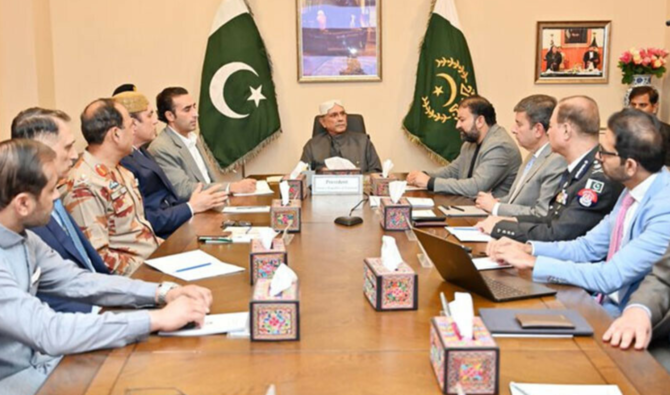

ISLAMABAD: Pakistan’s President Asif Ali Zardari visited Balochistan’s Quetta city on Wednesday to review the law and order situation in the province, vowing that the state would establish its writ there despite surging militant attacks in recent days.
Zardari’s visit to Quetta takes place as Pakistan struggles to contain militant attacks in the southwestern province, where separatists last week hijacked a train and held hostage hundreds of passengers. The military launched an operation and, after a day-long standoff, rescued 354 captives and killed 33 insurgents. A final count showed 23 soldiers, three railway employees and five passengers had died in the attack.
Zardari arrived in Quetta on a day-long visit with his son and Pakistan Peoples Party (PPP) Chairman Bilawal Bhutto-Zardari on Wednesday. The two attended a meeting with Balochistan Chief Minister Sarfraz Bugti to review the security situation in the province.
“President Asif Ali Zardari says the terrorist elements will be defeated at all costs and writ of the state will be ensured in Balochistan,” state broadcaster Radio Pakistan said.
The Pakistani president said “terrorists” want to divide the nation, vowing they would never succeed in their ambitions.
“The president said that modern arms would be provided to the Counter-Terrorism Département and other law enforcement institutions to strengthen security efforts,” the state broadcaster reported.
Balochistan is Pakistan’s largest province by land but its most backward by almost all economic and social indicators. For decades it has been plagued by a low-level insurgency by militants fighting for a greater share of the province’s wealth.
Separatist militants, such as the Baloch Liberation Army (BLA) accuse the central government of denying locals a share of Balochistan’s mineral resources. The federal government and the military strongly deny these accusations, and say they have launched several projects in the province to support its development.
Militant violence has persisted in the province after the train hijacking. Three paramilitary soldiers among five people were killed in a suicide attack in Balochistan’s Nushki district on Sunday.
A top parliamentary panel on national security met in Islamabad on Tuesday to discuss surging attacks in Balochistan. The panel stressed the need for a national consensus to counter militancy, calling for a unified political stance to confront the threat with “full force of the state.”