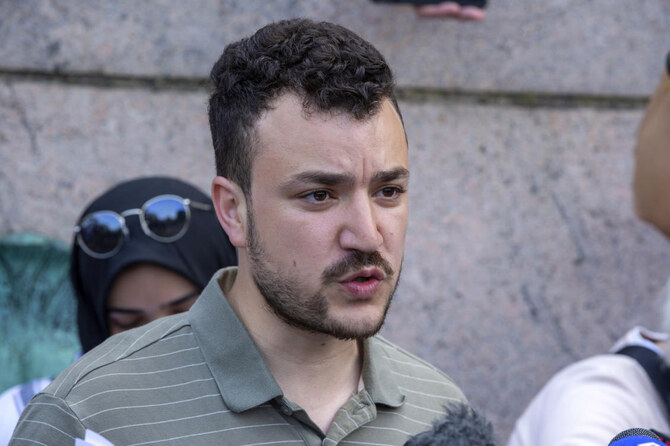
NEW YORK: A US judge on Wednesday denied a bid by President Donald Trump’s administration to dismiss detained Columbia University student Mahmoud Khalil’s challenge to the legality of his arrest by immigration agents over his participation in pro-Palestinian protests but moved the case to New Jersey.
Manhattan-based US District Judge Jesse Furman agreed with the Justice Department that he did not have jurisdiction over the case.
Furman ordered the case moved to federal court in the state of New Jersey, where Khalil was held at the time his lawyers first challenged his arrest in New York. Furman did not rule on Khalil’s bid to be released on bail from detention.
Neither Khalil’s lawyers nor the Justice Department immediately responded to requests for comment.
Khalil, 30, was arrested by US Immigration and Customs Enforcement (ICE) agents on March 8 outside his university residence in Manhattan. His lawyers have said he was targeted in retaliation for his role advocating for Palestinian rights, meaning the arrest violated free speech protections under the US Constitution’s First Amendment.
The case has become a flashpoint for the Republican president’s pledge to deport some non-US citizens who took part in the protests against Israel’s military campaign in Gaza that swept American college campuses including Columbia after the October 2023 attack against Israelis by Palestinian militant group Hamas.
Trump’s administration has said these protests included support for Hamas and antisemitic harassment of Jewish students. Student protest organizers have said criticism of Israel is being wrongly conflated with antisemitism.
Khalil, who is of Palestinian descent, entered the United States on a student visa in 2022, married his American citizen wife in 2023, and secured lawful permanent residency — known as a green card — last year. Khalil became one of the most visible leaders of Columbia’s pro-Palestinian protest movement while completing coursework for a master’s degree in public administration. He is due to graduate in May.
In ordering his removal, the administration has cited a little-used provision of the 1952 Immigration and Nationality Act allowing the deportation of any lawful permanent resident whose presence in the country the secretary of state has “reasonable grounds to believe” could harm US foreign policy.
Secretary of State Marco Rubio said on March 16 that taking part in “pro-Hamas events” runs counter to US foreign policy.
Khalil’s lawyers have said their client has no ties to Hamas, and have said he acted as a “mediator and negotiator” during the protests.
They also have said the administration is unlawfully targeting non-US citizens for removal based on protected speech, and asked Furman to immediately release Khalil.
Khalil’s wife, Noor Abdalla, is eight months pregnant with their first child and has not been able to travel to Louisiana to visit him.
Because the provision of the 1952 law used to justify Khalil’s deportation has been invoked so infrequently, it has been tested just once before, legal experts said.
The late federal Judge Maryanne Trump Barry — Trump’s older sister — found the provision unconstitutional in the 1990s in a case involving a former Mexican official wanted on criminal charges in his home country.
Barry said noncitizens in the United States legally could not be removed at the sole discretion of the secretary of state without a meaningful opportunity to be heard.
The administration of former President Bill Clinton appealed that ruling and it was reversed on a technicality that did not address the law’s constitutionality.

Judge denies Trump bid to toss Columbia student’s challenge to arrest
Short Url
https://arab.news/j8yam
Judge denies Trump bid to toss Columbia student’s challenge to arrest
- Furman ordered the case moved to federal court in the state of New Jersey, where Khalil was held at the time his lawyers first challenged his arrest in New York
- Furman did not rule on Khalil’s bid to be released on bail from detention
’Weak by design’ African Union gathers for summit
ADDIS ABABA: The African Union (AU) holds its annual summit in Ethiopia this weekend at a time of genocide, myriad insurgencies and coups stretching from one end of the continent to the other, for which it has few answers.
The AU, formed in 2002, has 55 member states who are often on opposing sides of conflicts. They have routinely blocked attempts to hand real enforcement power to the AU that could constrain their action, leaving it under-funded and under-equipped.
It has missed successive deadlines to make itself self-funding — in 2020 and 2025. Today, it still relies for 64 percent of its annual budget on the United States and European Union, who are cutting back support.
Its chairman, Mahmoud Ali Youssouf, is reduced to expressing “deep concern” over the continent’s endless crises — from wars in Sudan and the Democratic Republic of Congo to insurgencies across the Sahel — but with limited scope to act.
“At a time when the AU is needed the most, it is arguably at its weakest since it was inaugurated,” said the International Crisis Group (ICG) in a recent report.
- Ignoring own rules -
With 10 military coups in Africa since 2020, the AU has been forced to ignore the rule in its charter that coup-leaders must not stand for elections. Gabon and Guinea, suspended after their coups, were reinstated this past year despite breaking that rule.
Meanwhile, there has been no “deep concern” over a string of elections marred by rigging and extreme violence.
Youssouf was quick to congratulate Tanzania’s President Samia Suluhu Hassan after she won 98 percent in a vote in October in which all leading opponents were barred or jailed and thousands of protesters were killed by security forces.
The AU praised the “openness” of an election in Burundi in June described by Human Rights Watch as “dominated by repression (and) censorship.”
The problem, said Benjamin Auge, of the French Institute of International Relations, is that few African leaders care about how they are viewed abroad as they did in the early days after independence.
“There are no longer many presidents with pan-African ambitions,” he told AFP.
“Most of the continent’s leaders are only interested in their internal problems. They certainly don’t want the AU to interfere in domestic matters,” he added.
- AU ‘supports dialogue’ -
AU representatives point out that its work stretches far beyond conflict, with bodies doing valuable work on health, development, trade and much more.
Spokesman Nuur Mohamud Sheekh told AFP that its peace efforts went unnoticed because they were measured in conflicts that were prevented.
“The AU has helped de-escalate political tensions and support dialogue before situations descend into violence,” he said, citing the work done to prevent war between Sudan and South Sudan over the flashpoint region of Abyei.
But African states show little interest in building up an organization that might constrain them.
Power remains instead with the AU Assembly, made up of individual heads of state, including the three longest-ruling non-royals in the world: Teodoro Obiang Nguema of Equatorial Guinea (46 years), Paul Biya of Cameroon (44) and Yoweri Museveni of Uganda (40).
“The African Union is weak because its members want it that way,” wrote two academics for The Conversation last year.
This weekend, the rotating presidency of the AU assembly passes to Burundi’s President Evariste Ndayishimiye, fresh from his party’s 97-percent election victory.
Coups, conflicts and rights abuses may get discussed, but the main theme is water sanitation.
The AU, formed in 2002, has 55 member states who are often on opposing sides of conflicts. They have routinely blocked attempts to hand real enforcement power to the AU that could constrain their action, leaving it under-funded and under-equipped.
It has missed successive deadlines to make itself self-funding — in 2020 and 2025. Today, it still relies for 64 percent of its annual budget on the United States and European Union, who are cutting back support.
Its chairman, Mahmoud Ali Youssouf, is reduced to expressing “deep concern” over the continent’s endless crises — from wars in Sudan and the Democratic Republic of Congo to insurgencies across the Sahel — but with limited scope to act.
“At a time when the AU is needed the most, it is arguably at its weakest since it was inaugurated,” said the International Crisis Group (ICG) in a recent report.
- Ignoring own rules -
With 10 military coups in Africa since 2020, the AU has been forced to ignore the rule in its charter that coup-leaders must not stand for elections. Gabon and Guinea, suspended after their coups, were reinstated this past year despite breaking that rule.
Meanwhile, there has been no “deep concern” over a string of elections marred by rigging and extreme violence.
Youssouf was quick to congratulate Tanzania’s President Samia Suluhu Hassan after she won 98 percent in a vote in October in which all leading opponents were barred or jailed and thousands of protesters were killed by security forces.
The AU praised the “openness” of an election in Burundi in June described by Human Rights Watch as “dominated by repression (and) censorship.”
The problem, said Benjamin Auge, of the French Institute of International Relations, is that few African leaders care about how they are viewed abroad as they did in the early days after independence.
“There are no longer many presidents with pan-African ambitions,” he told AFP.
“Most of the continent’s leaders are only interested in their internal problems. They certainly don’t want the AU to interfere in domestic matters,” he added.
- AU ‘supports dialogue’ -
AU representatives point out that its work stretches far beyond conflict, with bodies doing valuable work on health, development, trade and much more.
Spokesman Nuur Mohamud Sheekh told AFP that its peace efforts went unnoticed because they were measured in conflicts that were prevented.
“The AU has helped de-escalate political tensions and support dialogue before situations descend into violence,” he said, citing the work done to prevent war between Sudan and South Sudan over the flashpoint region of Abyei.
But African states show little interest in building up an organization that might constrain them.
Power remains instead with the AU Assembly, made up of individual heads of state, including the three longest-ruling non-royals in the world: Teodoro Obiang Nguema of Equatorial Guinea (46 years), Paul Biya of Cameroon (44) and Yoweri Museveni of Uganda (40).
“The African Union is weak because its members want it that way,” wrote two academics for The Conversation last year.
This weekend, the rotating presidency of the AU assembly passes to Burundi’s President Evariste Ndayishimiye, fresh from his party’s 97-percent election victory.
Coups, conflicts and rights abuses may get discussed, but the main theme is water sanitation.
© 2026 SAUDI RESEARCH & PUBLISHING COMPANY, All Rights Reserved And subject to Terms of Use Agreement.