Key Pakistan-Afghanistan border crossing reopens after nearly a month

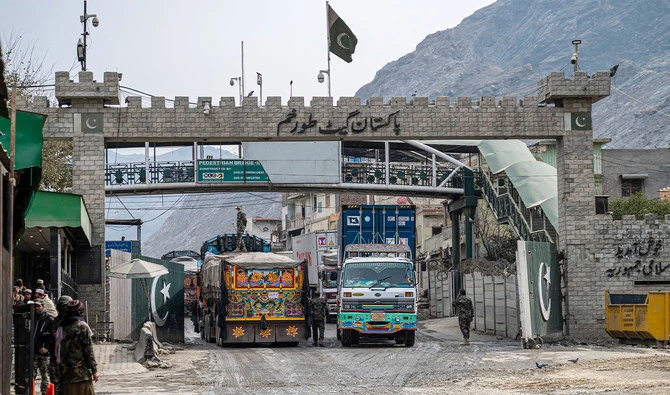
In this photo taken on February 2, 2023, Afghan cargo trucks enter Pakistan at the Afghanistan-Pakistan Torkham border post, in Nangarhar province. (AFP/File)
Short Url
Updated 19 March 2025
Follow

Key Pakistan-Afghanistan border crossing reopens after nearly a month

  • Pakistan closed Torkham crossing on Feb. 21, alleging Afghan authorities constructed trenches along border
  • Hundreds of trucks containing perishable items remained stranded for weeks on both sides of border 

PESHAWAR: The key Torkham border crossing between Pakistan and Afghanistan reopened on Wednesday after remaining closed for nearly a month, officials from both sides confirmed, paving the way for the resumption of trade between the countries. 

Pakistan closed the border crossing on Feb. 21 after Afghan authorities initiated “construction of trenches and other development work” along the border, Pakistani forces had said. This led to the suspension of cross-border trade and movement between the two sides. 

The Torkham border crossing is the main transit artery for travelers and goods between Pakistan and landlocked Afghanistan. Trade between the two countries was worth over $1.6 billion in 2024, according to Pakistan’s foreign office.

“The Torkham gate has been reopened for transport,” Naheed Khan, a senior police official in Pakistan’s northwestern Khyber district, told Arab News.

Hazrat Nabi Toor, an Afghan customs clearing agent, confirmed that the gate at the Torkham border had been opened for the movement of trucks to and from Afghanistan.

Hajji Hikmatullah, the Torkham gate commissioner in Afghanistan, told Arab News earlier that the reopening of the crossing would help trucks stranded on both sides of the border in reaching their destinations.

“The Torkham route between Pakistan and Afghanistan that remained closed will reopen today at around 4:00 p.m. while passengers’ movement through the border will start from Friday,” he added. 

Hikmatullah urged both countries to work out a “comprehensive strategy” to separate politics from business to foster stronger economic ties. 

Asghar Ali, a Pakistani customs clearing agent, told Arab News that upon hearing the news of the border reopening, hundreds of vehicles loaded with vegetables, fruits and other non-perishable items started moving toward the crossing point at the border.

“This border closure inflicted millions of dollars of losses on businessmen,” Ali said. “Trade should not suffer in diplomatic and political wars between the two countries.”

Border clashes between Pakistani and Afghan forces have led to the closure of key crossings like Torkham and Chaman in the past, severely disrupting trade and halting the movement of people between the two countries.

Last month, the Torkham closure escalated into a skirmish between the two border forces, leaving three Pakistani civilians wounded, a Pakistani police official said.

The development comes at a time of strained ties between Kabul and Islamabad over a surge in militant attacks in Pakistan’s western provinces that border Afghanistan.

Islamabad has frequently accused Afghanistan of sheltering and supporting militant groups that launch cross-border attacks. Afghan officials deny involvement and insist Pakistan resolve its security matters internally. 


Death toll in Pakistan shopping plaza fire rises to 67, officials say

Updated 22 January 2026
Follow

Death toll in Pakistan shopping plaza fire rises to 67, officials say

  • Rescue teams still searching for damaged Gul Plaza in Karachi where blaze erupted on Saturday, says police surgeon
  • Karachi has a long history of deadly fires, often linked to poor safety standards, weak regulatory enforcement

KARACHI: The death toll from a devastating fire at a shopping plaza in Pakistan’s southern port city of Karachi jumped to 67 on Thursday after police and a hospital official confirmed that the remains of dozens more people had been found.

Police surgeon Dr. Summaiya Syed said rescue teams were still searching the severely damaged Gul Plaza in the Karachi, where the blaze erupted on Saturday.

Most remains were discovered in fragments, making identification extremely difficult, but the deaths of 67 people have been confirmed, she said. Asad Raza, a senior police official in Karachi, also confirmed the death toll. Authorities previously had confirmed 34 deaths.

Family members of the missing have stayed near the destroyed plaza and hospital, even after providing their DNA for testing. Some have tried to enter the building forcibly, criticizing the rescue efforts as too slow.

“They are not conducting the search properly,” said Khair-un-Nisa, pointing toward the rescuers. She stood outside the building in tears, explaining that a relative who had left to go shopping has been missing since the blaze.

Another woman, Saadia Saeed, said her brother has been trapped inside the building since Saturday night, and she does not know what has happened to him.

“I am ready to go inside the plaza to look for him, but police are not allowing me,” she said.

There was no immediate comment from authorities about accusations they have been too slow.

Many relatives of the missing claim more lives could have been saved if the government had acted more swiftly. Authorities have deployed police around the plaza to prevent relatives from entering the unstable structure, while rescuers continue their careful search.

Investigators say the blaze erupted at a time when most shop owners were either closing for the day or had already left. Since then, the Sindh provincial government has said around 70 people were missing after the flames spread rapidly, fueled by goods such as cosmetics, clothing, and plastic items.

The cause of the fire remains under investigation, though police have indicated that a short circuit may have triggered the blaze.

Karachi has a long history of deadly fires, often linked to poor safety standards, weak regulatory enforcement, and illegal construction.

In November 2023, a shopping mall fire killed 10 people and injured 22. One of Pakistan’s deadliest industrial disasters occurred in 2012, when a garment factory fire killed at least 260 people.