
RIYADH: Egypt and India have reaffirmed their commitment to tripling bilateral trade from $4.2 billion in 2024 to $12 billion within five years, reinforcing a target set last year during a joint meeting.
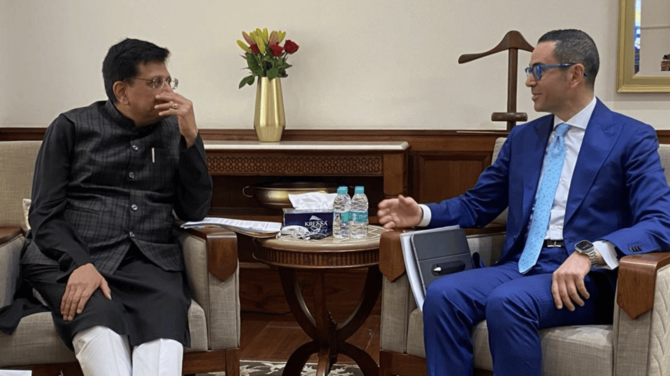
The pledge came during a trip to India by Egypt’s Minister of Investment and Foreign Trade Hassan El-Khatib, when he met with the Asian country’s Commerce and Industry Minister Piyush Goyal.
The push builds on a record $7.26 billion in bilateral trade during the 2021-22 financial year — a 75 percent rise from the previous year — positioning India as Egypt’s sixth-largest trading partner, according to the North African country’s Central Agency for Public Mobilization and Statistics.
Trade fell to $4.6 billion between April 2023 and February 2024, largely due to the Israel-Hamas conflict and Houthi disruptions to Suez Canal traffic.

Egypt’s Minister of Investment and Foreign Trade Hassan El-Khatib met with India’s Commerce and Industry Minister Piyush Goyal. Egyptian Cabinet/Facebook
El-Khatib emphasized Egypt’s commitment to attracting more Indian investments in key sectors such as renewable energy, chemicals, and automotive manufacturing, as well as pharmaceuticals, textiles, and information and communication technology.
“Al-Khatib also highlighted the expected surge in Indian investments in Egypt in the coming period, especially in light of the major investment agreements concluded by Indian companies in the energy sector, including the signing of two agreements for the production of green hydrogen and green ammonia in Egypt with an investment cost of up to $12 billion, in addition to other Indian investments in various sectors,” an official release stated.
The minister added that his country is ready to provide all necessary support and facilitation for Indian investors, highlighting Egypt’s efforts to create a favorable business climate by improving infrastructure, developing new ports, and enhancing existing facilities, including the Suez Canal Economic Zone.
El-Khatib also underscored India’s growing presence in other industries within the Egyptian market.
During the discussions, the minister extended an official invitation to Goyal to visit Egypt in 2025 to further strengthen bilateral economic ties and explore additional collaboration opportunities.
“Goyal confirmed the ministry’s commitment to taking the necessary measures to facilitate the entry of Egyptian products into the Indian market, particularly agricultural exports,” the release added.
The meeting also covered preparations for an upcoming visit by an Indian business delegation, led by the Asian country’s Ministry of Commerce and Industry and the Confederation of Indian Industry, to discuss the nation’s proposed industrial area in the Suez Canal Economic Zone.