


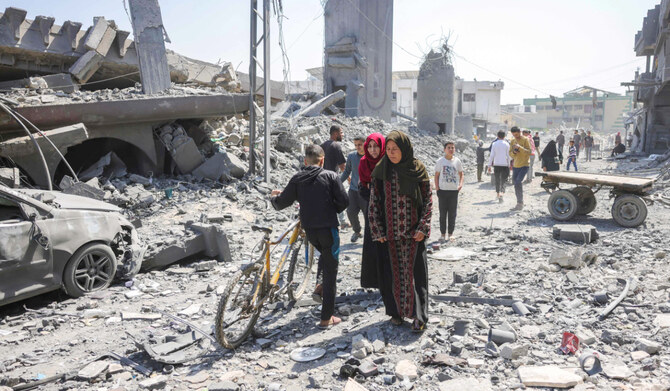
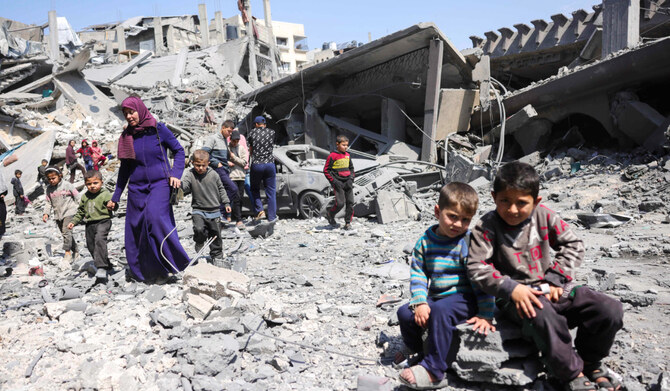
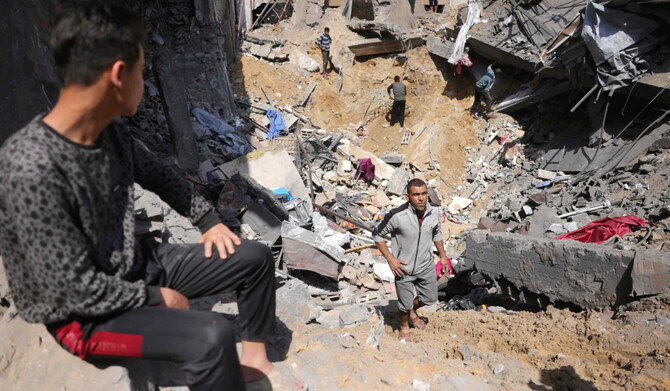
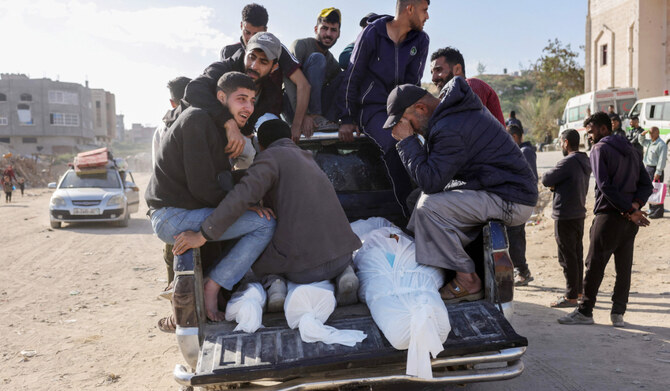

DEIR EL BALAH, Gaza Strip: The Israeli bombs began falling before dawn, lighting the sky with orange flares and shattering the stillness.
The surprise wave of airstrikes plunged Palestinians back into a nightmare they had hoped might be behind them.
The bombs crashed across Gaza early Tuesday, setting fire to a sprawling tent camp in the southern city of Khan Younis and flattening a Hamas-run prison. They hit the Al-Tabaeen shelter in Gaza City, where Majid Nasser was sleeping with his family.
“I went out to see where the bombing was. Suddenly the second strike happened in the room next to us,” he said. “I heard screaming, my mother and sister screaming, calling for help. I came and entered the room and found the children under the rubble.” Everyone was injured, but alive.
Palestinians tried to claw bodies from the wreckage with their bare hands. Parents arrived at hospitals, barefoot, carrying children who were limp and covered in ash. Streets and hospitals filled with bodies.
By midday, over 400 people had been killed. It was one of the deadliest days of the 17-month war, following two months of ceasefire.
During the truce that began on Jan. 19, hundreds of thousands of people in Gaza had returned to their homes, many of them destroyed. A surge of aid brought food and medicines — until Israel cut off aid two weeks ago to pressure the Hamas militant group into accepting a new proposal instead of continuing with the truce.
The Muslim holy month of Ramadan had even provided moments of joy as families held communal sunset meals ending each day’s fast without the fear of bombardment.
Instead, the war that has killed tens of thousands of Palestinians and caused widespread destruction was back with full force.
“What is happening to us is hell. Hell in every sense of the word,” said Zeyad Abed, as he stood among the blackened remains of tents in Khan Younis.
Fedaa Heriz, a displaced woman in Gaza City, said victims were killed in their sleep just before the predawn meal ahead of the daily Ramadan fast.
“They set the alarm to wake up for suhoor, and they wake up to death? They don’t wake up?” she screamed.
Fedaa Hamdan lost her husband and their two children in the strikes in Khan Younis.
“My children died while they were hungry,” she said, as funeral prayers were held over their bodies.
Hospitals ‘felt like Armageddon’
Scenes at hospitals recalled the early days of the war, when Israel launched a massive bombardment of Gaza in response to the Hamas attack on Oct. 7, 2023.
Survivors on Tuesday held rushed funeral rites over dozens of body bags lining the yard of Shifa Hospital in Gaza City. Mothers sobbed over the bloodied bodies of children, as warplanes hummed overhead. Doctors struggled to treat the flow of wounded.
“A level of horror and evil that is really hard to articulate. It felt like Armageddon,” said Dr. Tanya-Hajj Hassan, a volunteer with the Medical Aid for Palestinians aid group.
She described the Nasser Hospital emergency room in Khan Younis as chaos, with patients, including children, spread across the floor. Some were still wrapped in the blankets they had slept in.
Dr. Ismail Awad with the Doctors Without Borders aid group said the clinic received about 26 wounded people, including a woman seven months pregnant with shrapnel in her neck. She later died.
“It was overwhelming, the number of patients,” Awad said.
At the Al-Attar clinic in Muwasi in southern Gaza, medical staff said they were forced to operate without light bulbs and emergency ventilation devices.
Israel not only blocked all supplies from entering Gaza two weeks ago but also cut off electricity to the territory’s main desalination plant last week. That has again created scarcities in medicine, food, fuel and fresh water for Gaza’s over 2 million people.
Palestinians flee once more
New Israeli evacuation orders covering Gaza’s eastern flank next to Israel and stretching into a key corridor dividing Gaza’s north and south sent Palestinians fleeing again.
Israel’s Arabic-language military spokesperson, Avichay Adraee, published a map on X telling Palestinians in those areas, including highly populated neighborhoods, to leave immediately and head for shelters.
“Continuing to remain in the designated areas puts your life and the lives of your family members at risk,” he said.
The evacuation zone appeared to include parts of Gaza’s main north-south road, raising questions about how people might travel. Palestinians nevertheless gathered their belongings and set out, hardly knowing where to go.
UNICEF spokesperson Rosalia Bollen recalled that the days before the bombardment felt uneasy. She could sense fear. Children would ask if she believed the war would start again.
“This nightmare scenario has been on everyone’s mind,” she said. “It’s just heartbreaking that it is materializing right now and that it is shattering the last piece of hope that people had.”


