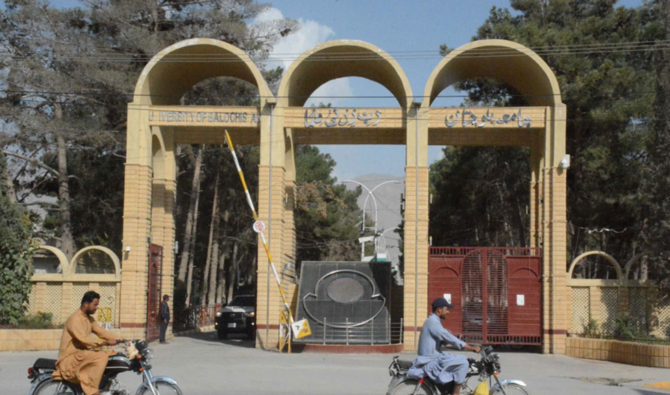
QUETTA: Pakistan’s volatile Balochistan province has ordered the closure of three universities in recent weeks due to “security concerns,” an official told AFP on Tuesday, as separatist attacks surge in the region.
Two universities in the provincial capital of Quetta were ordered to close for an “indefinite period” last week, while on Tuesday, a third was instructed to switch to virtual learning, a provincial administration official told AFP on condition of anonymity as he was not authorized to speak to the media.
“The decision was made after reviewing the overall security situation,” the official said
“It was decided to switch to virtual learning until further notice due to security concerns.”
The decision to reopen the campuses, which will impact thousands of students, will be made after the Muslim festival of Eid, just two weeks away, the official said.
Security across the provincial capital has been heightened, with an increased number of security forces on the streets and additional checkpoints set up throughout the city following the recent surge in separatist violence.
Last week, ethnic Baloch separatists attacked a train with 450 passengers on board, sparking a two-day siege during which dozens of people were killed.
And on Sunday, at least five paramilitaries were killed in a vehicle-borne suicide attack.
The assaults were claimed by the Baloch Liberation Army (BLA), one of a number of separatist groups that accuse outsiders of plundering natural resources in Balochistan near the borders with Afghanistan and Iran.

Pakistan shuts universities in southwest province over ‘security concerns’
https://arab.news/5nvx7
Pakistan shuts universities in southwest province over ‘security concerns’
- Security across the provincial capital has been heightened, with an increased number of security forces on the streets
- The decision to reopen the campuses will be made after the Muslim festival of Eid, just two weeks away, an official says
Pakistan joins 22 Muslim states, OIC to condemn Israeli FM’s visit to Somaliland
- Israeli Foreign Minister Gideon Saar visited breakaway African region of Somaliland on January 6
- Muslim states urge Israel to withdraw Somaliland recognition, respect Somalia’s sovereignty
ISLAMABAD: A joint statement by Pakistan, 22 other Muslim states and the Organization of Islamic Cooperation (OIC) on Thursday condemned Israeli Foreign Minister Gideon Saar’s recent visit to Somaliland as a violation of the African nation’s territorial integrity and sovereignty.
Saar’s visit to Somaliland capital Hargeisa on Jan. 6 followed Israel’s move last month to recognize Somaliland, a breakaway region from Somalia, as an independent country. The move drew a sharp reaction from Muslim states, including Pakistan, who said it was in contravention of the UN Charter and international norms.
Several international news outlets months earlier reported that Israel had contacted Somaliland over the potential resettlement of Palestinians forcibly removed from Gaza. Muslim countries fear Israel’s recognition of the breakaway region could be part of its plan to forcibly relocate Palestinians from Gaza to the region.
“The said visit constitutes a clear violation of the sovereignty and territorial integrity of the Federal Republic of Somalia, and undermines established international norms and the United Nations Charter,” the joint statement shared by Pakistan’s foreign office, read.
The joint statement was issued on behalf of 23 Muslim states, including Saudi Arabia, Bangladesh, Pakistan, Egypt, Iraq, Iran, Palestine, Jordan, Kuwait, Türkiye, Oman and others.
It reaffirmed support for Somalia’s territorial integrity and sovereignty, pointing out that respect for international law and non-interference in the internal affairs of sovereign states was necessary for regional stability.
“Encouraging secessionist agendas are unacceptable and risk exacerbating tensions in an already fragile region,” the statement said.
The joint statement urged Israel to revoke its recognition of the breakaway region.
“Israel should fully respect Somalia’s sovereignty, national unity and territorial integrity and honor its obligations in compliance with international law, and demand immediate revocation of the recognition issued by Israel,” the statement read.
Somaliland broke away from Somalia unilaterally in 1991 as a civil war raged in the country. Somaliland has its own constitution, parliament and currency, a move that has infuriated Somalia over the years as it insists the region is part of its territory.


