SYDNEY: Australia voiced unease on Tuesday over anonymous letters reportedly offering hefty rewards for information on a Hong Kong activist now living in Melbourne.
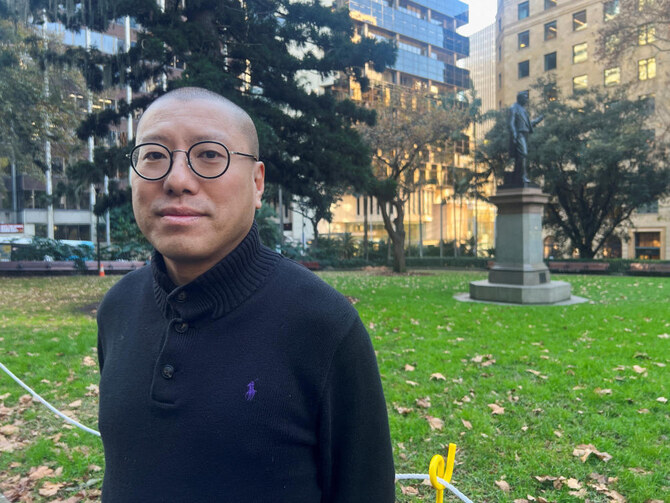
Australian citizen Kevin Yam, a lawyer and longtime Hong Kong pro-democracy activist, was targeted in letters that carried his photo and alleged national security offenses.
The letters, first reported in The Guardian newspaper, offered a reward of HK$1 million ($128,000) to anyone who could provide information about him and the allegations or “take him to Hong Kong or Australia Metropolitan Police.”
They were sent to homes next to two Melbourne locations cited in the notices as being linked to Yam, the paper said.
“The Australian government will not tolerate surveillance, harassment or intimidation against individuals or family members here in Australia — this undermines our national sovereignty and the security and safety of Australians,” said a spokesperson for Foreign Minister Penny Wong.
“We are raising our concerns directly with Chinese and Hong Kong authorities.”
In a message on social media, Yam said he would continue to live his “everyday life.”
“I will not voluntarily return to Hong Kong before it is free,” he said.
“I will not kill myself.”
Beijing expressed “strong dissatisfaction and resolute opposition” to what it called “Australia’s blatant interference” in Hong Kong’s law.
“Hong Kong affairs are purely a Chinese internal affair and brook no interference from any outside powers,” foreign ministry spokeswoman Mao Ning told a regular briefing, when asked about the case concerning Yam.
“China urges Australia to earnestly respect China’s sovereignty... and create favorable conditions and atmosphere for the sustainable development of China-Australia relations,” she added.
The letters were not signed but asked for information to be sent to a Hong Kong police email address used for tip-offs on wanted people.
The Hong Kong government said it does not issue anonymous letters.
Recipients should “remain cautious to verify the authenticity” of any such letters and seek help from local police if needed, a government spokesman told AFP.
Hong Kong law enforcement will pursue overseas suspects in accordance with the law and “take every measure” to stop them from continuing to endanger national security, the spokesman added.
Yam reportedly returned to Australia in 2022 after two decades in Hong Kong.
In 2023, Hong Kong chief executive John Lee called on eight overseas activists including Yam to turn themselves in for violating the national security law.
At the time, he backed a police decision to offer HK$1 million for information leading to their arrests, and warned the activists to surrender or “spend their days in fear.”
All eight fled Hong Kong after Beijing imposed a sweeping national security law on the financial hub in 2020 to quell dissent after huge, sometimes violent, pro-democracy protests in 2019 were quashed.

Australia slams reported targeting of citizen by Hong Kong
Short Url
https://arab.news/m25m2
Australia slams reported targeting of citizen by Hong Kong
- The letters offered a reward of $128,000 to anyone who could provide information about him
- “The Australian government will not tolerate surveillance, harassment or intimidation against individuals or family members here in Australia,” said a spokesperson
Austria turns Hitler’s home into a police station
BRAUNAU AM INN: Turning the house where Adolf Hitler was born into a police station has raised mixed emotions in his Austrian hometown.
“It’s a double-edged sword,” said Sibylle Treiblmaier, outside the house in the town of Braunau am Inn on the border with Germany.
While it might discourage far-right extremists from gathering at the site, it could have “been used better or differently,” the 53-year-old office assistant told AFP.
The government wants to “neutralize” the site and passed a law in 2016 to take control of the dilapidated building from its private owner.
Austria — which was annexed by Hitler’s Germany in 1938 — has repeatedly been criticized in the past for not fully acknowledging its responsibility in the Holocaust.
The far-right Freedom Party, founded by former Nazis, is ahead in the polls after getting the most votes in a national election for the first time in 2024, though it failed to form a government.
Last year, two streets in Braunau am Inn commemorating Nazis were renamed after years of complaints by activists.
- ‘Problematic’ -
The house where Hitler was born on April 20, 1889, and lived for a short period of his early life, is right in the center of town on a narrow shop-lined street.
A memorial stone in front reads: “For Peace, Freedom and Democracy. Never Again Fascism. Millions of Dead Warn.”
When AFP visited this week, workers were putting the finishing touches to the renovated facade.
Officers are scheduled to move in during “the second quarter of 2026,” the interior ministry said.
But for author Ludwig Laher, a member of the Mauthausen Committee Austria that represents Holocaust victims, “a police station is problematic, as the police... are obliged, in every political system, to protect what the state wants.”
An earlier idea to turn the house into a place where people would come together to discuss peace-building had “received a lot of support,” he told AFP.
Jasmin Stadler, a 34-year-old shop owner and Braunau native, said it would have been interesting to put Hitler’s birth in the house in a “historic context,” explaining more about the house.
She also slammed the 20-million-euro ($24-million) cost of the rebuild.
- ‘Bit of calm’ -
But others are in favor of the redesign of the house, which many years ago was rented by the interior ministry and housed a center for people with disabilities before it fell into disrepair.
Wolfgang Leithner, a 57-year-old electrical engineer, said turning it into a police station would “hopefully bring a bit of calm,” avoiding it becoming a shrine for far-right extremists.
“It makes sense to use the building and give it to the police, to the public authorities,” he said.
The office of Braunau’s conservative mayor declined an AFP request for comment.
Throughout Austria, debate on how to address the country’s Holocaust history has repeatedly flared.
Some 65,000 Austrian Jews were killed and 130,000 forced into exile during Nazi rule.
“It’s a double-edged sword,” said Sibylle Treiblmaier, outside the house in the town of Braunau am Inn on the border with Germany.
While it might discourage far-right extremists from gathering at the site, it could have “been used better or differently,” the 53-year-old office assistant told AFP.
The government wants to “neutralize” the site and passed a law in 2016 to take control of the dilapidated building from its private owner.
Austria — which was annexed by Hitler’s Germany in 1938 — has repeatedly been criticized in the past for not fully acknowledging its responsibility in the Holocaust.
The far-right Freedom Party, founded by former Nazis, is ahead in the polls after getting the most votes in a national election for the first time in 2024, though it failed to form a government.
Last year, two streets in Braunau am Inn commemorating Nazis were renamed after years of complaints by activists.
- ‘Problematic’ -
The house where Hitler was born on April 20, 1889, and lived for a short period of his early life, is right in the center of town on a narrow shop-lined street.
A memorial stone in front reads: “For Peace, Freedom and Democracy. Never Again Fascism. Millions of Dead Warn.”
When AFP visited this week, workers were putting the finishing touches to the renovated facade.
Officers are scheduled to move in during “the second quarter of 2026,” the interior ministry said.
But for author Ludwig Laher, a member of the Mauthausen Committee Austria that represents Holocaust victims, “a police station is problematic, as the police... are obliged, in every political system, to protect what the state wants.”
An earlier idea to turn the house into a place where people would come together to discuss peace-building had “received a lot of support,” he told AFP.
Jasmin Stadler, a 34-year-old shop owner and Braunau native, said it would have been interesting to put Hitler’s birth in the house in a “historic context,” explaining more about the house.
She also slammed the 20-million-euro ($24-million) cost of the rebuild.
- ‘Bit of calm’ -
But others are in favor of the redesign of the house, which many years ago was rented by the interior ministry and housed a center for people with disabilities before it fell into disrepair.
Wolfgang Leithner, a 57-year-old electrical engineer, said turning it into a police station would “hopefully bring a bit of calm,” avoiding it becoming a shrine for far-right extremists.
“It makes sense to use the building and give it to the police, to the public authorities,” he said.
The office of Braunau’s conservative mayor declined an AFP request for comment.
Throughout Austria, debate on how to address the country’s Holocaust history has repeatedly flared.
Some 65,000 Austrian Jews were killed and 130,000 forced into exile during Nazi rule.
© 2026 SAUDI RESEARCH & PUBLISHING COMPANY, All Rights Reserved And subject to Terms of Use Agreement.


