

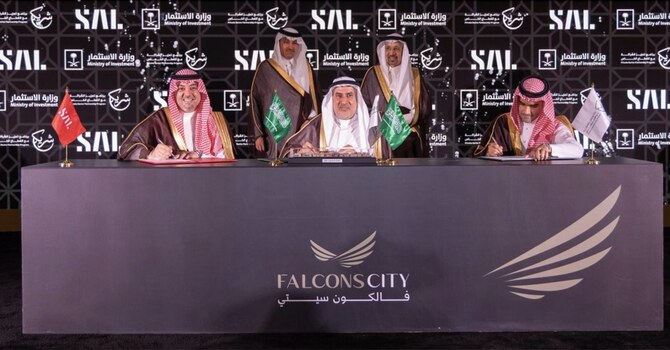

RIYADH: A new SR4 billion ($1.06 billion) logistics zone will be created within Falcon City in northern Riyadh, after a deal between Saudi firms SAL and Sela Co.
The development will provide integrated infrastructure combining Class A warehouses, multimodal connectivity, and smart logistics technologies to enhance supply chain efficiency and facilitate the faster movement of goods locally and regionally.
The deal, which aims to strengthen the Kingdom’s position as a global logistics hub, is backed by the Private Sector Partnership Program, also known as Shareek.
The agreement comes as the Kingdom plans to invest more than SR1 trillion in the logistics sector by 2030, with the number of facilities already up by 267 percent since 2021.
Commenting on the Falcon City deal, Omar bin Talal Hariri, CEO of SAL, said: “The SAL Logistics Zone is not just a development project — it is a model for the future of integrated logistics services.
“We are leveraging technology and sustainability to create an advanced operational environment that attracts investment and supports the Kingdom’s economic growth.”
The partnership for the 1.5 million sq. meter logistics zone was signed in Riyadh in the presence of Minister of Transport and Logistics Services Saleh Al-Jasser, Minister of Investment Khalid Al-Falih, and CEO of the Shareek Program Center Abdulaziz bin Abdulrahman Al-Arifi, along with senior officials, investors, and business leaders.
The zone will serve as a comprehensive hub catering to the increasing demand for custom-designed warehouses.
“Falcon City is more than just a development project; it is an integrated economic destination aimed at providing a modern business environment that supports multiple industries,” Rakan Al-Harthy, managing director of Sela, said.
He further emphasized that the partnership with SAL Logistics Services will facilitate the establishment of state-of-the-art facilities that cater to local and international companies and enhance business and investment flow.
This logistics zone significantly enhances the company’s capabilities due to its strategic location near King Khalid International Airport, major highways, and railway networks.
Falcon City spans 14.4 million sq. meters and will feature the Riyadh Exhibition and Convention Center, as well as a modern logistics zone designed to attract major global companies, an aviation runway, and an aircraft maintenance hub.
The development also includes economic, commercial, and residential zones, as well as hospitality and entertainment areas and an outlet mall.
This strategic partnership directly supports Saudi Vision 2030 by enhancing logistics connectivity, stimulating local and international investments, and developing modern infrastructure to attract businesses and investors.
It also reinforces the Kingdom’s role in regional and international trade, driving sustainable economic growth and positioning the country as a leading logistics powerhouse.


