WASHINGTON: When Andrew Sullivan thinks of the people his organization has helped resettle in America, one particular story comes to mind: an Afghan man in a wheelchair who was shot through the neck by a member of the Taliban for helping the US during its war in Afghanistan.
“I just think ... Could I live with myself if we send that guy back to Afghanistan?” said Sullivan, executive director of No One Left Behind. “And I thankfully don’t have to because he made it to northern Virginia.”
The charitable organization of US military veterans, Afghans who once fled their country and volunteers in the US is stepping in to help Afghans like that man in the wheelchair who are at risk of being stranded overseas. Their efforts come after the Trump administration took steps to hinder Afghans who helped America’s war effort in trying to resettle in the US
No One Left Behind helps Afghans and Iraqis who qualify for the special immigrant visa program, which was set up by Congress in 2009 to help people who are in danger because of their efforts to aid the US during the Afghanistan and Iraq Wars.
President Donald Trump in January suspended programs that buy flights for those refugees and cut off aid to the groups that help them resettle in the US Hundreds who were approved for travel to the US had visas but few ways to get here. If they managed to buy a flight, they had little help when they arrived.
The White House and State Department did not respond to requests for comment.
Meanwhile, the situation for Afghans has become more tenuous in some of the places where many have temporarily settled. Pakistan, having hosted millions of refugees, has in recent years removed Afghans from its country. increased deportations. An agreement that made Albania a waystation for Afghans expires in March, Sullivan said.
Hovering over all of this is the fear that the Trump administration may announce a travel ban that could cut off all access from Afghanistan. In an executive order signed on Inauguration Day, Trump told key Cabinet members to submit a report within 60 days that identifies countries with vetting so poor that it would “warrant a partial or full suspension” of travelers from those countries to the US.
US State Department spokeswoman Tammy Bruce said Monday that the review was ongoing and no list had been finalized.
But groups that work with Afghans are worried.
When funding was suspended, No One Left Behind stepped in. Their goal is to make sure Afghans with State Department visas don’t get stuck overseas. Other organizations — many who got their start helping Afghans during the US military’s chaotic withdrawal from Kabul in 2021 — are doing the same.
To qualify for this visa, Afghans must prove they worked for the US for at least one year. That means tracking down documentation from former supervisors, who were often affiliated with companies no longer in business. They also undergo extensive vetting and medical checks.
“Our view was, OK, we’ve got to act immediately to try and help these people,” said Sullivan. “We’ve been in kind of an all-out sprint.”
The organization has raised money to buy flights and help Afghans when they land. Between February 1 and March 17, the group said it successfully booked flights for 659 Afghans.
It also launched a website where visa holders can share information, giving Sullivan’s group a starting point to figure out where they might live in the US.
Sullivan and the organization’s “ambassadors” — Afghans and Iraqis who already have emigrated to the US, many through the special immigrant visa program — have gone to Albania and Qatar to help stranded Afghans.
Aqila is one of those ambassadors who went to Albania. The Associated Press is identifying Aqila by her first name because her family in Afghanistan is still at risk.
Aqila said many of the families didn’t know what would happen when they arrived in America. Would they be homeless? Abandoned? One man feared he’d end up alone in the airport parking lot because his contact in America — a long-haul trucker — couldn’t come pick him up. She assured him that someone would be there.
They gave them cards with contact information for attorneys. They printed papers with information about their rights in English, Dari, and Pashto.
No One Left Behind reached out to family members and friends in the US to help with the transition when they landed in America.
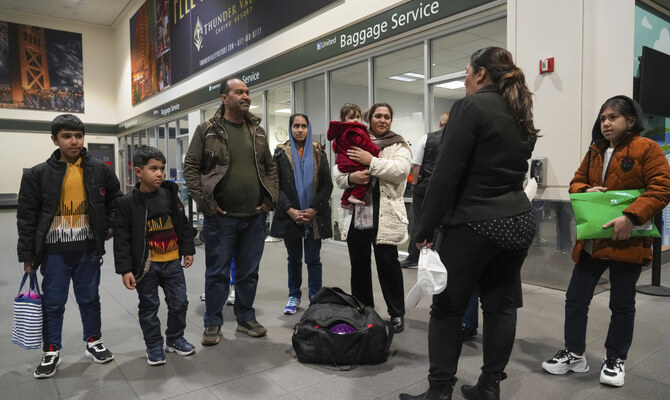
Mohammad Saboor, a father of seven children, worked as an electrician and A/C technician with international and US forces for 17 years. Two months ago, he and his family boarded a plane to Albania in anticipation of soon being able to go to America. They landed in California on March 12, exhausted but safe
The next day he and his family explored their new apartment in the Sacramento suburb of Rancho Cordova.
Saboor said he hasn’t felt safe in Afghanistan since the Taliban took over the country in August 2021. He worried that he’d be killed as retribution for the nearly two decades he’d worked with the US and its allies. He wondered what kind of future his children would have in a Taliban-controlled Afghanistan.
The family picked the suburb in the hope that the large Afghan population in the Sacramento area would help them get settled and find work. He envisions a bright future in America, where his kids can go to school and eventually give back to the country that took his family in. Arriving in the US, he said, gave them a “great feeling.”
“I believe that now we can live in a 100 percent peaceful environment,” he said.
Sullivan said he hopes there will be exceptions for Afghans in the special immigrant visa program if a travel ban is imposed. They’ve been thoroughly vetted, he said, and earned the right to be here.
“These are folks that actually served shoulder-to-shoulder with American troops and diplomats for 20 years,” he said.
Aqila, the Afghan ambassador, said it’s stressful to hear stories of what people went through in Afghanistan. But the reward comes when she sees photos of those who have arrived in America.
“You can see the hope in their eyes,” she said. “It’s nice to be human. It’s nice be kind to each other.”


![]()

After Trump halted funding for Afghans who helped the US, this group stepped in to help
Short Url
https://arab.news/5y6ya
After Trump halted funding for Afghans who helped the US, this group stepped in to help
- No One Left Behind helps Afghans and Iraqis who qualify for the special immigrant visa program, which was set up by Congress in 2009 to help people who are in danger because of their efforts to aid the US during the Afghanistan and Iraq Wars


Latest updates


© 2026 SAUDI RESEARCH & PUBLISHING COMPANY, All Rights Reserved And subject to Terms of Use Agreement.