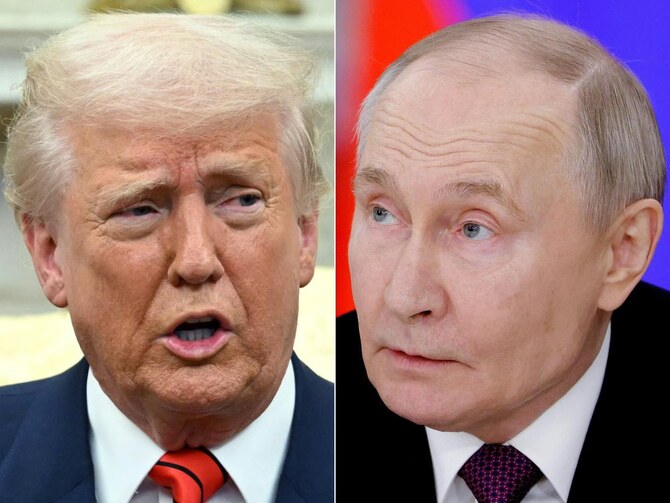
WASHINGTON: US President Donald Trump said he would speak to Russia’s Vladimir Putin on Tuesday about ending the Ukraine war, with territorial concessions by Kyiv and control of the Zaporizhzhia nuclear power plant likely to feature prominently in the talks.
“We want to see if we can bring that war to an end,” Trump told reporters on Air Force One during a flight to the Washington area from Florida. “Maybe we can, maybe we can’t, but I think we have a very good chance.
“I’ll be speaking to President Putin on Tuesday. A lot of work’s been done over the weekend.”
Trump is trying to win Putin’s support for a 30-day ceasefire proposal that Ukraine accepted last week, as both sides continued trading heavy aerial strikes early on Monday and Russia moved closer to ejecting Ukrainian forces from their months-old foothold in the western Russian region of Kursk.
Asked what concessions were being considered in ceasefire negotiations, Trump said: “We’ll be talking about land. We’ll be talking about power plants ... We’re already talking about that, dividing up certain assets.”
Trump gave no details but he appeared to be referring to the Russian-occupied facility in Ukraine, Europe’s largest nuclear plant. Russia and Ukraine have accused each other of risking an accident at the plant with their actions.
White House press secretary Karoline Leavitt told a regular briefing on Monday that “there’s a power plant that is on the border of Russia and Ukraine that was up for discussion with the Ukrainians, and he (Trump) will address it in his call with Putin tomorrow.”
Kremlin spokesperson Dmitry Peskov confirmed on Monday that Putin would speak with Trump by phone but declined to comment on Trump’s remarks about land and power plants.
The Kremlin said on Friday that Putin had sent Trump a message about his ceasefire plan via US envoy Steve Witkoff, who held talks in Moscow, expressing “cautious optimism” that a deal could be reached to end the three-year conflict.
In separate appearances on Sunday TV shows in the United States, Witkoff, Secretary of State Marco Rubio, and Trump’s National Security Adviser, Mike Waltz, emphasized there were still challenges to be worked out before Russia agrees to a ceasefire, much less a final peaceful resolution to the war.
Asked on ABC whether the US would accept a peace deal in which Russia was allowed to keep Ukrainian territory that it has seized, Waltz replied: “We have to ask ourselves, is it in our national interest? Is it realistic? ... Are we going to drive every Russian off of every inch of Ukrainian soil?“
“We can talk about what is right or wrong but also have to talk about the reality of the situation on the ground,” he said, adding that the alternative to finding compromises on land and other issues was “endless warfare” and even World War Three.
“Ironclad guarantees”
Ukraine’s President Volodymyr Zelensky has said he sees a good chance to end the war after Kyiv accepted the US proposal for a 30-day interim ceasefire.
However, Zelensky has consistently said the sovereignty of his country is not negotiable and that Russia must surrender the territory it has seized. Russia seized the Crimean Peninsula in 2014 and now controls most of four eastern Ukrainian regions since it invaded the country in 2022.
Zelensky has not responded publicly to Waltz’s remarks.
Russia will seek “ironclad” guarantees in any peace deal that NATO nations exclude Kyiv from membership and that Ukraine will remain neutral, Russian Deputy Foreign Minister Alexander Grushko told Russian media outlet Izvestia in remarks published on Monday that made no reference to the ceasefire proposal.
“We will demand that ironclad security guarantees become part of this agreement,” Izvestia cited Grushko as saying.
Putin says his actions in Ukraine are aimed at protecting Russia’s national security against what he casts as an aggressive and hostile West, in particular NATO’s eastward expansion. Ukraine and its Western partners say Russia is waging an unprovoked war of aggression and an imperial-style land grab.
Moscow has demanded that Ukraine drop its NATO ambitions, that Russia keep control of all Ukrainian territory seized, and that the size of the Ukrainian army be limited. It also wants Western sanctions eased and a presidential election in Ukraine, which Kyiv says is premature while martial law is in force.
The European Union’s foreign policy chief, Kaja Kallas, said on Monday that the conditions demanded by Russia to agree to a ceasefire showed that Moscow does not really want peace.
Finland’s Foreign Minister Elina Valtonen said the onus should be on Russia as the invading country, not Ukraine, to make concessions “because otherwise you would be compromising international law.”
British Prime Minister Keir Starmer said on Monday that “a significant number” of nations — including Britain and France — were willing to send peacekeeping troops to Ukraine in the event of a peace deal with Russia. Defense chiefs will meet this week to firm up plans.
Russia has ruled out peacekeepers until the war has ended.
“If they appear there, it means that they are deployed in the conflict zone with all the consequences for these contingents as parties to the conflict,” Russia’s Grushko said.
“We can talk about unarmed observers, a civilian mission that would monitor the implementation of individual aspects of this agreement, or guarantee mechanisms. In the meantime, it’s just hot air.”


![]()

Trump and Putin to discuss power plants, land in talks to end Ukraine war
Short Url
https://arab.news/cw8vt
Trump and Putin to discuss power plants, land in talks to end Ukraine war
- Trump said: “We’ll be talking about land. We’ll be talking about power plants ... We’re already talking about that, dividing up certain assets”


Latest updates


Recommended


© 2026 SAUDI RESEARCH & PUBLISHING COMPANY, All Rights Reserved And subject to Terms of Use Agreement.