French-British blueprint doesn’t foresee deploying a ‘mass’ of soldiers in Ukraine: Macron

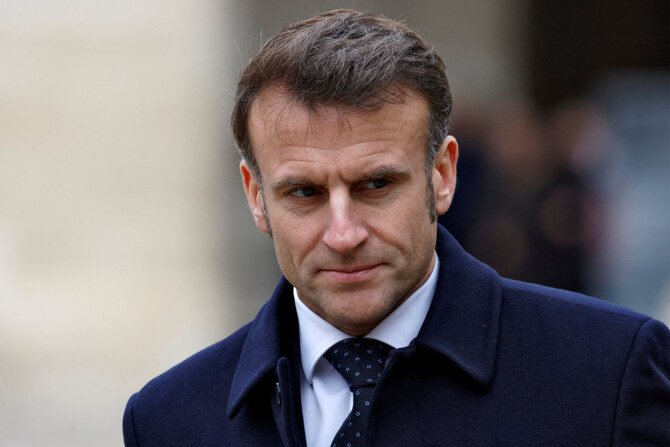
France's President Emmanuel Macron. (Pool via REUTERS)
Short Url
Updated 17 March 2025
Follow

French-British blueprint doesn’t foresee deploying a ‘mass’ of soldiers in Ukraine: Macron

  • The plan instead envisages stationing troop contingents in key locations, the French leader told local media
  • Their missions could include providing training and supporting Ukrainian defenses, he explained

PARIS: French President Emmanuel Macron has fleshed out some possible missions that could be undertaken by a military support force for Ukraine that Paris and London are working to put together with other nations, in a so-called “coalition of the willing” that could deploy after any ceasefire with Russia.
Speaking to French media ahead of an online summit that the UK hosted on Saturday, Macron said the French-British blueprint doesn’t aim to deploy a “mass” of soldiers in Ukraine and instead envisages stationing troop contingents in key locations.
Macron’s office said Sunday that it couldn’t provide a recording of the French leader’s exchange with reporters from regional French newspapers on Friday night.
But according to La Dépêche du Midi and Le Parisien, the French president spoke of participating nations each deploying several thousand troops to “key points” in Ukraine. Their missions could include providing training and supporting Ukrainian defenses, to demonstrate long-term support for Kyiv, the reports quoted Macron as saying.
Macron added that the proposed contingents from countries that are members of the NATO alliance would serve as “a guarantee of security” for Ukraine and that “several European nations, and also non-European, have expressed their willingness to join such an effort when it is confirmed,” La Dépêche reported.
Le Parisien cited Macron as saying that Moscow’s agreement wasn’t needed for such deployment. “Ukraine is sovereign. If it asks for Allied forces to be on its territory, it’s not up to Russia to accept or not,” he said.
Following Saturday’s two-hour virtual meeting, Starmer challenged Russian President Vladimir Putin to sign up to a ceasefire in its war against Ukraine if he is serious about peace, and said allies will keep increasing the pressure on the Kremlin, including by moving planning for a peacekeeping force to an “operational phase.”
Around 30 leaders were involved in the call, including Italian Prime Minister Giorgia Meloni, Ukraine’s President Volodymyr Zelensky and leaders from Australia, Canada and New Zealand, as well as officials from NATO and the European Union.
It was the second such meeting in two weeks, meant to help Ukraine face a change of approach by the US following the return of President Donald Trump, as well as gauging support for any future possible peacekeeping mission. Many more countries were involved this time than the previous meeting on March 2.
According to Starmer, military planners will convene again in the UK on Thursday to progress practical plans to support Ukraine’s future security.


Pakistan killed over 80 militants in strikes on TTP camps in Afghanistan — official

Updated 5 sec ago
Follow

Pakistan killed over 80 militants in strikes on TTP camps in Afghanistan — official

  • Saturday’s airstrikes followed a series of attacks inside Pakistan amid a surge in militancy
  • The Afghan Taliban authorities accuse Pakistani forces of killing civilians in the airstrikes

ISLAMABAD: Pakistan’s airstrikes in Afghanistan destroyed seven Tehreek-e-Taliban Pakistan (TTP) camps and killed over 80 militants, a Pakistani security official said on Sunday, with the Afghan Taliban accusing Pakistani forces of killing civilians in the assault.

Saturday’s airstrikes followed a series of attacks inside Pakistan amid a surge in militancy. Authorities say the attacks, particularly in Khyber Pakhtunkhwa province and the Pakistani capital of Islamabad, were carried out by the TTP and allied groups that Islamabad alleges are operating from sanctuaries in Afghanistan. Kabul denies this.

According to Pakistan’s information ministry, recent incidents included a suicide bombing at a Shiite mosque in Islamabad, separate attacks in Bajaur and Bannu, and another recent incident in Bannu during the holy month of Ramadan, which started earlier this week. The government said it had “conclusive evidence” linking the attacks to militants directed by leadership based in Afghanistan.

“Last night, Pakistan’s intelligence-based air strikes destroyed seven centers of Fitna Al-Khawarij TTP in three provinces of Nangarhar, Paktika and Khost, in which more than eighty Khawarij (TTP militants) have been confirmed killed, while more are expected,” a Pakistani security official, who spoke on condition of anonymity, told Arab News.

An earlier statement from Pakistan’s information ministry said the targets included a camp of a Daesh regional affiliate, the Islamic State Khorasan Province (ISKP), which claimed a suicide bombing at an Islamabad Shiite mosque that killed 32 people this month.

In an X post, Afghan government spokesperson Zabihullah Mujahid said Pakistani forces had violated Afghan territory.

“Pakistani special military circles have once again trespassed into Afghan territory,” Mujahid said. “Last night, they bombed our civilian compatriots in Nangarhar and Paktika provinces, martyring and wounding dozens of people, including women and children.”

 The Afghan Taliban’s claims of civilian casualties could not be independently verified. Pakistan did not immediately comment on the allegation that civilians had been killed in the strikes.

In a post on X, Afghanistan’s foreign ministry said it had summoned Pakistan’s charge d’affaires to Afghanistan Ubaid-ur-Rehman Nizamani and lodged protest through a formal démarche in response to the Pakistani military strikes.

“IEA-MoFA (The Islamic Emirate of Afghanistan’s Ministry of Foreign Affairs) vehemently condemns the violation of Afghanistan’s airspace and the targeting of civilians, describing it as a flagrant breach of Afghanistan’s territorial integrity & a provocative action,” it said in a statement.

“The Pakistani side was also categorically informed that safeguarding Afghanistan’s territorial integrity is the religious responsibility of the Islamic Emirate of Afghanistan; henceforth, the responsibility for any adverse consequences of such actions will rest with the opposing side.”

Tensions between Islamabad and Kabul have escalated since the Afghan Taliban returned to power in 2021. Pakistan says cross-border militant attacks have increased since then and has accused the Taliban of failing to honor commitments under the 2020 Doha Agreement to prevent Afghan soil from being used for attacks against other countries. The Taliban deny allowing such activity and have previously rejected similar accusations.

Saturday’s exchange of accusations marks one of the most direct confrontations between the two neighbors in recent months and risks further straining already fragile ties along the volatile border.