Chinese shipyard completes second submarine for ally Pakistan

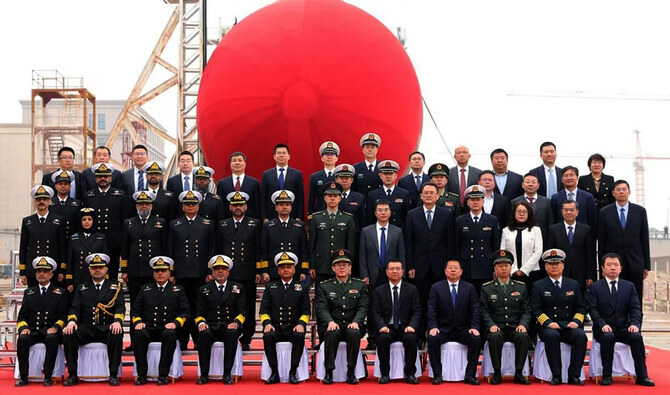
The handout photograph released on March 15, 2025, shows officials from Pakistan Navy and China Shipyard pose for a group photo during the launching ceremony of the second HANGOR Class Submarine at Wuhan, China. (Photo Courtesy: DR PR Pakistan Navy)
Short Url
Updated 16 March 2025
Follow

Chinese shipyard completes second submarine for ally Pakistan

  • The Hangor class is believed to be an export version of China’s 039A submarine, with a crew of 38 and equipped with anti-ship missiles
  • Pakistan contracted to buy eight of the submarines, the final four of which are to be built by the Karachi Shipyard & Engineering Works

TAIPEI: A Chinese shipyard has completed a second submarine for the Pakistan navy, further strengthening military ties between the two countries.
The diesel-electric Hangor class craft was launched on Thursday at China Shipbuilding Industry Corporation’s shipworks in the central city of Wuhan on the Yangtze River, Chinese state media reported Sunday.
Pakistan contracted to buy eight of the submarines, the final four of which are to be built by the Karachi Shipyard & Engineering Works in the Pakistani port city of the same name.
The Hangor class is believed to be an export version of China’s 039A submarine, with a crew of 38 plus eight spaces for special forces troops and equipped with torpedoes and anti-ship missiles.
Pakistan has used submarines in the past to confront India as part of their land wars over disputed territory in the north. Prohibitions on dual military and civilian use of technology by European nations that make diesel submarines has left China Pakistan’s best option for modern military equipment.
According to a Swedish military think tank, China has accounted for more than 81 percent of Pakistan’s weapons imports over the past five years. Joint venture projects include the Hangor as well as the JF-17 fighter jet.
Meanwhile, China and India have agreed to work toward a solution to their long-running border dispute in the Himalayas after a military standoff that flared with a deadly clash in 2020 but dates back decades.


Security forces kill four militants in Pakistan’s volatile southwest, military says

Updated 13 January 2026
Follow

Security forces kill four militants in Pakistan’s volatile southwest, military says

  • Balochistan, Pakistan’s largest province by land area bordering Iran and Afghanistan, has long been the site of a low-level insurgency
  • The Balochistan government has recently established a threat assessment center to strengthen early warning, prevent ‘terrorism’ incidents

ISLAMABAD: Pakistani security forces gunned down four militants in an intelligence-based operation in the southwestern Balochistan province, the military said on Tuesday.

The operation was conducted in Balochistan’s Kalat district on reports about the presence of militants, according to the Inter-Services Public Relations (ISPR), the Pakistani military’s media wing.

The “Indian-sponsored militants” were killed in an exchange of fire during the operation, while weapons and ammunition were also recovered from the deceased, who remained actively involved in numerous militant activities.

“Sanitization operations are being conducted to eliminate any other Indian-sponsored terrorist found in the area,” the ISPR said in a statement.

There was no immediate response from New Delhi to the statement.

Balochistan, Pakistan’s largest province by land area bordering Iran and Afghanistan, has long been the site of a low-level insurgency involving Baloch separatist groups, including the Balochistan Liberation Army (BLA) and the Balochistan Liberation Front (BLF).

Pakistan accuses India of supporting these separatist militant groups and describes them as “Fitna Al-Hindustan.” New Delhi denies the allegation.

The government in Balochistan has also established a state-of-the-art threat assessment center to strengthen early warning and prevention against “terrorism” incidents, a senior official said this week.

“Information that was once scattered is now shared and acted upon in time, allowing the state to move from reacting after incidents to preventing them before they occur,” Balochistan Additional Chief Secretary Hamza Shafqaat wrote on X.

The development follows a steep rise in militancy-related deaths in Pakistan in 2025. According to statistics released by the Pakistan Institute for Conflict and Security Studies (PICSS) last month, combat-related deaths in 2025 rose 73 percent to 3,387.

These included 2,115 militants, 664 security forces personnel, 580 civilians and 28 members of pro-government peace committees, the think tank said.