

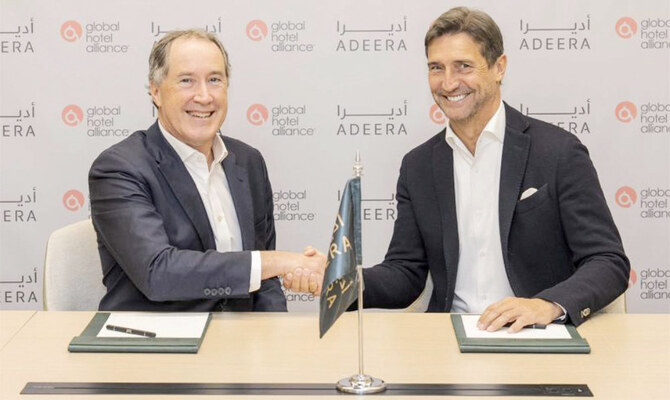
Adeera joins Global Hotel Alliance, connecting travelers to Saudi hospitality

This partnership represents a significant step in Adeera’s mission to showcase the warmth and generosity of Saudi hospitality while expanding its international presence in the luxury travel market.
Short Url
Updated 15 March 2025
Follow

Adeera joins Global Hotel Alliance, connecting travelers to Saudi hospitality

The Hotel Management Company, Adeera, a PIF company which is set to be Saudi Arabia’s national hospitality champion, has joined Global Hotel Alliance, the world’s largest alliance of independent hotel brands.

Through participation in the award-winning GHA DISCOVERY loyalty program, Adeera will connect with a global network of international travelers, offering exclusive experiences and benefits under its brand portfolio in the Kingdom of Saudi Arabia.

This partnership represents a significant step in Adeera’s mission to showcase the warmth and generosity of Saudi hospitality while expanding its international presence in the luxury travel market.

GHA brings together a unique collection of 45 brands with more than 850 hotels across 100 countries serving 30 million members with GHA DISCOVERY, a multi-brand rewards program. As part of GHA DISCOVERY, Adeera will offer future guests VIP recognition, exclusive member rates, DISCOVERY Dollars (D$) rewards and immersive local experiences.

They will also enjoy exclusive member privileges and bespoke offers curated by Adeera hotels, opening a privileged gateway to the Kingdom and connecting them to an elite global travel community.

Stefan Leser, CEO of Adeera, said: “At Adeera, our vision is to transform the way travelers experience hospitality by immersing them in the rich culture, traditions and warmth of Saudi Arabia.

“Through our membership in GHA, we will be opening the doors to travelers who seek authentic, curated experiences that create enriching moments and leave a lasting imprint on their journeys.

“Our efforts align with Saudi Arabia’s Vision 2030, as we actively shape the future of the hospitality sector, its local talents and showcase the Kingdom’s beauty and generosity to the world.”

Chris Hartley, CEO of Global Hotel Alliance, added: “Welcoming Adeera to our global network is an exciting step in strengthening GHA’s footprint in the Middle East. With its transformative ambition and deep cultural roots, Adeera represents the future of hospitality in Saudi Arabia. We look forward to working together to connect our global travelers with the exceptional service and experiences that Adeera will offer.”

As Adeera embarks upon its rapid expansion across Saudi Arabia, this collaboration will accelerate the reach and reputation of Adeera with a large audience of regional and international travelers who will be excited to discover the rich cultural diversity of Saudi Arabia.


More crop per drop: NADEC and EF Polymer deploy breakthrough technology to cut agricultural water use by 40%

Updated 14 January 2026
Follow

More crop per drop: NADEC and EF Polymer deploy breakthrough technology to cut agricultural water use by 40%

Following a strategic technology-scouting framework led by Universal Materials Incubator, the National Agricultural Development Company has entered into a partnership to launch large-scale field trials of EF Polymer, marking a significant step in deploying deep-technology solutions to strengthen the Kingdom’s food and water security.

The collaboration initiates field trials of EF Polymer’s proprietary solution — a 100 percent organic, biodegradable powder that performs like a “soil battery” upcycled from food waste. Engineered to address water scarcity in arid and semi-arid regions, the material can absorb up to 50 times its own weight in water and gradually release moisture directly to plant roots. This mechanism has the potential to reduce irrigation water use by up to 40 percent, while enhancing crop yield and long-term agricultural productivity.

Beyond water efficiency, EF Polymer improves nutrient retention by minimizing fertilizer leaching, thereby reducing overall fertilizer requirements. After approximately one year in the soil, the material fully biodegrades into organic carbon, organic matter, and trace nutrients such as magnesium, calcium, and nitrogen — contributing directly to improved soil health and long-term fertility.

The solution is affordable, easy to apply, and suitable for a wide range of crops, making it viable both for individual farmers and for industrial-scale agricultural operations such as NADEC’s. 

EF Polymer has already achieved significant commercial adoption across multiple global markets, including Japan, the US, India and Turkiye, where it is actively used by farmers and agribusiness operators to improve water efficiency, soil health, and crop resilience under varying climatic conditions.

Its organic credentials are certified by OMRI and Ecocert, reinforcing its alignment with sustainable and regenerative agricultural practices.

The stakes for this alliance are high. By 2030, global freshwater demand is projected to exceed supply by 40 percent. In Saudi Arabia, the challenge is localized but intense: the agricultural sector alone consumes approximately 11.4 billion cubic meters of water annually. This partnership underscores NADEC’s commitment to adopting innovative, scalable technologies that conserve natural resources while supporting resilient food systems across the Kingdom.

Mohamed Al-Rajhi, VP of supply chain sector at NADEC, said: “Strategic agriculture today requires a long-term commitment to soil health and resource circularity. NADEC is leading the shift toward regenerative practices that restore our natural capital rather than merely consuming it. By diversifying our crop portfolio and investing in closed-loop nutrient management, we are insulating our operations against global price volatility and environmental shifts.”

“We are aggressively deploying AI-driven irrigation systems and satellite-based crop monitoring to optimize every drop of water and every hectare of land. This strategic pivot toward agri-digitization allows us to mitigate climate risks in real-time while significantly reducing our carbon footprint. Our commitment to sustainability is our greatest competitive advantage, ensuring that NADEC remains the cornerstone of the Middle East’s agri-food sector for decades to come. These trials focus on strategic scalable crops like wheat and olive trees to ensure the future of the Kingdom’s food security is both sustainable and locally rooted,” he added.

Strategic trial milestones:

  • Wheat: Trials have commenced to demonstrate water retention in this water-intensive crop.
  • Olive and blueberry: Specialized testing is scheduled for March to evaluate yield improvements and nutrient efficiency.

This collaboration supports Saudi Vision 2030 goals of reducing non-renewable groundwater use by 90 percent.