WASHINGTON: The Trump administration is considering issuing sweeping travel restrictions for the citizens of dozens of countries as part of a new ban, according to sources familiar with the matter and an internal memo seen by Reuters.
The memo lists a total of 41 countries divided into three separate groups. The first group of 10 countries, including Afghanistan, Iran, Syria, Cuba and North Korea among others, would be set for a full visa suspension.
In the second group, five countries — Eritrea, Haiti, Laos, Myanmar and South Sudan — would face partial suspensions that would impact tourist and student visas as well as other immigrant visas, with some exceptions.
In the third group, a total of 26 countries that includes Belarus, Pakistan and Turkmenistan among others would be considered for a partial suspension of US visa issuance if their governments “do not make efforts to address deficiencies within 60 days,” the memo said.
A US official speaking on the condition of anonymity cautioned there could be changes on the list and that it was yet to be approved by the administration, including US Secretary of State Marco Rubio.
The New York Times first reported on the list of countries.
The move harkens back to President Donald Trump’s first term ban on travelers from seven majority-Muslim nations, a policy that went through several iterations before it was upheld by the Supreme Court in 2018.
Trump issued an executive order on January 20 requiring intensified security vetting of any foreigners seeking admission to the US to detect national security threats.
That order directed several cabinet members to submit by March 21 a list of countries from which travel should be partly or fully suspended because their “vetting and screening information is so deficient.”
Trump’s directive is part of an immigration crackdown that he launched at the start of his second term.
He previewed his plan in an October 2023 speech, pledging to restrict people from the Gaza Strip, Libya, Somalia, Syria, Yemen and “anywhere else that threatens our security.”
The State Department did not immediately respond to a request for comment from Reuters.

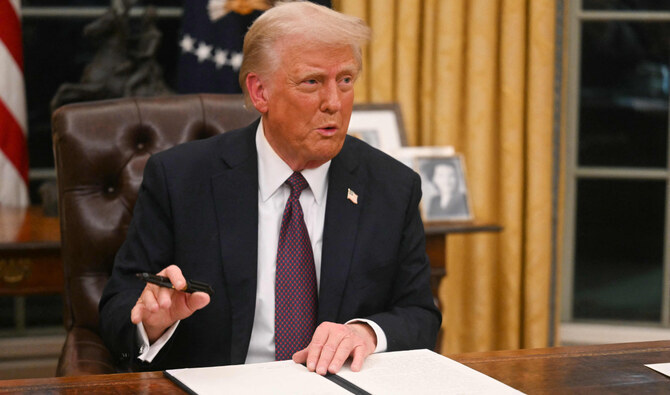
Trump administration weighs travel restrictions on Pakistan, several other countries
https://arab.news/c4nzn
Trump administration weighs travel restrictions on Pakistan, several other countries
- A total of 26 countries including Belarus, Pakistan and Turkmenistan would be considered for a partial suspension of US visa issuance
- A US official cautions there could be changes on the list and that it was yet to be approved by the administration of President Trump
Sindh assembly passes resolution rejecting move to separate Karachi
- Chief Minister Shah cites constitutional safeguards against altering provincial boundaries
- Calls to separate Karachi intensified amid governance concerns after a mall fire last month
ISLAMABAD: The provincial assembly of Pakistan’s southern Sindh province on Saturday passed a resolution rejecting any move to separate Karachi, declaring its territorial integrity “non-negotiable” amid political calls to carve the city out as a separate administrative unit.
The resolution comes after fresh demands by the Muttahida Qaumi Movement (MQM) and other voices to grant Karachi provincial or federal status following governance challenges highlighted by the deadly Gul Plaza fire earlier this year that killed 80 people.
Karachi, Pakistan’s largest and most densely populated city, is the country’s main commercial hub and contributes a significant share to the national economy.
Chief Minister Syed Murad Ali Shah tabled the resolution in the assembly, condemning what he described as “divisive statements” about breaking up Sindh or detaching Karachi.
“The province that played a foundational role in the creation of Pakistan cannot allow the fragmentation of its own historic homeland,” Shah told lawmakers, adding that any attempt to divide Sindh or separate Karachi was contrary to the constitution and democratic norms.
Citing Article 239 of Pakistan’s 1973 Constitution, which requires the consent of not less than two-thirds of a provincial assembly to alter provincial boundaries, Shah said any such move could not proceed without the assembly’s approval.
“If any such move is attempted, it is this Assembly — by a two-thirds majority — that will decide,” he said.
The resolution reaffirmed that Karachi would “forever remain” an integral part of Sindh and directed the provincial government to forward the motion to the president, prime minister and parliamentary leadership for record.
Shah said the resolution was not aimed at anyone but referred to the shifting stance of MQM in the debate while warning that opposing the resolution would amount to supporting the division of Sindh.
The party has been a major political force in Karachi with a significant vote bank in the city and has frequently criticized Shah’s provincial administration over its governance of Pakistan’s largest metropolis.
Taha Ahmed Khan, a senior MQM leader, acknowledged that his party had “presented its demand openly on television channels with clear and logical arguments” to separate Karachi from Sindh.
“It is a purely constitutional debate,” he told Arab News by phone. “We are aware that the Pakistan Peoples Party, which rules the province, holds a two-thirds majority and that a new province cannot be created at this stage. But that does not mean new provinces can never be formed.”
Calls to alter Karachi’s status have periodically surfaced amid longstanding complaints over governance, infrastructure and administrative control in the megacity, though no formal proposal to redraw provincial boundaries has been introduced at the federal level.


