
BRUSSLES: The EU is expected to sanction nine individuals in connection with violence in the Democratic Republic of Congo, two EU diplomats said on Friday.
They did not identify the people set to be listed, in keeping with the practice of not revealing such details before the sanctions are officially approved.
EU foreign ministers are expected to approve the sanctions in Brussels next Monday.
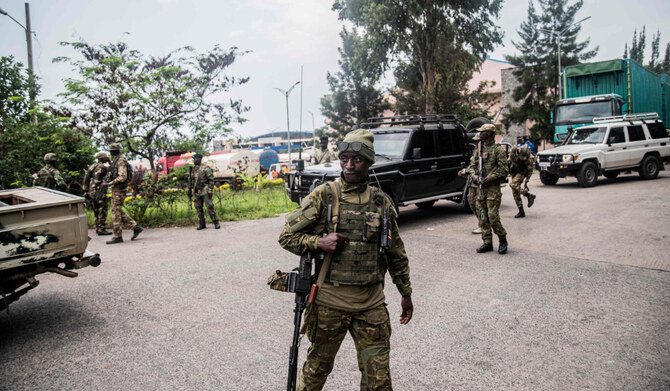
Rebels of the M23 group have seized east Congo’s two biggest cities since January in an escalation of a long-running conflict rooted in the spillover into Congo of Rwanda’s 1994 genocide and the struggle for control of Congo’s vast mineral resources.
FASTFACT
The government of the Democratic Republic of Congo has said at least 7,000 people had died in the fighting since January.
Congo is considering sending representatives to peace talks with the M23 group that Angola plans to host next week, government sources said on Thursday.
Rwanda is accused of backing the Tutsi-led M23 rebels, a charge it denies.
The EU summoned the ambassador of Rwanda last month, calling on the country to “immediately withdraw” troops from Congolese territory and to “stop supporting the M23 and any other armed group.”
EU foreign policy chief Kaja Kallas has also said that the 27-nation bloc will review its agreement with Rwanda over critical raw materials due to the country’s links with the M23 rebels.
Rwanda denies providing arms and troops to M23 rebels.
Congo’s government has said at least 7,000 people have died in the fighting since January.
According to the UN Humanitarian Affairs Office, at least 600,000 people have been displaced by the fighting since November.
With Congo’s army and allied forces putting up weak resistance to the rebel advance, regional powers appear in agreement that dialogue is the only way forward, diplomats and analysts said.
“I haven’t talked to a single African country that says Kinshasa shouldn’t talk to M23,” one senior diplomat said.
“The line of everyone is, ‘How do you stop the fighting if you don’t engage with them?’“
One source said on Friday that government participation was a sure thing but that it was still too early to say who would represent Kinshasa in Luanda.
Other sources said the debate was still ongoing and a final decision would not likely be made until next week.
M23, for its part, said on Thursday it was demanding an unequivocal commitment from DRC President Felix Tshisekedi to engage in talks.
Both sides said they had questions about the framework and how the Angola-hosted talks would comply with decisions from regional bodies attempting to resolve the conflict.
Southern and East African foreign and defense ministers are due to meet in Harare on Monday to discuss the push for a cessation of hostilities and political dialogue.
Sitting down with M23 would likely be deeply unpopular in Kinshasa, especially after Tshisekedi’s repeated vows never to do so.
But it would amount to an acknowledgment that Tshisekedi’s pursuit of a military solution has “failed,” said Congolese analyst Bob Kabamba of the University of Liege in Belgium.
“Kinshasa’s position of dialogue is understandable because it finds itself stuck, thinking that the (rebel alliance) must not reach a critical threshold,” he said.
Stephanie Wolters, a Congo analyst with South Africa’s Institute for Security Studies, said Angola had “clearly decided that it is necessary to intervene to prevent the advance of the M23 toward the west of the DRC.”
The lack of faith in Tshisekedi’s ability to turn the tide militarily was also seen this week in Southern African leaders’ approval of the “phased withdrawal” of a regional deployment known as SAMIDRC that had a mandate to fight rebels.
Although the deployment was too weak to mean much in the fight against M23, its presence was an essential sign of regional support for Congo, Wolters said, making its departure a “significant blow.”