

Fasting on the frontline: Karachi ambulance driver navigates chaos to save lives during Ramadan

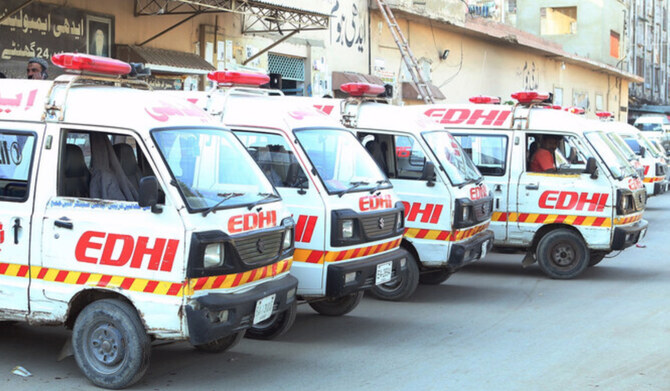
The Edhi Foundation, one of the world’s largest charities, operates nearly 1,800 ambulances. (Supplied)
Short Url
Updated 15 March 2025
Follow

Fasting on the frontline: Karachi ambulance driver navigates chaos to save lives during Ramadan

  • For Ghulam Nabi and hundreds of other Edhi ambulance drivers, Ramadan does not change their daily duties
  • Nabi says his iftar often consists of just dates and water, eaten on the road between emergencies

KARACHI: In Karachi, where traffic is relentless and sirens are a constant, 63-year-old Ghulam Nabi has spent the past 14 years behind the wheel of an Edhi Foundation ambulance, responding to emergencies in a city where every second can mean the difference between life and death.

The Edhi Foundation, one of the world’s largest charities, operates nearly 1,800 ambulances, including over 200 in Karachi, where it was founded by the late veteran philanthropist Abdul Sattar Edhi, who passed away in July 2016. Nabi is one of the hundreds of drivers keeping the wheels of these ambulances going.

Even during the Muslim fasting month of Ramadan, he remains committed to his duty. Often, his iftar — the evening meal to break the fast, which most people share with their families at home — happens on the road, between dispatches.

“Whether it’s sunny, hot, stormy, rainy, Ramadan or Eid, no matter what, we have to do our duty and serve humanity,” he said in a recent conversation with Arab News.

Living in an old apartment in the city’s historic Kharadar area, he begins his day by walking to the Edhi headquarters nearly a kilometer away. From there, his shift unfolds unpredictably, sometimes requiring him to attend to road accidents, rush cardiac arrest patients to hospitals or transport the deceased to their final resting places.

“Just yesterday, it was time to break the fast. Five-to-ten minutes before iftar, we were informed that an accident had occurred on Mai Kolachi Road,” Nabi recalled, adding that he had to leave iftar and rush to the spot.

“On the way, someone gave us dates, and we broke our fast with them,” he added.

Nabi recalled that at one point during Ramadan, he was asked to pick up a corpse from a house where it had remained unattended for nearly a week. As he reached the place, he realized it was decomposed and in such a condition that no one wanted to go near it.

But Nabi handled it, giving it to the relatives in a casket after completing the required legal procedures.

“We had to carry the body while fasting,” he said.

‘FRONTLINE HEROES’

Muhammad Amin, who oversees the Karachi Control Room at the Edhi Foundation, holds his team, particularly Nabi, in high esteem.

“He is an excellent driver, and all the qualities required in his job are found in him,” he told Arab News. “From keeping the ambulance clean to its general upkeep, following driving protocols and handling emergencies, Ghulam Nabi excels in all these aspects.”

Amin noted Ramadan always brought unique challenges to the drivers since their workload never decreased.

“There was a fire near Chakar Hotel on the Super Highway (yesterday), where our team, which included the drivers, went,” he said. “The drivers were fasting, but they worked through the fire and performed their duties.

“If you look at it, these drivers can truly be called our frontline heroes,” he added.

Nabi said his entry into this line of work was unexpected. He used to run a small business that suffered losses, forcing him to shut it down. As he started looking for employment opportunities, a friend referred him to Edhi in 2010.

“Since that day, I have been engaged in humanitarian work,” he said.

‘SAVING HUMANITY’

Karachi, a megacity with over 20 million people, suffers from broken roads, congested streets and widespread disregard for traffic rules. These conditions significantly increase the challenges of Nabi’s job, making him fear that he might not be able to reach people in need on time.

Despite such hardships, he said he was proud of his work and found fulfillment in transporting patients and the injured to hospitals for treatment.

“Whoever saves a life, saves all of humanity,” he said, his eyes shining.

To Nabi, his work is a continuation of the legacy of Abdul Sattar Edhi, the late humanitarian whose foundation has provided free ambulance services for decades.

“Here, we are carrying forward Edhi Sahib’s mission,” he said. “Humanitarian work will never stop.”

As dusk falls and families across Karachi gather for iftar at home, Nabi finds himself away from his loved ones.

“Our hearts also long to break our fast with our children, but our iftar is often on the road or in the ambulance, and we have to break our fast with dates or water,” he said, as he ended his fast with the evening prayer call while sitting on a roadside bench in a Karachi street.


EU leaders to reassess US ties despite Trump U-turn on Greenland

Updated 22 January 2026
Follow

EU leaders to reassess US ties despite Trump U-turn on Greenland

  • Diplomats stressed that, although Thursday’s emergency EU talks in Brussels would now lose some of their urgency, the longer-term issue of how to handle the relationship with the US remained

BRUSSELS: EU leaders will rethink their ties with the US at an emergency summit on Thursday after Donald Trump’s threat of tariffs and even military action to ​acquire Greenland badly shook confidence in the transatlantic relationship, diplomats said.
Trump abruptly stepped back on Wednesday from his threat of tariffs on eight European nations, ruled out using force to take Greenland, a semi-autonomous territory of NATO ally Denmark, and suggested a deal was in sight to end the dispute.
German Chancellor Friedrich Merz, welcoming Trump’s U-turn on Greenland, urged Europeans not to be too quick to write off the transatlantic partnership.
But EU governments remain wary of another change of mind by a mercurial president who is increasingly seen as a bully that Europe will have to stand up to, and they are focused on coming up with a longer-term plan on how to deal with the ‌United States under this ‌administration and possibly its successors too.
“Trump crossed the Rubicon. He might do ‌it ⁠again. ​There is no ‌going back to what it was. And leaders will discuss it,” one EU diplomat said, adding that the bloc needed to move away from its heavy reliance on the US in many areas.
“We need to try to keep him (Trump) close while working on becoming more independent from the US It is a process, probably a long one,” the diplomat said.
EU RELIANCE ON US
After decades of relying on the United States for defense within the NATO alliance, the EU lacks the needed intelligence, transport, missile defense and production capabilities to defend itself against a possible Russian attack. This gives the US substantial leverage.
The US ⁠is also Europe’s biggest trading partner, making the EU vulnerable to Trump’s policies of imposing tariffs to reduce Washington’s trade deficit in goods, and, as in ‌the case of Greenland, to achieve other goals.
“We need to discuss where ‍the red lines are, how we deal with this bully ‍across the Atlantic, where our strengths are,” a second EU diplomat said.
“Trump says no tariffs today, but does ‍that mean also no tariffs tomorrow, or will he again quickly change his mind? We need to discuss what to do then,” the second diplomat said.
The EU had been considering a package of retaliatory tariffs on 93 billion euros ($108.74 billion) on US imports or anti-coercive measures if Trump had gone ahead with his own tariffs, while knowing such a step would harm Europe’s economy as well ​as the United States.
WHAT’S THE GREENLAND DEAL?
Several diplomats noted there were still few details of the new plan for Greenland, agreed between Trump and NATO Secretary General Mark Rutte late on ⁠Wednesday on the sidelines of the World Economic Forum in Davos, Switzerland.
“Nothing much changed. We still need to see details of the Greenland deal. We are a bit fed up with all the bullying. And we need to act on a few things: more resiliency, unity, get our things together on internal market, competitiveness. And no more accepting tariff bullying,” a third diplomat said.
Rutte told Reuters in an interview in Davos on Thursday that under the framework deal he reached with Trump the Western allies would have to step up their presence in the Arctic.
He also said talks would continue between Denmark, Greenland and the US on specific issues.
Diplomats stressed that, although Thursday’s emergency EU talks in Brussels would now lose some of their urgency, the longer-term issue of how to handle the relationship with the US remained.
“The approach of a united front in solidarity with Denmark and Greenland while focusing on de-escalation and finding an off-ramp has worked,” a fourth EU diplomat said.
“At the ‌same time it would be good to reflect on the state of the relationship and how we want to shape this going forward, given the experiences of the past week (and year),” he said.