BAGHDAD: The head of the Daesh in Iraq and Syria has been killed in Iraq in an operation by members of the Iraqi national intelligence service along with US-led coalition forces, the Iraqi prime minister announced Friday.
“The Iraqis continue their impressive victories over the forces of darkness and terrorism,” Prime Minister Mohammed Shia Al-Sudani said in a statement posted on X, formerly known as Twitter.
Abdallah Maki Mosleh Al-Rifai, or “Abu Khadija,” was “deputy caliph” of the militant group and as “one of the most dangerous terrorists in Iraq and the world,” the statement said.
A security official said the operation was carried out by an airstrike in Anbar province, in western Iraq. A second official said the operation took place Thursday night but that Al-Rifai’s death was confirmed Friday. They spoke on condition of anonymity because they were not authorized to comment publicly.
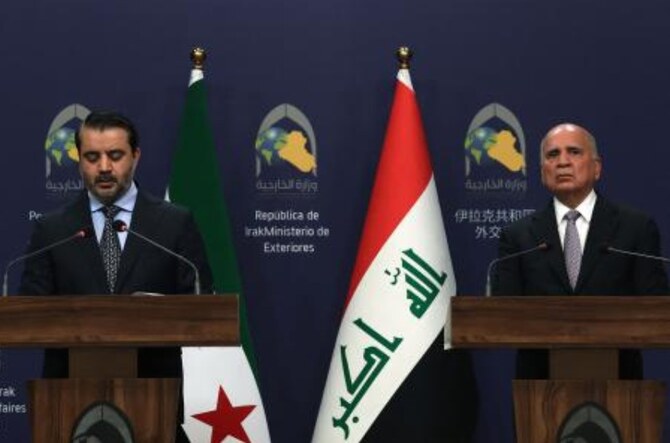
The announcement came on the same day as the first visit by Syria’s top diplomat to Iraq, during which the two countries pledged to work together to combat Daesh.
Iraqi Foreign Minister Fouad Hussein said at a news conference that “there are common challenges facing Syrian and Iraqi society, and especially the terrorists of Daesh.” He said the officials had spoken “in detail about the movements of Daesh, whether on the Syrian-Iraqi border, inside Syria or inside Iraq” during the visit.
Hussein referred to an operations room formed by Syria, Iraq, Turkiye, Jordan and Lebanon at a recent meeting in Amman to confront Daesh, and said it would soon begin work.
The relationship between Iraq and Syria is somewhat fraught after the fall of former Syrian President Bashar Assad. Al-Sudani came to power with the support of a coalition of Iran-backed factions, and Tehran was a major backer of Assad. The current interim president of Syria, Ahmad Al-Sharaa, was previously known as Abu Mohammed Al-Golani and fought as an Al-Qaeda militant in Iraq after the US invasion of 2003, and later fought against Assad’s government in Syria.
But Syrian interim Foreign Minister Asaad Hassan Al-Shibani focused on the historic ties between the two countries.
“Throughout history, Baghdad and Damascus have been the capitals of the Arab and Islamic world, sharing knowledge, culture and economy,” he said.
Strengthening the partnership between the two countries “will not only benefit our peoples, but will also contribute to the stability of the region, making us less dependent on external powers and better able to determine our own destiny,” he said.
The operation and the visit come at a time when Iraqi officials are anxious about an Daesh resurgence in the wake of the fall of Assad in Syria.
While Syria’s new rulers — led by the Islamist former insurgent group Hayat Tahrir Al-Sham — have pursued Daesh cells since taking power, some fear a breakdown in overall security that could allow the group to stage a resurgence.
The US and Iraq announced an agreement last year to wind down the military mission in Iraq of an American-led coalition fighting the Daesh group by September 2025, with US forces departing some bases where they have stationed troops during a two-decade-long military presence in the country.
When the agreement was reached to end the coalition’s mission in Iraq, Iraqi political leaders said the threat of Daesh was under control and they no longer needed Washington’s help to beat back the remaining cells.
But the fall of Assad in December led some to reassess that stance, including members of the Coordination Framework, a coalition of mainly Shiite, Iran-allied political parties that brought current Iraqi Prime Minister Mohammad Shia Al-Sudani to power in late 2022.

Head of the Daesh in Iraq and Syria has been killed, Iraqi prime minister says
Short Url
https://arab.news/cshba
Head of the Daesh in Iraq and Syria has been killed, Iraqi prime minister says
- “The Iraqis continue their impressive victories over the forces of darkness and terrorism,” Al-Sudani said
- Syrian interim Foreign Minister Asaad Hassan Al-Shibani focused on the historic ties between the two countries
Trump demands role in choosing next Iran leader, Khamenei's son ‘unacceptable’
- US president tells Axios US would likely return to war within five years without a favorable leader in Iran
- Draws parallel with Venezuela where interim president Delcy Rodriguez has cooperated under threat of violence
WASHINGTON: US President Donald Trump on Thursday insisted he should have a role in picking Iran’s next supreme leader after the killing of Ayatollah Ali Khamenei, whose son he said he found unacceptable.
“Khamenei’s son is a lightweight. I have to be involved in the appointment, like with Delcy,” Trump told Axios in an interview, drawing a comparison to Venezuela, where interim president Delcy Rodriguez has cooperated with him under threat of violence after the United States ousted her boss, Nicolas Maduro.
Trump told the news outlet that the United States would likely return to war within five years without a favorable leader in Iran.
“Khamenei’s son is unacceptable to me. We want someone that will bring harmony and peace to Iran,” Trump was quoted saying by the news outlet.
It was unclear in what way Trump would be able to take a role in the Islamic republic’s selection of a new supreme leader, a decision made by an assembly of senior Shiite Muslim clerics mostly staunchly opposed to the United States. Trump was raised a Presbyterian.
But his remarks imply a willingness to work with someone from within the Islamic republic rather than seek to topple the government, which has been a sworn enemy of the United States since the 1979 Islamic revolution toppled the pro-Western shah.
The late shah’s son, Reza Pahlavi, has proposed that he return as a transitional figure before Iran drafts a new constitution as a secular democracy. Pahlavi earlier Thursday said that any new supreme leader within the Islamic republic would be illegitimate.
Ali Khamenei, who ruled Iran since 1989 with hard-line policies that included repression at home and confrontation with neighboring countries, was killed Saturday in an Israeli strike as Israel and the United States opened war.
His son, Mojtaba Khamenei, is considered one of the contenders to succeed his father, who was only the second supreme leader after revolutionary leader Ayatollah Ruhollah Khomeini.
In Venezuela, Trump ordered a deadly January 3 attack in which US forces snatched Maduro, a longtime US nemesis.
Rather than backing the opposition long championed by the United States, Trump has said he has been pleased by Rodriguez, who was Maduro’s vice president but has cooperated on key US demands, notably on benefiting oil companies.
She is doing so under Trump’s threat of violence if she does not do what he wants, particularly on access to natural resources.
“Khamenei’s son is a lightweight. I have to be involved in the appointment, like with Delcy,” Trump told Axios in an interview, drawing a comparison to Venezuela, where interim president Delcy Rodriguez has cooperated with him under threat of violence after the United States ousted her boss, Nicolas Maduro.
Trump told the news outlet that the United States would likely return to war within five years without a favorable leader in Iran.
“Khamenei’s son is unacceptable to me. We want someone that will bring harmony and peace to Iran,” Trump was quoted saying by the news outlet.
It was unclear in what way Trump would be able to take a role in the Islamic republic’s selection of a new supreme leader, a decision made by an assembly of senior Shiite Muslim clerics mostly staunchly opposed to the United States. Trump was raised a Presbyterian.
But his remarks imply a willingness to work with someone from within the Islamic republic rather than seek to topple the government, which has been a sworn enemy of the United States since the 1979 Islamic revolution toppled the pro-Western shah.
The late shah’s son, Reza Pahlavi, has proposed that he return as a transitional figure before Iran drafts a new constitution as a secular democracy. Pahlavi earlier Thursday said that any new supreme leader within the Islamic republic would be illegitimate.
Ali Khamenei, who ruled Iran since 1989 with hard-line policies that included repression at home and confrontation with neighboring countries, was killed Saturday in an Israeli strike as Israel and the United States opened war.
His son, Mojtaba Khamenei, is considered one of the contenders to succeed his father, who was only the second supreme leader after revolutionary leader Ayatollah Ruhollah Khomeini.
In Venezuela, Trump ordered a deadly January 3 attack in which US forces snatched Maduro, a longtime US nemesis.
Rather than backing the opposition long championed by the United States, Trump has said he has been pleased by Rodriguez, who was Maduro’s vice president but has cooperated on key US demands, notably on benefiting oil companies.
She is doing so under Trump’s threat of violence if she does not do what he wants, particularly on access to natural resources.
© 2026 SAUDI RESEARCH & PUBLISHING COMPANY, All Rights Reserved And subject to Terms of Use Agreement.


