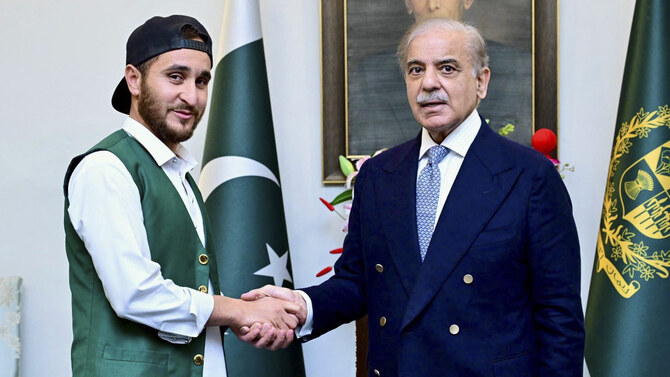
ISLAMABAD: Prime Minister Shehbaz Sharif has met with Pakistani footballer Muhammad Riaz and handed him Rs2.5 million ($8,916) cheque and promised a government job for him in a federal department of his choice, Sharif’s office said on Friday.
Riaz, who represented Pakistan in the 2018 Asian Games, made headlines after a video of him selling jalebis, a popular street snack, went viral online, with netizens criticizing the government and sports bodies for ignoring the footballer.
Sports athletes in the subcontinent, including Pakistan, usually come from economically disadvantaged backgrounds before becoming household names overnight and attaining financial success.
In his meeting with the footballer, PM Sharif praised his courage and determination, and urged to continue playing football and an active role in promoting the game in the South Asian country.
“Pakistani youth are a valuable asset of the country,” Sharif’s office quoted him as saying. “Providing all kinds of facilities to Pakistani athletes and resources for them to compete at the international level is among the top priorities of the government.”
The prime minister instructed officials to provide Riaz with job in federal department of his choice.
“Steps should be taken to promote sports in the country,” he said. “A strategy should be formulated to provide sustainable employment opportunities to the athletes representing Pakistan at the international level and for their welfare.”
Riaz thanked the prime minister for the financial support and for taking steps for the welfare of players and the promotion of sports, according to Sharif’s office.
The plight of football in Pakistan is a tale of unfulfilled potential, administrative chaos and lack of investment. Despite a passionate fan base and a pool of talented players, the sport has suffered due to mismanagement by governing bodies, political interference and inadequate infrastructure.
The Pakistan Football Federation (PFF) has been marred by internal disputes and FIFA suspensions which have hindered the development of the game at all levels.
On Wednesday, the Pakistan Football League (PFL) also announced a cash prize of Rs1 million ($3,573) and a “prominent position” in the league for Riaz.
The PFL is a franchise league that says it is driven by a UK-based company with foreign investment solely committed to uplifting football from the grassroots to a professional level in Pakistan.


![]()

PM presents Rs2.5 million cheque to struggling Pakistani footballer, promises government job
Short Url
https://arab.news/phyt2
PM presents Rs2.5 million cheque to struggling Pakistani footballer, promises government job
- A video of Muhammad Riaz frying popular street snack to make ends meet went viral on social media this month, drawing online criticism
- PM Shehbaz Sharif calls for a strategy to provide sustainable employment opportunities to athletes representing Pakistan internationally


Latest updates


© 2026 SAUDI RESEARCH & PUBLISHING COMPANY, All Rights Reserved And subject to Terms of Use Agreement.