

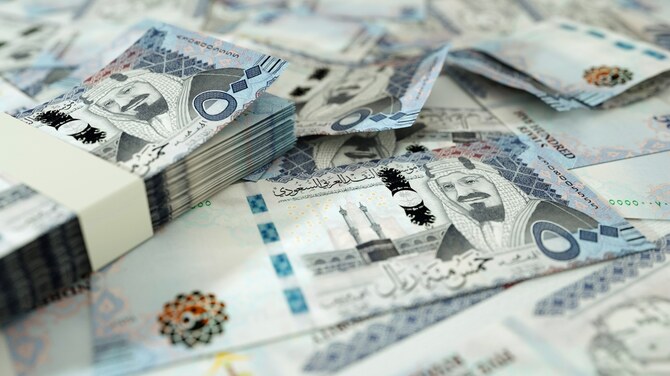

RIYADH: Saudi Arabia’s money supply climbed to SR2.97 trillion ($791 billion) in January, marking a 9 percent annual rise, official data showed.
According to figures from the Saudi Central Bank, known as SAMA, demand deposits accounted for 48.75 percent of the total, reaching SR1.45 trillion. While still below the April 2021 peak of 60.21 percent, they edged up from 48.42 percent a year ago, reflecting shifting monetary conditions.
Demand deposits are a crucial part of the money supply. When individuals deposit money into checking accounts, it increases the total amount of demand deposits, thereby expanding the overall money supply in the economy.
A demand deposit refers to money held in a bank account that can be withdrawn at any time, whenever the account holder requires it.
These funds are generally used for everyday expenses. Banks or financial institutions typically offer little to no interest on the balance in a demand deposit account.
Time and savings deposits — which surged during the US Federal Reserve’s aggressive rate hikes, mirrored by Saudi Arabia due to the riyal’s peg to the US dollar — reached SR985.03 billion in January, accounting for 33.21 percent of total deposits.
As the Fed began easing monetary policy in September, lowering interest rates from their 6 percent peak to 5 percent by December, time deposits started to decline from their 33.61 percent high in November.
This shift reflects a gradual return to shorter-term deposit preferences as rate-sensitive accounts adjust to a lower-yield environment.
The third-largest category, other quasi-money deposits — including residents’ foreign currency accounts, marginal deposits for letters of credit, outstanding remittances, and bank repo transactions with the private sector — stood at SR301.28 billion, making up 10.16 percent of total deposits. Currency outside banks totaled SR233.71 billion.
Over the past two years, the Fed’s aggressive rate hikes aimed at curbing inflation led to a rise in term deposits as customers sought higher-yielding accounts, but with benchmark rates now easing, demand deposits have started to regain share.
Despite the 9 percent annual rise in money supply, deposit growth continues to lag behind bank lending, which surged 14.66 percent during the same period to exceed SR3 trillion for the first time. This growth has been driven by corporate credit expansion, particularly in real estate, infrastructure, and other key Vision 2030 sectors.
As deposit inflows moderate, Saudi banks have increasingly turned to external borrowing to bridge funding gaps. Recent issuances of euro-denominated bonds highlight the evolving financing landscape, with the debt capital market playing an increasingly pivotal role.
Speaking at the Capital Markets Forum 2025 in Riyadh in February, Mohammad Al-Faadhel, assistant deputy of financing at the Capital Market Authority, highlighted how Vision 2030 has transformed Saudi Arabia from a capital exporter to a credit-driven market, accelerating debt market growth.
Al-Faadhel noted that the Sukuk and Development Capital Market Committee was established in collaboration with key stakeholders to remove obstacles and support market expansion.
With ongoing structural reforms, Saudi Arabia’s financial ecosystem is evolving rapidly, setting the stage for continued growth in capital markets, corporate lending, and alternative financing mechanisms under Vision 2030.
Loan-to-deposit ratio holds steady
Saudi Arabia’s loan-to-deposit ratio rose to 82.78 percent in January, up from 80.05 percent in the same month last year, yet slightly lower than December’s 83.24 percent, according to SAMA data.
The LDR, a key banking metric, measures the proportion of loans issued by banks relative to their total deposits, indicating liquidity levels and lending capacity.
The increase over the past year reflects strong credit demand, particularly from corporate borrowers in key Vision 2030 sectors such as real estate, infrastructure, and industrial expansion.
However, the slight month-on-month decline suggests a stabilization in lending activity, as banks balance loan issuance with available deposit inflows. Despite the surge in credit, the LDR remains well below the regulatory cap of 90 percent, ensuring ample liquidity and financial stability within the banking system.
This ratio is closely monitored by regulators and investors as it influences banks’ ability to extend new loans while maintaining a healthy funding base.


