NEW YORK: Mahmoud Khalil will remain detained in Louisiana until at least next week following an initial court hearing in New York on Wednesday over the Trump administration’s plans to deport the Columbia University graduate student for his role in campus protests against Israel.
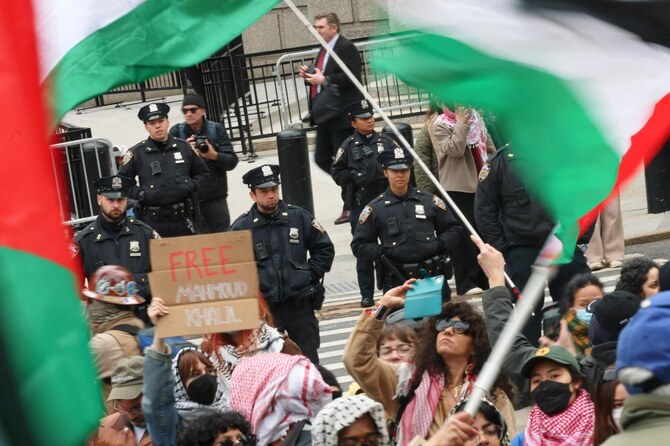
The brief hearing, which focused on thorny jurisdictional issues, drew hundreds of demonstrators to the federal courthouse in lower Manhattan to denounce the Saturday arrest of Khalil, a permanent US resident who is married to an American citizen. Khalil, 30, didn’t attend — after initially being held in New Jersey, he was moved to an immigration detention center in Louisiana.
After Khalil’s Manhattan arrest, Judge Jesse M. Furman ordered that the 30-year-old not be deported while the court considers a legal challenge brought by his lawyers, who want Khalil returned to New York and released under supervision.
During Wednesday’s hearing, attorney Brandon Waterman argued on behalf of the Justice Department that the venue for the deportation fight should be moved from New York City to Louisiana or New Jersey because those are the locations where Khalil has been held.
One of Khalil’s lawyers, Ramzi Kassem, told the judge that Khalil was “identified, targeted and detained” because of his advocacy for Palestinian rights and his protected speech. He said Khalil has no criminal convictions, but “for some reason, is being detained.”
Kassem also told Furman that Khalil’s legal team hasn’t been able to have a single attorney-client-protected phone call with him.
Furman ordered that the lawyers be allowed to speak with him by phone at least once on Wednesday and Thursday. Calling the legal issues “important and weighty,” the judge also directed the two sides to submit a joint letter on Friday describing when they propose to submit written arguments over the legal issues raised by Khalil’s detention.
Kassem said Khalil’s lawyers would update their lawsuit on Thursday.
Khalil’s arrest has sparked protests in New York and other US cities. Actor Susan Sarandon emerged from the courthouse and told reporters that “no matter where you stand on genocide, freedom of speech ... is a right that we all have.” She added: ”And this is a turning point in the history and the freedom of this country.”
Some of Khalil’s supporters, many of them wearing a keffiyeh and mask, attended the hearing. Hundreds more demonstrated outside the courthouse, beating drums, waving Palestinian flags and chanting for Khalil’s release. The raucous crowd grew quiet, though, to hear Kassem speak.
“As we tried to make clear in court today, what happened to Mahmoud Khalil is nothing short of extraordinary and shocking and outrageous,” Kassem told the crowd. “It should outrage anybody who believes that speech should be free in the United States of America.”
Kassem said the legal grounds cited by the government to detain Khalil were “vague” and “rarely used,” masking the true intent: “retaliation and punishment for the exercise of free speech.”
Columbia became the center of a US pro-Palestinian protest movement that swept across college campuses nationwide last year and led to more than 2,000 arrests.
Khalil, whose wife is pregnant with their first child, finished his requirements for a Columbia master’s degree in December. Born in Syria, he is a grandson of Palestinians who were forced to leave their homeland, his lawyers said in a legal filing.
President Donald Trump heralded Khalil’s arrest as the first “of many to come,” vowing on social media to deport students he described as engaging in “pro-terrorist, anti-Semitic, anti-American activity.”
During a stopover in Ireland while headed from Saudi Arabia to a meeting of the G7 foreign ministers in Canada, Secretary of State Marco Rubio told reporters that Khalil’s case is “not about free speech.”
“This is about people that don’t have a right to be in the United States to begin with. No one has a right to a student visa. No one has a right to a green card,” Rubio said.
Khalil, who acted as a spokesperson for Columbia protesters, hasn’t been charged with a crime. White House press secretary Karoline Leavitt said Tuesday that the administration moved to deport him under a section of the Immigration and Nationality Act that gives the secretary of state the power to deport a noncitizen on foreign policy grounds.
Civil rights groups and Khalil’s attorneys say the government is unconstitutionally using its immigration control powers to stop him from speaking out.
US Jewish groups and leaders and organizations have been divided in their response to Khalili’s detention.
Among those welcoming the move was the Anti-Defamation League, which said it hopes it serves as a “deterrent.”
“We appreciate the Trump Administration’s broad, bold set of efforts to counter campus antisemitism — and this action further illustrates that resolve by holding alleged perpetrators responsible for their actions,” the ADL said on social media.
Amy Spitalnick, CEO of Jewish Council for Public Affairs, decried Khalil’s detention.
The Trump administration “is exploiting real concerns about antisemitism to undercut democracy: from gutting education funding to deporting students to attacking diversity, equity, & inclusion,” she wrote on Bluesky. “As we’ve repeatedly said: this makes Jews — & so many others — less safe.”


![]()

Columbia grad student’s detention will stretch on as lawyers spar over Trump’s plan to deport him
Short Url
https://arab.news/8bwwz
Columbia grad student’s detention will stretch on as lawyers spar over Trump’s plan to deport him
- After Khalil’s Manhattan arrest, Judge Jesse M. Furman ordered that the 30-year-old not be deported while the court considers a legal challenge brought by his lawyers
- One of Khalil’s lawyers, Ramzi Kassem, told the judge that Khalil was “identified, targeted and detained” because of his advocacy for Palestinian rights and his protected speech


Latest updates


© 2026 SAUDI RESEARCH & PUBLISHING COMPANY, All Rights Reserved And subject to Terms of Use Agreement.