

Pakistan army says operation against militants who hijacked train has ended, 21 hostages killed

A Pakistan Army soldier stands guard next to a rescue train, after the attack on a train by separatist militants in Bolan, at the railway station in Mushkaf, Balochistan, Pakistan, March 12, 2025. (REUTERS)
Short Url
Updated 12 March 2025
Follow

Pakistan army says operation against militants who hijacked train has ended, 21 hostages killed

  • Separatist Balochistan Liberation Army outfit stormed train in southwest Pakistan on Tuesday, held over 400 passengers hostage 
  • Pakistan military spokesperson says security forces killed 33 militants, no passengers harmed during final clearance operation

QUETTA: A military operation against militants who hijacked a train in Pakistan’s southwestern Balochistan a day earlier ended on Wednesday, army spokesperson General Ahmad Sharif Chaudhry said, with 21 hostages killed. 

The separatist Balochistan Liberation Army (BLA) bombed part of a railway track and stormed the Quetta-Peshawar-bound Jaffar Express on Tuesday afternoon in Mushkaaf, an area in the mountainous Bolan range of Balochistan. The group said on Tuesday night it was holding 214 people as hostages, including military, police and intelligence officials, while a security official said 190 passengers had been rescued by Wednesday afternoon.

Balochistan province has been the site of a low-level separatist insurgency for decades, with separatist groups accusing the government of stripping the province’s natural resources and leaving its people mired in poverty. They say security forces routinely abduct, torture, and execute ethnic Baloch, allegations echoed by human rights campaigners. Government officials and security forces strongly deny violating human rights and say they are uplifting the province through development projects, including multi-billion-dollar schemes funded by China.
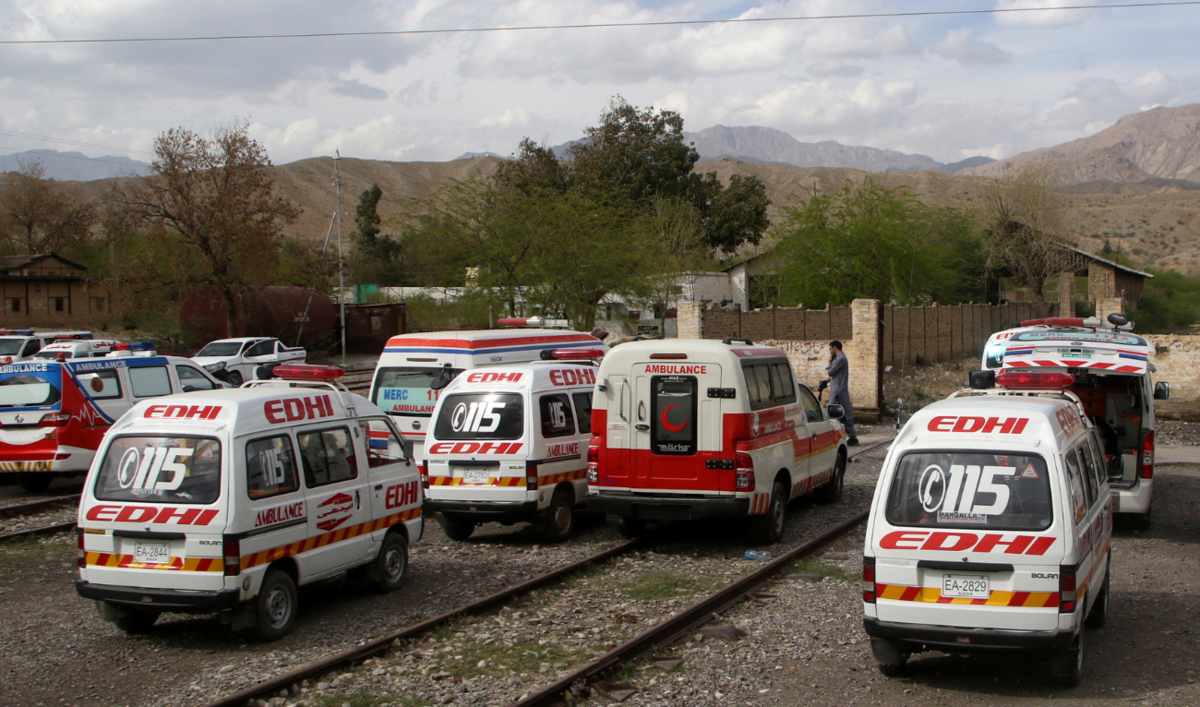


Ambulances are parked outside a railway station where rescued and injured passengers of a train attacked by separatist militants are brought, in Mach, Balochistan, Pakistan, March 12, 2025. (REUTERS)

“Firstly, our forces’ marksmen sent the suicide bombers to hell and in phases cleared all the bogies there to send all terrorists to hell,” Chaudhry told Dunya News, a private TV channel, adding that 33 militants had been killed in the operation, and no passengers were harmed during the final clearance operation by security forces. 

“However, before this operation commenced, these heathen terrorists had already taken 21 lives,” the military spokesperson said.

He said a rescue operation had been launched immediately after the train was attacked on Tuesday, disclosing that the army, air force, paramilitary Frontier Corps (FC) force and Special Services Group (SSG) personnel took part in the mission.

Four paramilitary FC soldiers had been killed in the operation, while no army men had been harmed, Chaudhry added.

Passengers who were held hostage and had fled to surrounding areas during the operation were also being accounted for, the military spokesman said. 
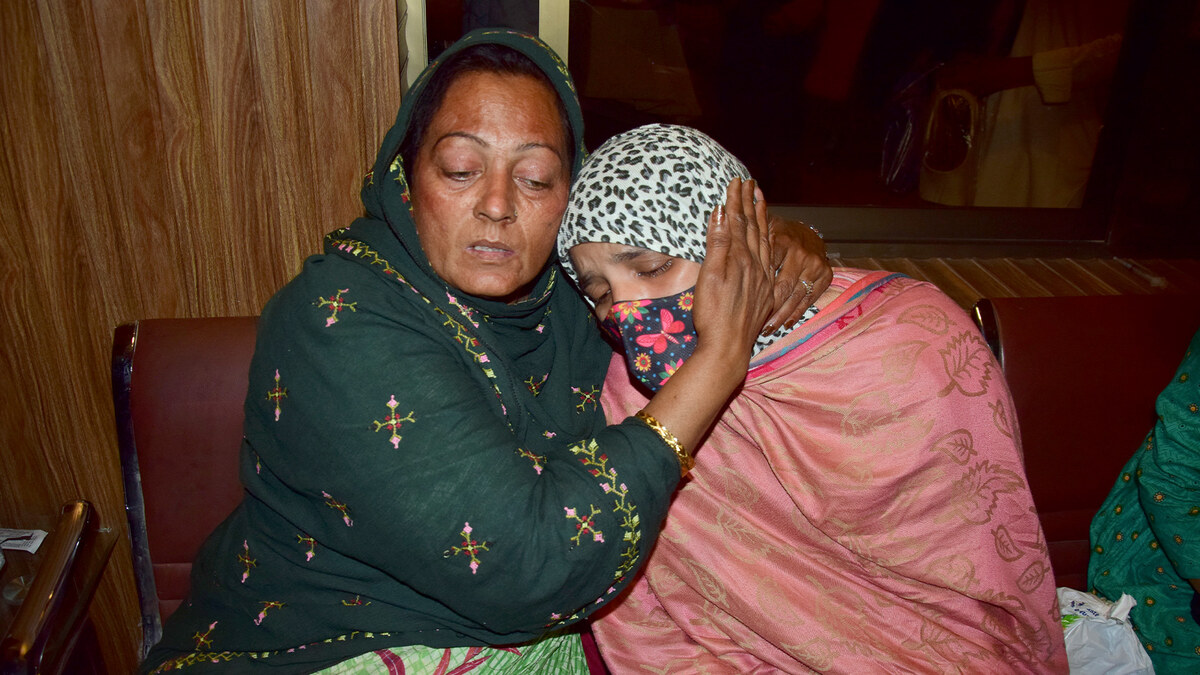


Passengers rescued by security forces from a passenger train attacked by insurgents comfort each other upon their arrival at a railway station in Quetta, Pakistan on Wednesday, March 12, 2025. (AP)

ARMY TAKES CONTROL OF RAILWAY STATION 

Earlier on Wednesday afternoon, an Arab News eyewitness described seeing dozens of empty coffins being brought to the Quetta Railway Station in the provincial capital. He said the station was overrun with army personnel while dozens of family members of hostages had arrived in search of their loved ones. These included the family of Amjad Yasin, the 50-year-old driver of the Jaffar Express, who officials said on Tuesday had been killed in the assault. 

“We have been contacting railway officials since yesterday, but no one is telling the truth,” Amir Yasin, the driver’s younger brother, told Arab News. 

“There are multiple reports coming about my brother’s death but how can we believe it until we see his body?” 

Muhammad Abid, a railway employee who was on the train and arrived at Mach Station, described the attack as the most “horrific day” of his life.

“We were sitting in one of the compartments of Jaffar Express when a powerful explosion targeted the train and intense firing started,” he told Arab News over the phone. 

“We hid in the washrooms with other passengers, but then armed men came in and off boarded us from the train,” he added. “After checking our identity cards, they asked us to run on the track. My life flashed before my eyes when I saw dozens of armed men standing on the railway track.”

Muhammad Ashraf, a 68-year-old passenger traveling to Hafizabad in Punjab to meet his daughter, said that when the train departed from Paneer Railway Station, he heard an explosion about seven to eight kilometers into the journey, followed by intense gunfire, saying many people had been killed and injured.

“Armed men boarded the train and asked everyone to leave the train or prepare to die,” he told Arab News, adding that the militants made the passengers walk on the tracks for three and a half hours on foot.
Ashraf said the militants had detained over 200 passengers, in his rough estimate.


IMF warns against policy slippage amid weak recovery as it clears $1.2 billion for Pakistan

Updated 11 December 2025
Follow

IMF warns against policy slippage amid weak recovery as it clears $1.2 billion for Pakistan

  • Pakistan rebuilt reserves, cut its deficit and slowed inflation sharply over the past one year
  • Fund says climate shocks, energy debt, stalled reforms threaten stability despite recent gains

ISLAMABAD: Pakistan’s economic recovery remains fragile despite a year of painful stabilization measures that helped pull the country back from the brink of default, the International Monetary Fund (IMF) warned on Thursday, after it approved a fresh $1.2 billion disbursement under its ongoing loan program.

The approval covers the second review of Pakistan’s Extended Fund Facility (EFF) and the first review of its climate-focused Resilience and Sustainability Facility (RSF), bringing total disbursements since last year to about $3.3 billion.

Pakistan entered the IMF program in September 2024 after years of weak revenues, soaring fiscal deficits, import controls, currency depletion and repeated climate shocks left the economy close to external default. A smaller stopgap arrangement earlier that year helped avert immediate default, but the current 37-month program was designed to restore macroeconomic stability through strict monetary tightening, currency adjustments, subsidy rationalization and aggressive revenue measures.

The IMF’s new review shows that Pakistan has delivered significant gains since then. Growth recovered to 3 percent last year after shrinking the year before. Inflation fell from over 23 percent to low single digits before rising again after this year’s floods. The current account posted its first surplus in 14 years, helped by stronger remittances and a sharp reduction in imports. And the government delivered a primary budget surplus of 1.3 percent of GDP, a key program requirement. Foreign exchange reserves, which had dropped dangerously low in 2023, rose from US$9.4 billion to US$14.5 billion by June.

“Pakistan’s reform implementation under the EFF arrangement has helped preserve macroeconomic stability in the face of several recent shocks,” IMF Deputy Managing Director Nigel Clarke said in a statement after the Board meeting.

But he warned that Islamabad must “maintain prudent policies” and accelerate reforms needed for private-sector-led and sustainable growth.

The Fund noted that the 2025 monsoon floods, affecting nearly seven million people, damaging housing, livestock and key crops, and displacing more than four million, have set back the recovery. The IMF now expects GDP growth in FY26 to be slightly lower and forecasts inflation to rise to 8–10 percent in the coming months as food prices adjust.

The review warns Pakistan against relaxing monetary or fiscal discipline prematurely. It urges the State Bank to keep policy “appropriately tight,” allow exchange-rate flexibility and improve communication. Islamabad must also continue raising revenues, broadening the tax base and protecting social spending, the Fund said.

Despite the progress, Pakistan’s structural weaknesses remain severe.

Power-sector circular debt stands at about $5.7 billion, and gas-sector arrears have climbed to $11.3 billion despite tariff adjustments. Reform of state-owned enterprises has slowed, including delays in privatizing loss-making electricity distributors and Pakistan International Airlines. Key governance and anti-corruption reforms have also been pushed back.

The IMF welcomed Pakistan’s expansion of its flagship Benazir Income Support Program, which raises cash transfers for low-income families and expands coverage, saying social protection is essential as climate shocks intensify. But it warned that high public debt, about 72 percent of GDP, thin external buffers and climate exposure leave the country vulnerable if reform momentum weakens.

The Fund said Pakistan’s challenge now is to convert short-term stabilization into sustained recovery after years of economic volatility, with its ability to maintain discipline, rather than the size of external financing alone, determining the durability of its gains.