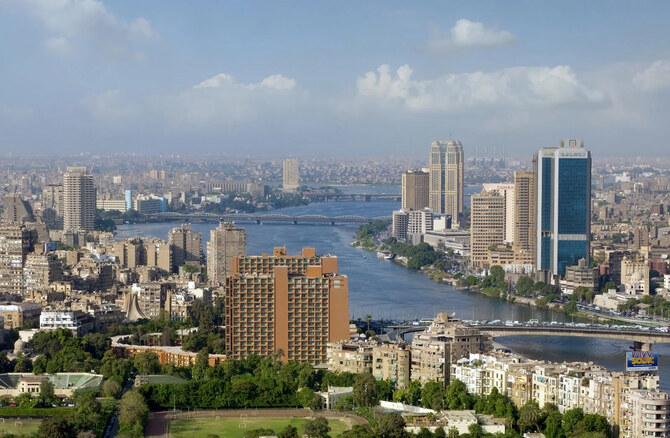
Egypt secures $1.2bn IMF disbursement amid reforms

Egypt continues to face significant fiscal challenges, including high debt levels and substantial financing needs. File
Short Url
Updated 12 March 2025
Follow

Egypt secures $1.2bn IMF disbursement amid reforms

  • Cairo tackles fiscal hurdles with strategic reforms, international support

RIYADH: Egypt has secured a $1.2 billion disbursement from the International Monetary Fund following the completion of the fourth review of its economic reform program.

This disbursement, approved by the IMF’s Executive Board under the Extended Fund Facility, brings Egypt’s total funding under the program to approximately $3.2 billion.

In addition, the IMF has approved a $1.3 billion arrangement under the Resilience and Sustainability Facility to support Egypt’s climate-related reforms.

The 46-month EFF arrangement, which was initially approved in December 2022, is designed to promote macroeconomic stability and drive structural reforms to support sustainable growth. The IMF has acknowledged Egypt’s progress in stabilizing its economy, despite external challenges such as regional conflicts and trade disruptions.

“Since March 2024, the authorities have made considerable progress in stabilizing the economy and rebuilding market confidence despite a challenging external environment,” said Nigel Clarke, deputy managing director and chair of the IMF executive board.  

Macroeconomic indicators show a mixed recovery for Egypt. Gross domestic product growth, which slowed to 2.4 percent in the fiscal year 2023-24 from 3.8 percent the previous year, rebounded to 3.5 percent in the first quarter of the fiscal year 2024-25.

Inflation, which had surged in recent years, has been gradually moderating since September 2023, alleviating some pressure on household incomes.

Meanwhile, the government achieved a primary fiscal surplus of 2.5 percent of GDP in 2023-24, marking a one-percentage-point improvement from the previous year. This was primarily driven by expenditure controls, which helped offset weaker domestic revenue performance.

Despite several improvements, Egypt continues to face significant fiscal challenges, including high debt levels and substantial financing needs. The country’s current account deficit widened to 5.4 percent of GDP in 2023-24, largely due to a $6 billion drop in Suez Canal receipts in 2024, caused by trade disruptions in the Red Sea.

However, remittances from Egyptian workers abroad and strong tourism revenues have provided crucial foreign exchange inflows.

To ensure fiscal sustainability, the IMF has recommended that Egypt expand its tax base, streamline tax incentives, and improve compliance. As IMF spokesperson Clarke noted, “Broadening the tax base, streamlining tax incentives, and enhancing compliance are essential to creating fiscal space for priority development and social needs.”

Additionally, the IMF stressed the importance of a comprehensive debt management strategy, which includes deepening the domestic debt market and enhancing fiscal transparency, particularly concerning off-budget entities.

In response to external challenges, the Egyptian government has adjusted its medium-term fiscal targets.


US trade policy uncertainty sees muted response from markets

Updated 7 sec ago
Follow

US trade policy uncertainty sees muted response from markets

RIYADH: President Donald Trump renewed his condemnation of the US Supreme Court on Monday after it ruled against his sweeping tariff program last week, vowing to ‌turn to ‌other ​powers ‌and ⁠licenses ​but giving no ⁠details.

The Supreme Court, in a 6-3 ruling on Friday, voided most of the tariffs Trump imposed in 2025, finding that the emergency law he relied on did not allow the imposition of the levies.

Trump said on Saturday he would raise ‌a temporary tariff from 10 percent to 15 percent on US ⁠imports ⁠from all countries, the maximum level allowed under the law, a day after the court ruled he had exceeded his presidential authority when he imposed an array of higher rates ​under an ​economic emergency law.

"The court has also approved all other Tariffs, of which there are many, and they can all be used in ⁠a much more ‌powerful and obnoxious ‌way, with legal ​certainty, than ‌the Tariffs as initially ‌used," he wrote in a social media post.

US stock index futures slipped on Monday as traders reacted to the latest twist in the US’s economic policy. 

At 12noon GMT, Dow E-minis were down ​162 points, or 0.33 percent, Nasdaq 100 E-minis ‌were down 129 points, or 0.51 percent, and S&P 500 E-minis were down 23.75 points, or 0.34 percent.

Most ‌megacap and growth stocks were lower in premarket trading, though Alphabet bucked the trend with a 0.3 percent gain after rising around 4 percent on Friday.

“It’s really hard from ​a ‌business ⁠standpoint when ​you ⁠are at a company to know how do you plan if you’re not even sure about suppliers, supply chains and what the tariffs are going to look like,” said Arthur Laffer Jr., president of Laffer Tengler Investments, according to Reuters.

“That’s a huge concern for corporate America and why it was really important to get that hammered out and ironed out as fast as possible, so that companies know what the playing field really looks like, and they can plan accordingly,” he added.

All three main stock ⁠indexes clocked weekly gains on Friday as markets took the Supreme ‌Court’s decision in stride, with the Nasdaq snapping a five-week ‌losing streak.

Other stock markets across the world greeted the latest wave of uncertainty with a muted response.

In the Gulf region, Saudi Arabia’s main market — which had been closed on Sunday due to a national holiday — ended the day up 0.34 percent.

Dubai’s main share index closed up 1.82 percent, led by a 3.64 percent gain in blue-chip developer Emaar Properties and a 2.92 percent leap in Emirates NBD Bank.

In Abu Dhabi, the index ended the session up 0.55 percent, with Americana Restaurants International leading the gainers with its share price surging 7.73 percent.

Qatar’s index closed up 1.08 percent, driven ​by banking shares, including ​a 0.43 percent uptick in Qatar National Bank, the region’s largest lender. 

Other global markets faced a mixed picture, with the UK's FTSE 100 subdued on Monday.

The blue-chip ‌index was up ‌0.1 percent at 12:00noon GMT, after closing ​at ‌record ⁠highs ​last week. For the UK, the ⁠tariff rate has increased from 10 percent ‌to 15 percent,

Unicredit analysts noted, ‌following Trump's latest announcement.

Vijay Valecha, chief investment officer at Century Financial said the possible US tariff increase from 10 percent to 15 percent “ has brought trade tensions back into focus, tempering the optimism seen after the recent Supreme Court tariff ruling.”

He added: “Markets are now reassessing the economic impact of higher import costs, possible retaliation from trade partners, and the broader implications for global growth.”