

How separatist militants hijacked a train in Pakistan

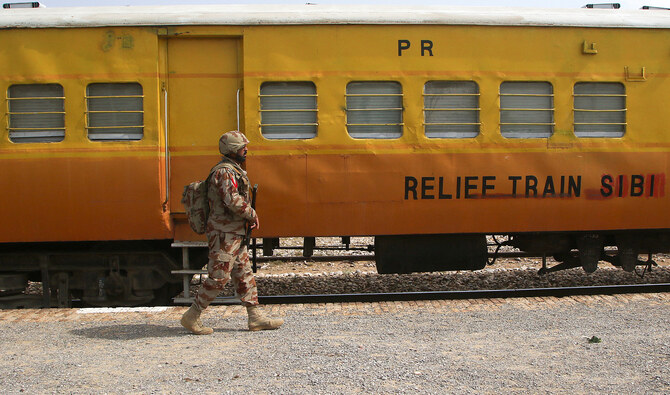
A Pakistan Army soldier walks next to a rescue train, after the attack on a train by separatist militants in Bolan, at the railway station in Mushkaf, Balochistan, Pakistan, on March 12, 2025. (REUTERS)
Short Url
Updated 12 March 2025
Follow

How separatist militants hijacked a train in Pakistan

  • Jaffar Express was heading to Peshawar city from Quetta with 425 people on board
  • Militants blew up railway tracks, fired at train and trapped locomotive inside tunnel

Pakistani security forces are carrying out a rescue operation to free dozens of passengers taken hostage by separatist militants who hijacked their train in the southwest of the country on Tuesday.

Here is a look at what happened, and the current situation.

THE TRAIN
The Jaffar Express was heading to the city of Peshawar in Khyber Pakhtunkhwa province from Quetta, the capital of Balochistan province, with 425 people on board when it was attacked.

The passengers included personnel from the Pakistani army and other security forces who were traveling on leave.

THE ATTACK
Militants blew up the railway tracks and opened fire on the train, killing the driver and trapping the locomotive inside a tunnel before taking control of it.

Some of those rescued said they crouched low when the firing started, while others spoke of passengers who had been injured or killed.

RESCUE OPERATION
Security forces have launched a massive operation to free the hostages, deploying special forces and helicopters, and 155 passengers have been rescued so far.

Some 27 militants have also been killed, sources say.

However, attackers wearing suicide bombs, who have been seated next to some of the hostages, have made the rescue efforts tougher.

THE DEMANDS
Ethnic armed group Baloch Liberation Army (BLA), which has claimed responsibility for the attack, has demanded the release of Baloch political prisoners, activists, and missing persons who it says were abducted by the military, within 48 hours.

It has threatened to start executing the hostages if the government does not fulfil the demand.

GOVERNMENT RESPONSE
Pakistan’s prime minister, Shehbaz Sharif, has condemned the attack and said security officials are “repelling” the militants.

Interior Minister Mohsin Naqvi has called the attackers “enemies” of Pakistan and vowed to foil their conspiracy to destabilize the nation.

Pakistan bank enables Shariah-compliant digital payment facility for passengers at Islamabad airport

Updated 23 February 2026
Follow

Pakistan bank enables Shariah-compliant digital payment facility for passengers at Islamabad airport

  • Pakistan is a cash-dominated market where a significant portion of transactions in the informal sector are made without any taxes, officials say
  • The move comes amid Pakistan’s efforts to introduce a cashless model at airports under which only digital service providers can provide services

KARACHI: Aik, Pakistan’s first Islamic digital bank, has enabled fully digital payments at Islamabad International Airport to offer travelers and passengers secure, Shariah compliant digital transaction facility.

The development comes amid Pakistan’s efforts to introduce a cashless model at airports across the country, under which only digital service providers can provide services to customers.

Aik, a subsidiary of Bank Islami, said it has onboarded merchants across the Islamabad airport and integrated QR code deployments at key touchpoints to allow passengers and visitors to make secure, seamless, and Shariah-compliant digital transactions at all counters, retail outlets, and service points.

It said the implementation complies with the regulations and framework set by the State Bank of Pakistan (SBP) and is a working model for a large-scale adoption of cashless systems in public infrastructure.

“This deployment reflects our commitment to building practical digital infrastructure that improves everyday transactions,” Aik Chief Officer Ashfaque Ahmed said in a statement.

“By enabling a fully cashless environment at a major national gateway, we are supporting efficiency, transparency, and financial inclusion at scale. This is not only a project; it is a foundation for Pakistan’s cashless future.”

Pakistan is a cash-dominated market where a significant portion of transactions, particularly in the informal sector, are conducted in cash. Officials say many of these transactions are aimed at avoiding taxes.

In recent years, the SBP has taken steps to ensure a transition toward a more cashless economy so that transactions are more traceable, reducing chances of tax evasion and corruption.

By digitizing Islamabad airport, aik said it continues to invest in secure and accessible financial solutions that “expand digital participation and support national economic modernization.”