



NEW YORK: A Palestinian activist who helped lead student protests at Columbia University faces deportation after being arrested over the weekend by federal immigration officials.
Trump has warned that the apprehension of Mahmoud Khalil, a legal permanent resident, represents the “first arrest of many” as his administration cracks down on campus opposition to the war in Gaza. But a federal judge temporarily blocked the 30-year old’s expulsion from the country.
Here’s what you need to know:
What happened?
Khalil was detained Saturday night as he and his wife were returning to their Columbia University-owned apartment in upper Manhattan by officials from the US Department of Homeland Security.
The agents told the couple that Khalil was being detained because his student visa had been revoked.
When his wife provided documents proving he was a green card holder, the agents said that was also being revoked and took him away in handcuffs, according to a lawsuit Khalil’s attorneys filed challenging his detention.
Why is he facing deportation?
The Department of Homeland Security, confirming his arrest Saturday, accused Khalil of leading “activities aligned to Hamas, a designated terrorist organization.”
The White House, elaborating more on its position Tuesday, claimed Khalil organized protests where pro-Hamas propaganda was distributed.
“This administration is not going to tolerate individuals having the privilege of studying in our country and then siding with pro-terrorist organizations that have killed Americans,” said Karoline Leavitt, Trump’s press secretary.
Khalil’s lawyers didn’t immediately respond to the White House’s latest claims.
Who is Mahmoud Khalil?
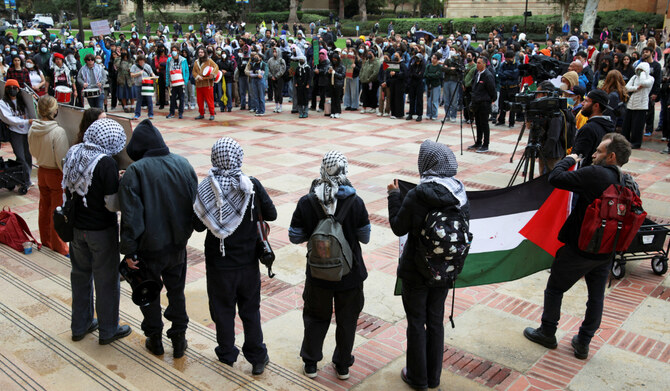
Khalil was one of the most visible activists in the protests last spring at Columbia, which also happened on other college campuses around the world.
He served as a student negotiator — a role that had him speaking frequently with university officials and the press.
More recently, he was among the pro-Palestinian activists investigated by a new disciplinary body at Columbia University focused on harassment and discrimination complaints.
Khalil completed his master’s degree in public administration at Columbia’s School of International and Public Affairs in December.
What’s his legal status?
Khalil was born and raised in Syria after his Palestinian grandparents were removed from their homeland, according to his lawsuit.
He came to the US on a student visa in 2022 to pursue his graduate studies at Columbia.
Khalil and his wife, who is a US citizen, then married in 2023. He became a legal permanent resident — also known as a green card holder — last year.
Can the government deport green card holders?
Short answer: yes. Green card holders can be deported, but the government has the burden to prove the person is deportable.
Grounds for deportation can range from being convicted of a range of crimes, from murder, assault and burglary to tax evasion, domestic violence and illegal firearms possession, according to Stephen Yale-Loehr, an immigration law expert and retired Cornell Law School professor.
But a legal permanent resident can also be expelled for providing material support to a terrorist group, in which case the government doesn’t need a criminal conviction to bring deportation charges, he said.
“Material support for immigration purposes is much broader than the criminal definition of the term,” Yale-Loehr explained. “For example, people have been deported for simply providing a cup of water or bowl of rice to guerrilla groups, even under duress.”
Where is Khalil?
Khalil is being held at a federal immigration detention facility in a central Louisiana town roughly 170 miles (274 kilometers) northwest of New Orleans.
The Central Louisiana ICE Processing Center in Jena, which is a low-slung complex ringed by barbed wire fences, can hold about 1,160 detainees.
Louisiana became a hub for immigrant detention during the first Trump administration and has nine centers, most of them run by private contractors.
Critics say the isolated complexes cut prisoners off from easy access to attorneys and family.
“The intent is to kind of break the morale, the spirits, of those that are held at these facilities,” Yasmine Taeb, the legislative and political director for the Muslim activist group MPower Change, told reporters Tuesday.
What’s next?
Khalil is expected to make an initial appearance before an immigration court but is unclear when — it could happen anywhere from 10 days to a month, experts told the AP .
Meanwhile, a federal judge in Manhattan ordered the government to not deport Khalil until the court has a chance to review the case. A hearing was tentatively scheduled for Wednesday.
Khalil’s lawyers contend that he has a right to due process as a legal permanent resident and that the government is “engaging in blatant efforts to target and chill” Khalil’s free speech and to “discriminate against particular viewpoints,” in violation of the First Amendment.
They’ve also petitioned the court to have him returned to New York, as his wife is eight months pregnant.
“For everyone reading this, I urge you to see Mahmoud through my eyes as a loving husband and the future father to our baby,” his wife, who has not been named, wrote in a statement provided by his lawyers. “I need your help to bring Mahmoud home, so he is here beside me, holding my hand in the delivery room as we welcome our first child into this world.”


