Russian gains in Kursk threaten vital leverage for Kyiv

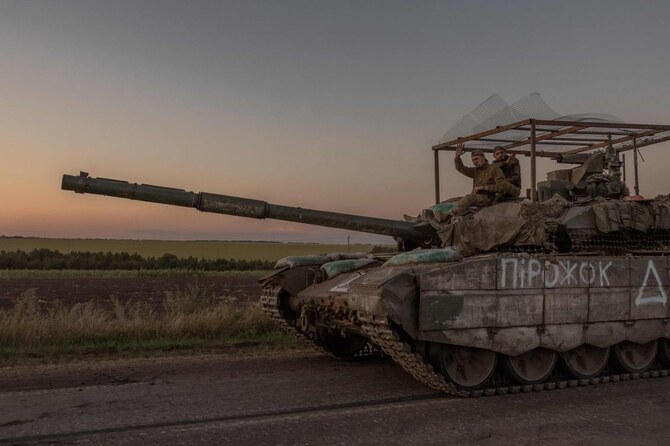
Ukrainian servicemen operate a tank on a road near the border with Russia, in the Sumy region of Ukraine, on Aug. 14, 2024. (AFP)
Short Url
Updated 12 March 2025
Follow

Russian gains in Kursk threaten vital leverage for Kyiv

  • In the past five days, Moscow has broken through Kyiv’s defensive lines, reclaiming dozens of square kilometers of territory
  • The result is that Kyiv may have lost one of its only bargaining chips on swapping land with Russia

KYIV: The images shared by Kremlin-controlled media were shocking: Russian troops hunched, dirt on their faces, as they crept through an empty gas pipeline under Ukrainian defense lines.
Since Kyiv launched its audacious cross-border assault into the Kursk region last August, Moscow has been pushing back hard, using unconventional tactics and deploying thousands of North Korean troops to turf out the Ukrainian army.
They have since stepped up their advances.
In the past five days, Moscow has broken through Kyiv’s defensive lines, reclaiming dozens of square kilometers of territory, according to military bloggers.
Russian military bloggers reported Tuesday that Moscow’s troops had entered the town of Sudzha, the largest settlement in the region under Kyiv’s control.
“The enemy is retreating in panic and disorder without have received any orders. That’s it. It’s a collapse,” a Russian serviceman, who identified himself as Zombie, told Kremlin-run television.
The result is that Kyiv may have lost one of its only bargaining chips on swapping land with Russia, which has seized and occupied around a fifth of Ukraine since it took Crimea in 2014 and launched its full-scale invasion in February 2022.
For Ukraine, which has painted a more controlled picture of the fighting, the stakes of its difficult operation in Kursk could hardly be higher.
The assault last summer injected a much-needed morale boost into the Ukrainian war effort, and represented the first and only incursion by a foreign army into Russian territory since World War II.
President Volodymyr Zelensky said the operation was key to future negotiations on ending the war, and that holding Russian territory would give Kyiv vital leverage.
But that leverage — just as Washington starts rounds of talks with Moscow and Kyiv — is dwindling as Russian forces press forward.
Franz-Stefan Gady, a military analyst, said Russia had built up its force in Kursk over recent weeks and escalated strikes on Ukraine’s “tenuous” supply route.
“The result is that now that the Russians are pushing a lot. Parts of the front line are actually giving way,” he told AFP.
The British defense ministry estimates Ukraine controls around 300 square kilometers (115 square miles) of Kursk — a five-fold territorial loss since Kyiv launched its gambit.
On Monday, Ukrainian commander-in-chief Oleksandr Syrsky conceded the situation was worsening.
He dismissed reports Ukrainian troops were in danger of being encircled but acknowledged they had been forced to fall back and that he was sending forward reinforcements.
One Ukrainian soldier who had been deployed in Kursk told AFP on Monday his unit had “fortunately” withdrawn five days earlier, and described fighting there as “very” hard.
Another, who had overseen operations from inside Ukraine and also asked not to be identified to speak freely about the dynamics of the fighting, said Russia’s use of drones to disrupt logistics was a key problem.
“It was the end, so to speak. And we started to get out of there because if we didn’t, we would have been surrounded,” he said, recounting the decision of some troops to leave Kursk due to resupply problems and Russian advances.
From the outset, analysts were skeptical of the purpose of diverting thousands of Ukrainian troops and key military assets from front lines inside Ukraine that were under immense Russian pressure.
With Moscow now clawing back land, this question remains.
Russia last week even claimed to have captured a village inside Ukraine, Novenke, which lies just several kilometers from the vital Ukrainian resupply route into Kursk.
The Institute for the Study of War has warned Moscow is “consolidating” its gains and likely preparing to attack the largest town still under Ukrainian control, Sudzha.
The situation is complicated off the battlefield, too.
Since President Donald Trump returned to office in January, he has sought to bring a speedy end to the fighting, halting US military aid and intelligence-sharing with Kyiv.
A Ukrainian official told AFP it was possible the US moves were having an effect on fighting as Washington had stopped sharing information that “allowed strikes specifically on Russia.”
But Gady cautioned against drawing any direct link between the halt in US backing and fighting in Kursk.
“I, first and foremost, see it as a difficult situation that was already difficult prior to the cessation of US military support,” Gady said.
“You run your supplies essentially down one major route that is under enemy fire, right, and that’s a challenge — and that will be a challenge with US military support as well,” he said.


After accepting US deportees, South Sudan wanted sanctions relief for top official, documents show

Updated 1 sec ago
Follow

After accepting US deportees, South Sudan wanted sanctions relief for top official, documents show

JUBA: After agreeing to accept deportees from the United States last year, South Sudan sent a list of requests to Washington that included American support for the prosecution of an opposition leader and sanctions relief for a senior official accused of diverting over a billion dollars in public funds.
The requests, contained in a pair of diplomatic communications made public by the State Department this month, offer a glimpse into the kind of benefits that some governments may have sought as they negotiated with the US over the matter of receiving deportees.
In the documents, the US expresses “appreciation” to South Sudan for accepting the deportees and details the names, nationalities and crimes for which each individual was convicted.
In July, South Sudan became the first African country to receive third-country deportees from the US Rwanda, Eswatini, Ghana and Equatorial Guinea have since received deportees.
The eight deportees to South Sudan included nationals of Mexico, Cuba, Vietnam, Laos, Myanmar and South Sudan itself.
Contentious deportations
They arrived in the South Sudanese capital of Juba after spending weeks on a US military base in Djibouti, where they were held after a US court temporarily blocked their deportation. Six of the eight men remain at a residential facility in Juba under the supervision of security personnel.
South Sudanese national Dian Peter Domach was later freed, according to the Ministry of Foreign Affairs, while Jesus Munoz-Gutierrez, a Mexican, was repatriated in September.
South Sudanese officials have not publicly said what long-term plan is in place for those still in custody. The third-country deportations were highly contentious, criticized by rights groups and others who expressed concern South Sudan would become a dumping ground.
Details of the deal between the US and South Sudan remain murky. It is still unclear what, if anything, South Sudan may have actually received or been promised. The documents only offer a glimpse into what the South Sudanese government hoped to get in return.
In other cases, Human Rights Watch said it saw documents showing the US agreed to pay Rwanda’s government around $7.5 million to take up to 250 deportees. The US will give Eswatini $5.1 million to take up to 160 deportees, according to the group.
For South Sudan, in one communication dated May 12 and marked confidential, South Sudan’s Ministry of Foreign Affairs raised eight “matters of concern which the Government of South Sudan believes merit consideration.” These ranged from the easing of visa restrictions for South Sudanese nationals to the construction of a rehabilitation center and “support in addressing the problem of armed civilians.”
Request to lift sanctions
But an eye-catching ask was for the lifting of US sanctions against former Vice President Benjamin Bol Mel as well as Washington’s support for the prosecution of opposition leader Riek Machar, the now-suspended first vice president of South Sudan who faces treason, murder and other criminal charges in a controversial case.
The allegations against Machar stem from a violent incident in March, when an armed militia with historical ties to him attacked a garrison of government troops. Machar’s supporters and some activists describe the charges as politically motivated.
Bol Mel is accused of diverting more than a billion dollars earmarked for infrastructure projects into companies he owns or controls, according to a UN report. He wielded vast influence in the government and was touted by some as Kiir’s likely successor in the presidency until he was dismissed and placed under house arrest in November.
Bol Mel was also viewed as a key figure behind the prosecution of Machar, one of the historical leaders of South Sudan’s ultimately successful quest for independence from Sudan in 2011.
Machar was Kiir’s deputy when they fell out in 2013, provoking the start of civil war as government troops loyal to Kiir fought forces loyal to Machar.
A 2018 peace agreement brought Machar back into government as the most senior of five vice presidents. His prosecution has been widely criticized as a violation of that agreement, and has coincided with a spike in violence that the UN says killed more than 1,800 people between January and September 2025.
The UN has also warned that a resurgence of fighting has brought the country “back to the edge of a relapse into civil war.” Machar is under house arrest in Juba while his criminal trial proceeds slowly.
In its communications with the US, South Sudan also asked for sanctions to be lifted over South Sudanese oil companies “to encourage direct foreign investments,” and for the US to consider investing in other sectors including fossil fuels, minerals and agriculture.
When asked if the US government had provided or promised South Sudan anything in return for accepting the deportees, a State Department official said, “In keeping with standard diplomatic practice, we do not disclose the details of private discussions.”
A spokesman for South Sudan’s Ministry of Foreign Affairs, Thomas Kenneth Elisapana, declined to comment.
US aid cuts
Despite accepting the US request to admit deportees, relations between the two governments have been strained in recent months.
In December, the US threatened to reduce aid contributions to the country, accusing the government of imposing fees on aid groups and obstructing their operations.
The US has historically been one of the largest donors to South Sudan, providing roughly $9.5 billion in aid since 2011. Over the years, South Sudan’s government has struggled to deliver many of the basic services of a state, and years of conflict have left the country heavily reliant on foreign aid.