

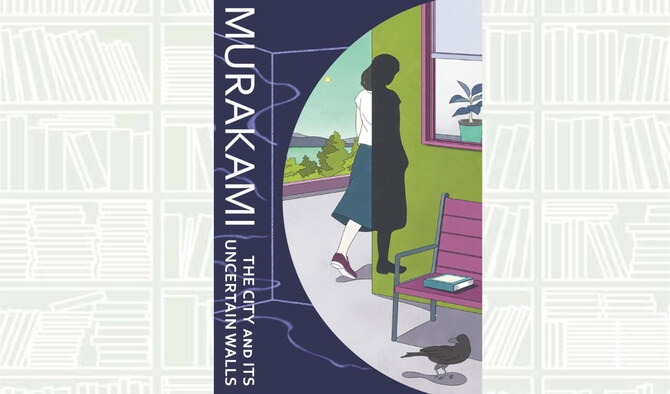
What We Are Reading Today: ‘The City and Its Uncertain Walls’

Photo/Supplied
Short Url
Updated 11 March 2025
Follow

What We Are Reading Today: ‘The City and Its Uncertain Walls’

  • The novel invites readers to engage with complex themes, making it impossible to summarize in a straightforward way

Author: Haruki Murakami

Haruki Murakami’s novel “The City and Its Uncertain Walls,” with an English translation by Philip Gabriel, is a mesmerizing journey into the complexities of human emotions, memory and the elusive nature of reality.

As I delved into its pages, I found myself drawn into a world that felt both familiar and strangely distant, echoing the sentiments of my own life experiences.

The 2024 novel revolves around a nameless protagonist who navigates the labyrinthine streets of a city that is both vibrant and haunting. Murakami’s signature blend of magical realism and profound introspection creates a narrative that challenges the reader to ponder the walls we build around ourselves — both physically and emotionally.

The city serves as a character in its own right, with its “uncertain walls” symbolizing the barriers we erect to protect ourselves from pain and vulnerability.

Interestingly, the story has its roots in a short story published by Murakami in 1980, also titled “The City and Its Uncertain Walls.” The writer has expressed that he felt he could never let go of that initial narrative, which drove him to expand it into this larger, more fulfilling work.

One of the most striking aspects of the book is Murakami’s ability to evoke a sense of loneliness amid the bustling cityscape. As I read, I was reminded of my own moments of isolation, even in crowded spaces.

The protagonist’s encounters with various individuals — each grappling with their own fears and desires — resonated deeply with me. It made me reflect on the connections we seek and the disconnections we often experience in modern life.

The novel invites readers to engage with complex themes, making it impossible to summarize in a straightforward way. It led me to compare it to “1Q84,” one of my favorite Murakami novels, which also delves into parallel universes and unconventional love stories. However, “The City and Its Uncertain Walls” leans more toward philosophical exploration, prompting contemplation about reality and self.

The narrative unfolds in three parts, beginning with a young love story reminiscent of classic fantasy, where a boy searches for a girl who has mysteriously vanished. The first part conjures images of a medieval world, complete with castles and guards, which initially felt disconnected from my expectations of Murakami’s style.

The second part washes over the reader like a wave of melancholic familiarity, anchoring us back to the essence of Murakami’s storytelling.

In conclusion, “The City and Its Uncertain Walls” is more than just a novel; it is an exploration of the human condition. Murakami’s ability to capture the essence of solitude and connection left a lasting impression on me.

The book is a testament to the power of storytelling, inviting readers to reflect on their own lives while navigating the uncertain walls we all confront. I emerged from its pages with a renewed appreciation for the beauty and complexity of existence.


Book Review: ‘Gut: the inside story of our body’s most underrated organ’

Updated 30 January 2026
Follow

Book Review: ‘Gut: the inside story of our body’s most underrated organ’

The New York Times bestseller “Gut: the inside story of our body’s most underrated organ” by Dr. Giulia Enders is an eye-opener.

Originally published in German in 2014 as “Darm mit Charme,” the English version, “Gut,” translated by David Shaw, has gone through several revisions, the most recent of which was published in January 2026.

Layering her medical knowledge with lived human experience, Enders shapes the material at hand into a tangible map of digestion, metabolism and immunity while weaving in real life stories to tie it all in.

She begins with her own personal story, before providing additional context as an expert who specializes in internal medicine and gastroenterology, with a focus on gut health, microbiology and the gut-brain connection.

While some parts might seem like an oversimplification, I like her storytelling style — she makes the dense science accessible for the masses.

Viewers of Netflix might have seen her animated antidotes more recently as one of the main experts in the 2024 documentary, “Hack your Health: The Secrets of Your Gut.”

Similarly, in this book, she expressively explores the microbiome’s connection to the brain and delves into psychobiotics — the microbes that influence mood, stress and even depression.

Enders showcases how and why the gut is powerful; it is not just background machinery within the human body, or even an organ often oddly used as a punchline in a joke.

She highlights how digestion, immunity, metabolism, and mental health are all intertwined and that the gut might arguably be the most vital and predictable organ we could use as a metric to predict overall imminent and immune health.

Some of the things she mentions at the beginning of the book hit me in the gut, as they say. She touches on some key things that are intricately linked and might unlock some of the digestive issues one might develop throughout one’s life. I feel seen.

Nodding along with nearly each page flip, I found my stomach flipping with excitement too, finally finding the parallels between her early experiences and connecting it to my own eventual gut issues.

By the last page, “Gut” will leave you aware that everything does happen for a reason.

You feel those butterflies in your stomach? It is not merely poetic — it signals much more than a seemingly fleeting feeling. It is central to how your whole body works. The “gut feeling” is not just a feeling but also a fact.

“Seen under the microscope, bacteria look like nothing but little, bright spots. But taken together, their sum is much greater than their parts,” she writes.

“Most sit in our mucus membrane, training our immune system, soothing our villi, and producing vitamins. If the good and the bad are in equilibrium, the bad ones can make us stronger and the good ones can keep us healthy.”

When the science parts get slightly too heavy, the whimsy illustrations scattered throughout the book will make you feel grounded. Illustrated by her older sister, Jill Enders, the playful drawings make the complex concepts even easier to digest.