

Philippine ex-president Duterte arrested after ICC warrant

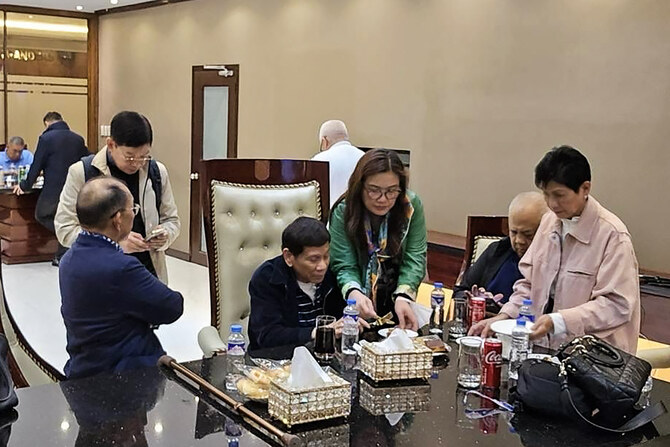
This handout photo taken and released by the Partido Demokratiko Pilipino–Lakas ng Bayan (PDP Laban) on March 11, 2025, shows former Philippines’ president Rodrigo Duterte, center, inside the Villamor Air Base in Pasay, Metro Manila, after arriving from Hong Kong. (AFP)
Short Url
Updated 11 March 2025
Follow

Philippine ex-president Duterte arrested after ICC warrant

  • Court estimates death toll from Duterte’s anti-drug campaign could be 30,000
  • Any state can comply with ICC arrest warrant, human rights lawyer says

MANILA: Former President Rodrigo Duterte was taken into custody on Tuesday after the Philippine government said it received an International Criminal Court warrant over his involvement in suspected crimes against humanity related to the country’s bloody “war on drugs.”

The ICC had been investigating Duterte over his administration’s deadly anti-drugs campaign, in which according to official data over 6,000 Filipinos were killed during the ex-president’s six-year term since 2016. ICC prosecutors estimate, however, that the number of extrajudicial killings committed by security forces could be as many as 30,000.

He was arrested at Manila’s main airport after returning from a trip to Hong Kong, the office of President Ferdinand Marcos Jr. said in a statement.

“Earlier this morning, Interpol Manila received the official copy of the arrest warrant from the International Criminal Court,” the Presidential Communications Office said.

“Upon his arrival, the prosecutor general presented the ICC notification for an arrest warrant against the former president for crimes against humanity … As of now, he is in the custody of the authorities.”

Duterte won the Philippine presidency in 2016 on a promise to eradicate illegal drugs, after serving for more than two decades as mayor of Davao, the second-largest city in the Philippines, where he allegedly ran a deadly anti-drug crackdown with impunity.

The ensuing nationwide campaign drew international condemnation.

The 79-year-old has repeatedly defended the crackdown and denied the extrajudicial killing of alleged drug suspects, although he has also openly admitted to instructing police to kill in self-defense.

Duterte officially withdrew the Philippines from the ICC in 2019 as it began to look into allegations of systematic killings under his leadership.

But under the court’s withdrawal mechanism, it keeps jurisdiction over alleged crimes committed while a country was a member. While the Philippine government had refused to cooperate, the Marcos administration signaled in November that it would comply if an arrest warrant was issued.

The Philippines also remains a member of Interpol, which can seek Duterte’s arrest on behalf of the ICC.

“Under the rules of the ICC, any state, whether a state party or non-state party, can accede to the request of the ICC,” human rights lawyer Neri Colmenares told Arab News.

For the families of victims of Duterte’s deadly anti-drug campaign, his arrest has sparked new hopes for justice.

“The families of the victims see a light in, at least a glimmer of light, at the end of the tunnel for their search for justice for their loved ones who were mercilessly killed during the time of President Duterte,” Colmenares, who also serves as one of the legal counsels for the families, said.

“We will demand from President Marcos … that he should pursue the ends of justice, because that is his obligation under the Philippine laws, to execute the law and, of course, afford justice to the Filipino people.”

Rights group Karapatan is also calling on Marcos to make sure that Duterte “is actually delivered to the ICC for detention and trial.”

If transferred to the Hague, Duterte may become Asia’s first former head of state to go on trial at the ICC.

“(Marcos) should also cooperate in ensuring that Duterte is convicted by making available to the International Criminal Court additional pieces of evidence in the hands of the government,” Maria Sol Taule, Karapatan deputy secretary-general, said in a statement.

“With Duterte’s arrest, the Filipino people are hopefully a step closer to attaining justice and accountability for Duterte’s many crimes.”


Nobel laureate Machado says US helped her leave Venezuela, vows return

Updated 6 sec ago
Follow

Nobel laureate Machado says US helped her leave Venezuela, vows return

  • Machado emerged on a hotel balcony in Oslo to cheering supporters early Thursday
  • “We did get support from the United States government to get here,” Machado said

OSLO: Nobel Peace laureate Maria Corina Machado said on Thursday that the United States helped her get to Norway from hiding in Venezuela, expressing support for US military action against her country and vowing to return home.
Machado, who vanished in January after challenging the rule of President Nicolas Maduro, emerged on a hotel balcony in Oslo to cheering supporters early Thursday after several days of confusion over her whereabouts.
“We did get support from the United States government to get here,” Machado told a press conference when asked by AFP about whether Washington had helped.
The Wall Street Journal reported that she wore a wig and a disguise on the high-risk journey, leaving her hide-out in a Caracas suburb on Monday for a coastal fishing village, where she took a fishing skiff across the Caribbean Sea to Curacao.
The newspaper said the US military was informed to avoid the boat being targeted by airstrikes. Once on the island, she took a private jet to Oslo early on Wednesday.
Machado thanked those who “risked their lives” to get her to Norway but it was not immediately clear how or when she will return to Venezuela, which has said it would consider her a fugitive if she left.
“Of course, the risk of going back, perhaps it’s higher, but it’s always worthwhile. And I’ll be back in Venezuela, I have no doubt,” she added.
Machado has been hailed for her fight for democracy but also criticized for aligning herself with US President Donald Trump, to whom she has dedicated her Nobel, and for inviting foreign intervention in her country.

- Military build-up -

The United States has launched a military build-up in the Caribbean in recent weeks and deadly strikes on what Washington says are drug-smuggling boats.
“I believe every country has the right to defend themselves,” Machado told reporters Thursday.
“I believe that President Trump’s actions have been decisive to reach the point where we are right now, in which the regime is weaker than ever, because the regime previously thought that they could do anything,” she continued.
Late Wednesday, Trump said the United States had seized a “very large” oil tanker near Venezuela, which Caracas denounced as “blatant theft.”
Maduro maintains that US operations are aimed at toppling his government and seizing Venezuela’s oil reserves.
Machado first appeared on a balcony of the Grand Hotel in the middle of the night, waving and blowing kisses to supporters chanting “libertad” (“freedom“) below.
On the ground, she climbed over metal barriers to get closer to her supporters, many of whom hugged her and presented her with rosaries.
She said she has missed much of her children’s lives while hiding, including graduations and weddings.

- ‘ Political risk’ -

Machado won the Peace Prize for “her struggle to achieve a just and peaceful transition from dictatorship to democracy.”
She has accused Maduro of stealing Venezuela’s July 2024 election, from which she was banned — a claim backed by much of the international community.
She last appeared in public on January 9 in Caracas, where she protested Maduro’s inauguration for his third term.
The decision to leave Venezuela and join the Nobel festivities in Oslo comes at both personal and political risk.
“She risks being arrested if she returns even if the authorities have shown more restraint with her than with many others, because arresting her would have a very strong symbolic value,” said Benedicte Bull, a professor specializing in Latin America at the University of Oslo.
While Machado is the ” undisputed” leader of the opposition, “if she were to stay away in exile for a long time, I think that would change and she would gradually lose political influence,” Bull said.
In her acceptance speech read by one of her daughters Wednesday, Machado denounced kidnappings and torture under Maduro’s tenure, calling them “crimes against humanity” and “state terrorism, deployed to bury the will of the people.”