Indonesia’s central bank uses Ramadan sermons to preach on inflation

1 / 2
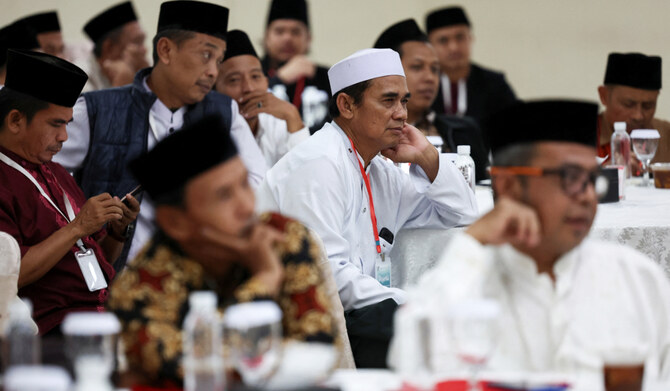
Muslim clerics attend a sermon, led by Indonesia's central bank official, on the importance of managing inflation, at Islamic Center in Majalengka, West Java province, Indonesia March 6, 2025. (REUTERS)
2 / 2
Muslim clerics attend a sermon, led by Indonesia's central bank official, on the importance of managing inflation, at Islamic Center in Majalengka, West Java province, Indonesia March 6, 2025. (REUTERS)
Short Url
Updated 11 March 2025
Follow

Indonesia’s central bank uses Ramadan sermons to preach on inflation

  • Ramadan ends with the Eid Al-Fitr festival, which, like in other Muslim countries, typically marks peak demand in Indonesia, where Muslims make up the majority of the population of 280 million

MAJALENGKA, Indonesia: Waiting to break their fast during the Muslim holy month of Ramadan, clerics in the Indonesian town of Majalengka gathered for an unusual briefing on the subject of inflation, led by the country’s central bank.
The address by a central bank official and two Muslim clerics in the town’s Islamic center was part of Bank Indonesia’s strategy to enlist preachers to warn against overconsumption during Ramadan, which can trigger price pressures in a country with a history of runaway inflation.
Though inflation has been brought under control in the past decade as authorities beef up efforts to strengthen food distribution along the supply chain, the central bank is keen to spread its message about the need to keep prices stable.


Muslim clerics attend a sermon, led by Indonesia's central bank official, on the importance of managing inflation, at Islamic Center in Majalengka, West Java province, Indonesia March 6, 2025. (REUTERS)

“We hope you as the ulemas (scholars of Islam) can be mediators to convey the message that inflation management is our common task,” said Agung Budilaksono, the senior central bank official for Majalengka.
“Inflation must be managed, because it’s like blood pressure ... If it’s too high, it will ruin your health in the long run and if it’s too low, you will get weak,” he told the clerics.
Ramadan ends with the Eid Al-Fitr festival, which, like in other Muslim countries, typically marks peak demand in Indonesia, where Muslims make up the majority of the population of 280 million.
Islamic clerics are influential among the public in Indonesia’s remote areas and towns like Majalengka in West Java, about three hours from the capital Jakarta.
“People tend to want more during Ramadan, so maybe we need to remind them again that the point of fasting is to control our lust,” said Mohamad Padil, 53, one of the clerics listening at the forum.
Inflation once ran hot in Southeast Asia’s largest economy, but in 2024 was 1.57 percent, near the lower end of the central bank’s target range, while West Java’s rate was 1.64 percent.
The rate dropped further in the first two months of 2025 due to a large increase in subsidies for electricity prices, and economists predict it will remain within the central bank’s 1.5 percent to 3.5 percent target range this year.
The central bank has run other unconventional initiatives including a podcast on spending management and programs to foster entrepreneurship as well as boost local food supply.
At the nearby Islamic boarding school of Santi Asromo, it helped build a greenhouse for students to plant Chinese cabbage and water spinach, constructing a fish farm for the school next door.


Archbishop of York says he was ‘intimidated’ by Israeli militias during West Bank visit

Archbishop of York Stephen Cottrell poses for a photograph with York Minster’s Advent Wreath.
Updated 5 sec ago
Follow

Archbishop of York says he was ‘intimidated’ by Israeli militias during West Bank visit

  • “We were … intimidated by Israeli militias who told us that we couldn’t visit Palestinian families in the occupied West Bank,” the archbishop said

LONDON: The Archbishop of York has revealed that he felt “intimidated” by Israeli militias during a visit to the Holy Land this year.

“We were stopped at various checkpoints and intimidated by Israeli militias who told us that we couldn’t visit Palestinian families in the occupied West Bank,” the Rev. Stephen Cottrell told his Christmas Day congregation at York Minster.

The archbishop added: “We have become — and really, I can think of no other way of putting it — we have become fearful of each other, and especially fearful of strangers, or just people who aren’t quite like us.

“We don’t seem to be able to see ourselves in them, and therefore we spurn our common humanity.”

He recounted how YMCA charity representatives in Bethlehem, who work with persecuted Palestinian communities in the West Bank, gave him an olive wood Nativity scene carving.

The carving depicted a “large gray wall” blocking the three kings from getting to the stable to see Mary, Joseph and Jesus, he said.

He said it was sobering for him to see the wall in real life during his visit.

He continued: “But this Christmas morning here in York, as well as thinking about the walls that divide and separate the Holy Land, I’m also thinking of all the walls and barriers we erect across the whole of the world and, perhaps most alarming, the ones we build around ourselves, the ones we construct in our hearts and minds, and of how our fearful shielding of ourselves from strangers — the strangers we encounter in the homeless on our streets, refugees seeking asylum, young people starved of opportunity and growing up without hope for the future — means that we are in danger of failing to welcome Christ when he comes.”