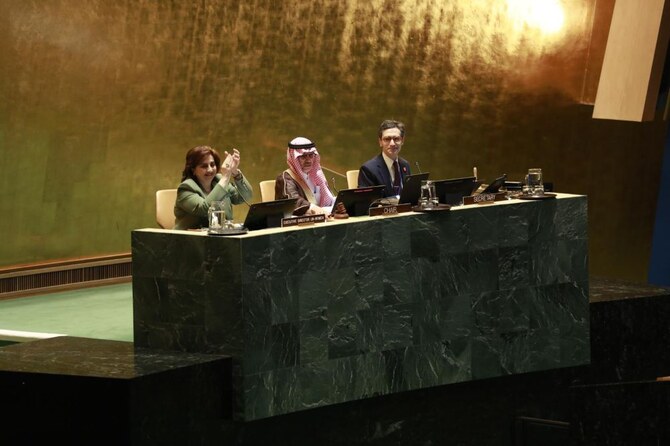
Saudi envoy chairs landmark global conference, says barriers denying women equal rights must fall

Ambassador & Permanent Representative of the Kingdom of Saudi Arabia to the United Nations Abdulaziz Alwasil, center, chairs the 69th Commission on the Status of Women. (X/@unwomenchief)
Short Url
Updated 11 March 2025
Follow

Saudi envoy chairs landmark global conference, says barriers denying women equal rights must fall

  • Call from Abdulaziz Alwasil, Kingdom’s permanent representative to the UN, comes in New York at opening of 69th Commission on the Status of Women
  • Jana Suleiman Al-Rifi, a Saudi woman who became the youngest member of the NEOM megacity project team at age 16, tells event of her trailblazing journey in science and engineering

NEW YORK CITY: Saudi Arabia’s permanent representative to the UN, Abdulaziz Alwasil, on Monday urged nations to use a pivotal conference in New York on the status of women not only as a chance to reflect on achievements to date, but to translate decades of commitments to gender equality into concrete, measurable action.

He warned that global challenges such as climate change, conflict and economic instability pose risks that could reverse the significant strides made in gender equality, and said true progress demands “unwavering political will,” inclusive leadership and continuous investment.

His comments came during the opening session in New York of the 69th Commission on the Status of Women, which underscored the urgent need to advance efforts to achieve gender parity worldwide.

The commission, established in 1946, is a key global platform for gender equality and the empowerment of women. It meets annually to review and appraise progress toward these aims and make recommendations for further action.

This year’s session marks the 30th anniversary of the historic 1995 Beijing Declaration and Platform for Action, a groundbreaking framework adopted by 181 countries during the 4th World Conference on Women. The declaration set ambitious goals for the advancement of women’s rights, including equal access to education, healthcare and economic participation, and the eradication of violence against women and girls.

Alwasil, who serves as chairperson of the commission’s 69th session, said it is important to reflect on the achievements that have been made since the Beijing Declaration, while also confronting the challenges that remain.

“The promise of Beijing remains as urgent as ever,” he added, acknowledging that although progress has been made — including more women in leadership positions, improved access to education, and the introduction of legal frameworks to advance gender equality — much still needs to be done.

He warned that global crises such as climate change, conflict and economic instability threaten to undo hard-won gains in gender equality, and that real progress requires political will, inclusive governance and sustained investments.

“We must create the conditions for women and girls to lead, shape policies and drive solutions," Alwasil said.

He highlighted the important need to convert commitments into concrete actions, and underscored the importance of a gender-equal approach in all policies and initiatives.

“Let us use this historic moment not only to reflect on our achievements and challenges, but also reignite our collective determination to turn commitments into concrete action,” he added.

“This means ensuring that gender equality is centered across all policies, which must be fully funded and implemented. It means dismantling the structural barriers that continue to exclude women and girls from leadership opportunity and equal rights.

“It means holding ourselves accountable, not only for the progress we celebrate, but for the gaps that persist.”

The Saudi envoy gave a portion of his speaking time to three remarkable women who shared their journeys. They included Jana Suleiman Al-Rifi, a young woman from Saudi Arabia, who captivated the audience with the story of her personal journey as a trailblazer in STEM (science, technology, engineering, and mathematics).

At just 16 years old, she became the youngest member of the NEOM project team, a futuristic project to develop and build a sustainable, smart megacity in Saudi Arabia. As an advocate for the empowerment of women, she told how the support of her family, the Kingdom’s Vision 2030 plan for national development and diversification, and international opportunities had enabled her to pursue a career in renewable energy and electrical engineering.

“I stand today as proof that determination, resilience and a supportive environment can empower young women to achieve incredible dreams,” Al-Rifi said.

She credited Vision 2030 in particular for providing young women like her with opportunities to break barriers in traditionally male-dominated fields such as science and technology. Through educational programs and leadership initiatives, it has played a key role in changing the narrative about the roles of women in Saudi society, she added.

Al-Rifi also highlighted the importance of continuing support for women and girls in all areas of life, noting: “Every step you take builds a bridge for the next generations.”

The commission will convene for two weeks, during which delegates and advocates from around the world will discuss a range of critical topics, including poverty, work opportunities, climate change, violence against women, and youth engagement.



Is sourdough Saudi Arabia’s latest craft food?

Updated 07 February 2026
Follow

Is sourdough Saudi Arabia’s latest craft food?

  • Saudi home bakers point to a practice that was once routine, not artisanal
  • Naturally fermented bread reflects a broader shift toward process-driven, premium food culture

ALKHOBAR: Sourdough has started to shift from a niche interest into a mainstream feature of home kitchens, cafes and specialty bakeries across the Kingdom.

The rise of sourdough is part of a wider shift in Saudi Arabia’s food landscape, where artisanal production and slower preparation methods are gaining traction.

Specialty coffee seems to have set the early template for this transition, normalizing premium pricing, craftsmanship and an interest in process.

The rise of sourdough is part of a wider shift in Saudi Arabia’s food landscape, where artisanal production and slower preparation methods are gaining traction. (Supplied/creativecommons)

Bread is now undergoing a similar shift, with fermentation replacing extraction and roasting as the central point of differentiation.

In both cases, the appeal is rooted in the product’s perceived authenticity, reduced additives, and a clearer link between raw ingredients and final consumption.

Home bakers in Riyadh, Jeddah and the Eastern Province have adapted natural yeast cultures to the Saudi environment, adjusting feeding schedules, hydration ratios, and fermentation times to accommodate higher temperatures and lower humidity in the summer months.

HIGHLIGHTS

• Home bakers in Riyadh, Jeddah and the Eastern Province have adapted natural yeast cultures to the Saudi environment.

• They adjust feeding schedules, hydration ratios, and fermentation times to accommodate higher temperatures and lower humidity in the summer months.

Cafes and specialty bakeries have responded by adding sourdough loaves, baguettes and focaccia to their menus, often positioned as premium alternatives to conventional commercial bread.

For younger home bakers, the appeal lies in the craft and the learning curve rather than nostalgia. “It feels more real and more intentional,” home baker Sarah Al-Almaei told Arab News. She began experimenting with natural yeast at home after watching starter tutorials online.

The technical aspect — hydration percentages, fermentation control and starter maintenance — has become content in its own right, with TikTok and Instagram compressing trial-and-error learning into short videos and recipe cards.

But the practice of maintaining a natural yeast culture is not new in Saudi Arabia. Long before sourdough became a global trend, Saudi households kept what was commonly referred to as the “mother dough,” a natural yeast starter fed and used daily.

“We used to maintain it every day and bake with it,” said Hessa Al-Otaibi, 56, a Saudi home baker with more than four decades’ experience. “People today call it sourdough. For us, it was simply bread.”

Her comment highlights a cultural continuity that has remained largely unrecognized, partly because the practice was not framed as artisanal or health-oriented, but as a routine household function.

The modern sourdough trend differs in its market positioning. While the older model was practical and domestic, the current model is commercial, aesthetic and often health-coded. Bakeries justify higher pricing through longer fermentation times, higher ingredient costs and smaller batch production.

Consumers justify their purchases through digestibility, perceived health benefits, flavor and product integrity.

“Once you get used to it, it’s hard to go back,” said Amina Al-Zahrani, a regular buyer of sourdough from specialty bakeries in Alkhobar.

Digestibility and texture are often cited as reasons for substitution, especially among buyers who report discomfort from standard commercial bread.

Another consumer, Majda Al-Ansari, says sourdough has become part of her weekly routine, noting that availability and quality have improved significantly in the past year.

The social media component has played an outsized role in accelerating adoption. Home bakers document starter feeding cycles, cold proofing and first bakes, turning a once-private domestic process into visible public content.

This has also created micro-markets of home-based sellers, where individual bakers offer loaves to local buyers, often fulfilling orders through direct messaging.

What remains to be seen is how far the trend will scale. If specialty bakeries continue to expand and consumers maintain willingness to pay premium prices, sourdough could establish a long-term place in Saudi food culture.

If not, it may revert to a smaller niche of committed home bakers and specialty cafes. For now, however, sourdough occupies an unusual position: both a newly fashionable trend and a quiet continuation of an older Saudi baking practice.