

Global rights watchdog classifies Pakistan as ‘repressed’ in civic freedom report

Members of the Pakistan Federal Union of Journalists protesting against amendments in the Prevention of Electronic Crimes Act (PECA) in Islamabad on January 28, 2025. (AFP/File)
Short Url
Updated 10 March 2025
Follow

Global rights watchdog classifies Pakistan as ‘repressed’ in civic freedom report

  • Online platform CIVICUS blames Pakistan for stifling protests, criminalizing activists and restricting digital spaces
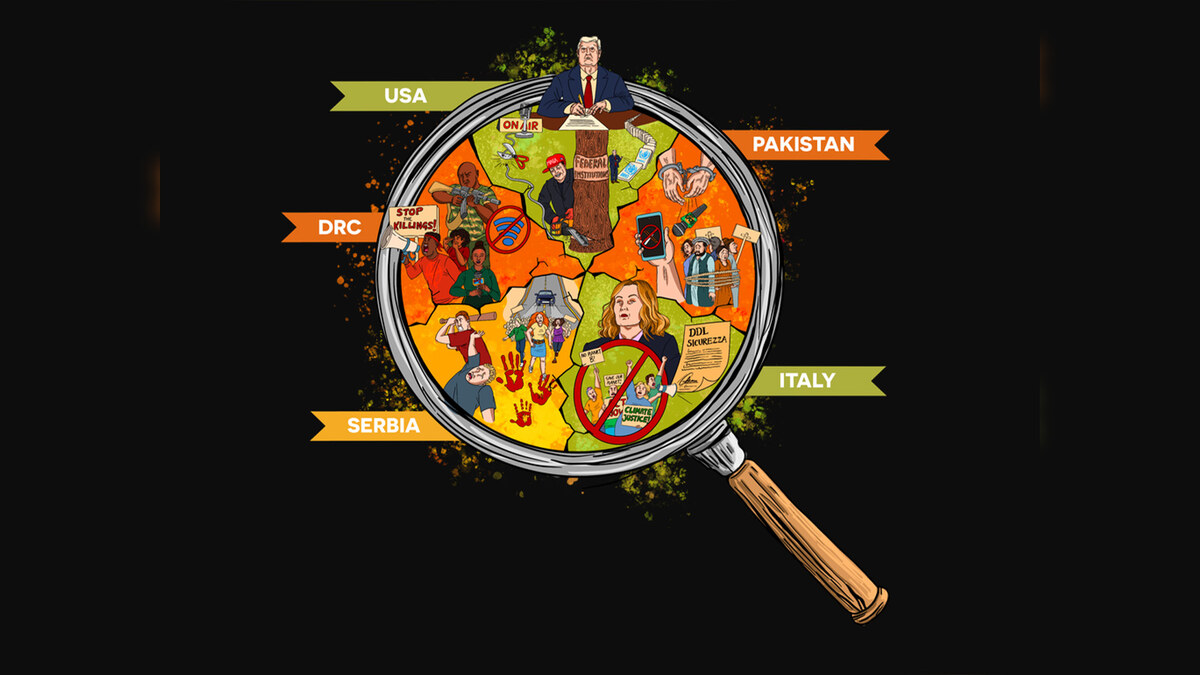
  • Includes Pakistan with Congo, Serbia, Italy and US among countries “experiencing rapid declines in civic freedoms“

ISLAMABAD: International rights watchdog CIVICUS classified Pakistan as “repressed” in its latest report on civic freedom on Monday, accusing authorities of placing restrictions on social media platforms, stifling protests from opposition parties and criminalizing activists. 

Pakistan’s rights groups and opposition parties have highlighted what they say is growing suppression of their fundamental rights over the past few years. They point to legislations in recent months that recommend hefty fines and jail terms for those spreading “fake news” online, a ban on social media platform X that has been in place since February last year, arrests of opposition leaders and their supporters, and alleged harassment of journalists. 

Pakistan’s government denies the allegations, saying that its legislations ensure data privacy on social media platforms, and it only takes action against violent protesters who take the law into their hands. 

According to the latest report compiled by CIVICUS, an online platform that tracks the latest developments to civic freedoms worldwide, Pakistan joins Congo, Serbia, Italy and the US in this year’s watchlist which “lists countries experiencing rapid declines in civic freedoms.”

“Pakistan’s recent criminalization of activists, stifling of opposition and minority protests, and digital space restrictions have resulted in the county being added to the CIVICUS Monitor watchlist,” the rights body said in a press release. 
CIVICUS classified Pakistan in the “repressed” section, where it said countries where civic spaces are significantly constrained are included. CIVICUS said individuals and civil society members who criticize power holders risk surveillance, harassment, intimidation, imprisonment, injury and death in countries categorized as repressed. 

The press release mentioned the government’s move to ban the Pashtun Tahafuz Movement (PTM) last year under it anti-terror laws. The PTM is a pro-Pashtun rights group that is known for its criticism of Pakistan’s powerful military. The online platform also mentioned the charges that prominent ethnic Baloch rights activist Dr. Mahrang Baloch, a fierce critic of Pakistan’s military who blames it for enforced disappearances and extrajudicial killings in southwestern Balochistan province, faces. 

The army says many of Balochistan’s so-called disappeared have links to separatists while military spokespersons have also variously accused the rights movement led by Baloch of being “terrorist proxies.”

“She faces multiple criminal charges including under Anti-Terrorism Act, for organizing sit-in across the country and attending gatherings,” Rajavelu Karunanithi, CIVICUS Advocacy and Campaign Officer for Asia, said. “CIVICUS calls on the government to drop these fabricated charges immediately and to revoke the ban against the Pashtun Tahaffuz Movement.”

It also mentioned the government’s amendments to the Prevention of Electronic Crimes Act (PECA) in January, saying that they aim to tighten control on online speech and target journalists. 

“The crackdown on protests by the opposition and ethnic minority groups and targeting of journalists and digital restrictions are inconsistent with Pakistan’s international human rights obligations,” Karunanithi said. 

“The authorities must take steps to reverse course and protect the rights to peaceful assembly and expression and bring perpetrators to justice,” Karunanithi added. 

CIVICUS said it assigns ratings as either “closed,” “repressed,” “obstructed,” “narrowed” or “open,” based on a methodology that combines several data sources on the freedoms of association, peaceful assembly and expression.

Over 20 organizations collaborated to provide an evidence base for action to improve civic space on all continents, the platform said in its press release.


Islamabad dismisses claims about paying up to 8 percent interest on foreign loans as ‘misleading’

Updated 22 February 2026
Follow

Islamabad dismisses claims about paying up to 8 percent interest on foreign loans as ‘misleading’

  • Pakistan has long relied on external loans to help bridge persistent gaps in public finances and foreign exchange reserves
  • Pakistan’s total external debt, liabilities stand at $138 billion at an overall average cost of around 4 percent, ministry says

KARACHI: Pakistan’s finance ministry on Sunday dismissed as “misleading” claims that the country is paying up to 8 percent interest on external loans, saying the overall average cost of external public debt is approximately 4 percent.

Pakistan has long relied on external loans to help bridge persistent gaps in public finances and foreign exchange reserves, driven largely by a narrow tax base, chronic trade deficits, rising debt-servicing costs and repeated balance-of-payments pressures.

Over the decades, successive governments have turned to multilateral and bilateral lenders, including the International Monetary Fund, the World Bank and the Asian Development Bank, to support budgetary needs and shore up foreign exchange reserves.

The finance ministry on Sunday issued a clarification in response to a “recent press commentary” regarding the country’s external debt position and associated interest payments, and said the figures required contextual explanation to ensure accurate understanding of Pakistan’s external debt profile.

“Pakistan’s total external debt and liabilities currently stand at $138 billion. This figure, however, encompasses a broad range of obligations, including public and publicly guaranteed debt, debt of Public Sector Enterprises (both guaranteed and non-guaranteed), bank borrowings, private-sector external debt, and intercompany liabilities to direct investors. It is therefore important to distinguish this aggregate figure from External Public (Government) Debt, which amounts to approximately $92 billion,” it said.

“Of the total External Public Debt, nearly 75 percent comprises concessional and long-term financing obtained from multilateral institutions (excluding the IMF) and bilateral development partners. Only about 7 percent of this debt consists of commercial loans, while another 7 percent relates to long-term Eurobonds. In light of this composition, the claim that Pakistan is paying interest on external loans ‘up to 8 percent’ is misleading.

The overall average cost of External Public Debt is approximately 4 percent, reflecting the predominantly concessional nature of the borrowing portfolio.”

With respect to interest payments, public external debt interest outflows increased from $1.99 billion in Fiscal Year (FY) 2022 to $3.59 billion in FY2025, representing an increase of 80.4 percent, not 84 percent as reported. In absolute terms, interest payments rose by $1.60 billion over this period, not $1.67 billion, it said.

According to the State Bank of Pakistan’s records, Pakistan’s total debt servicing payments to specific creditors during the period under reference were as follows: the IMF received $1.50 billion, of which $580 million constituted interest; Naya Pakistan Certificates payments totaled $1.56 billion, including $94 million in interest; the Asian Development Bank received $1.54 billion, including $615 million in interest; the World Bank received $1.25 billion, including $419 million in interest; and external commercial loans amounted to nearly $3 billion, of which $327 million represented interest payments.

“While interest payments have increased in absolute terms, this rise cannot be attributed solely to an expansion in the debt stock,” the ministry said. “Although the overall debt stock has increased slightly since FY2022, the additional inflows have primarily originated from concessional multilateral sources and the IMF’s Extended Fund Facility (EFF) under the ongoing IMF-supported program.”

Pakistan secured a $7 billion IMF bailout in Sept. 2024 as part of Prime Minister Shehbaz Sharif’s efforts to stabilize the South Asian economy that narrowly averted a default in 2023. The government has since been making efforts to boost trade and bring in foreign investment to consolidate recovery.

“It is also important to note that the increase in interest payments reflects prevailing global interest rate dynamics. In response to the inflation surge of 2021–22, the US Federal Reserve raised the federal funds rate from 0.75-1.00 percent in May 2022 to 5.25–5.50 percent by July 2023. Although rates have since moderated to around 3.75 percent, they remain significantly higher than 2022 levels,” the finance ministry said.

“The government remains committed to prudent debt management, transparency, and the continued strengthening of Pakistan’s macroeconomic stability,” it added.