North Korea fires missiles as South begins drills with US

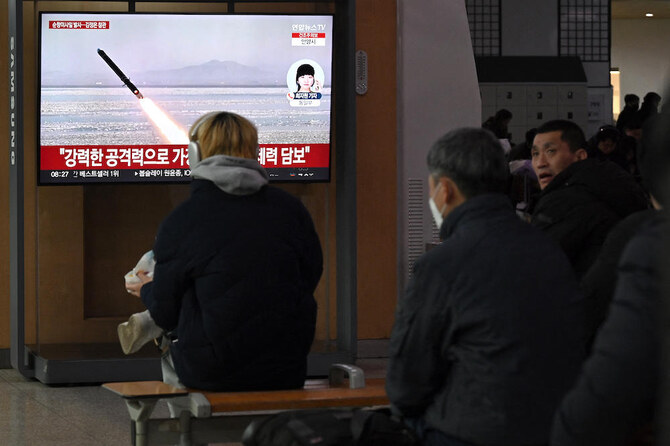
Above, news footage of North Korea’s latest test-launch of strategic cruise missiles is shown at a train station in Seoul on Feb. 28, 2025. (AFP)
Short Url
Updated 10 March 2025
Follow

North Korea fires missiles as South begins drills with US

  • The United States stations tens of thousands of US soldiers in South Korea
  • The allies regularly stage joint drills, which they describe as defensive in nature

SEOUL: North Korea fired “multiple unidentified ballistic missiles” on Monday, South Korea’s military said, the same day Seoul and Washington began a major annual joint military drill known as Freedom Shield.
“Our military has detected at around 13:50 (0450 GMT) multiple unidentified ballistic missiles fired from Hwanghae province into the West Sea,” the Joint Chiefs of Staff said, referring to the body of water also known as the Yellow Sea.
“Our military will bolster surveillance and maintain a full readiness posture under close cooperation with the United States,” the JCS added.
The United States stations tens of thousands of US soldiers in South Korea, and the allies regularly stage joint drills, which they describe as defensive in nature.
But such exercises infurate Pyongyang, which regards them as rehearsals for invasion and routinely responds with weapons tests of its own.
Earlier Monday, the nuclear-armed North slammed the drills as a “provocative act,” warning of the danger of sparking war with “an accidental single shot.”
“This is a dangerous provocative act of leading the acute situation on the Korean peninsula, which may spark off a physical conflict between the two sides by means of an accidental single shot,” said Pyongyang’s foreign ministry, according to the Korean Central News Agency.
The joint US-South Korea “Freedom Shield 2025” exercise kicked off on Monday, and will involve “live, virtual, and field-based training,” according to a US statement.
The exercise will run until March 20, the statement said.
The latest exercise comes after two South Korean Air Force fighter jets accidentally dropped eight bombs on a village during a joint training exercise with US forces on March 6.
Some 31 people, including civilians and military personnel, were wounded in that incident, South Korea’s military said.
Relations between Pyongyang and Seoul have been at one of their lowest points in years, with the North launching a flurry of ballistic missiles last year in violation of UN sanctions.
The two Koreas remain technically at war since their 1950-1953 conflict ended in an armistice, not a peace treaty.
The large-scale Freedom Shield exercises are one of the allies’ biggest annual joint exercises.
In its statement on Monday, North Korea’s foreign ministry dubbed the exercises “an aggressive and confrontational war rehearsal.”
Last week, Pyongyang slammed the United States for “political and military provocations” over the visit of a US Navy aircraft carrier to the South Korean port of Busan.


After nearly 7 weeks and many rumors, Bolivia’s ex-leader reappears in his stronghold

Updated 20 February 2026
Follow

After nearly 7 weeks and many rumors, Bolivia’s ex-leader reappears in his stronghold

  • Morales was Bolivia’s first Indigenous president who served from 2006 until his fraught 2019 ouster and subsequent self-exile
  • He dismissed rumors fueled by local politicians and fanned by social media that he would try to flee the country

LA PAZ: Bolivia’s long-serving socialist former leader, Evo Morales, reappeared Thursday in his political stronghold of the tropics after almost seven weeks of unexplained absence, endorsing candidates for upcoming regional elections and quieting rumors he had fled the country in the wake of the US seizure of his ally, Venezuela’s ex-President Nicolás Maduro.
The weeks of hand-wringing over Morales’ fate showed how little the Andean country knows about what’s happening in the remote Chapare region, where the former president has spent the past year evading an arrest warrant on human trafficking charges, and how vulnerable it is to fears about US President Donald Trump’s potential future foreign escapades.
The media outlet of Morales’ coca-growing union, Radio Kawsachun Coca, released footage of Morales smiling in dark sunglasses as he arrived via tractor at a stadium in the central Bolivian town of Chimoré to address his supporters.
Morales, Bolivia’s first Indigenous president who served from 2006 until his fraught 2019 ouster and subsequent self-exile, explained that he had come down with chikungunya, a mosquito-borne ailment with no treatment that causes fever and severe joint pain, and suffered complications that “caught me by surprise.”
“Take care of yourselves against chikungunya — it is serious,” the 66-year-old Morales said, appearing markedly more frail than in past appearances.
He dismissed rumors fueled by local politicians and fanned by social media that he would try to flee the country, vowing to remain in Bolivia despite the threat of arrest under conservative President Rodrigo Paz, whose election last October ended nearly two decades of rule by Morales’ Movement Toward Socialism party.
“Some media said, ‘Evo is going to leave, Evo is going to flee.’ I said clearly: I am not going to leave. I will stay with the people to defend the homeland,” he said.
Paz’s revival of diplomatic ties with the US and recent efforts to bring back the Drug Enforcement Administration — some 17 years after Morales expelled American anti-drug agents from the Andean country while cozying up to China, Russia, Cuba and Iran — have rattled the coca-growing region that serves as Morales’ bastion of support.
Paz on Thursday confirmed that he would meet Trump in Miami on March 7 for a summit convening politically aligned Latin American leaders as the Trump administration seeks to counter Chinese influence and assert US dominance in the region.
Before proclaiming the candidates he would endorse in Bolivia’s municipal and regional elections next month, Morales launched into a lengthy speech reminiscent of his once-frequent diatribes against US imperialism.
“This is geopolitical propaganda on an international scale,” he said of Trump’s bid to revive the Monroe Doctrine from 1823 in order to reassert American dominance in the Western Hemisphere. “They want to eliminate every left-wing party in Latin America.”