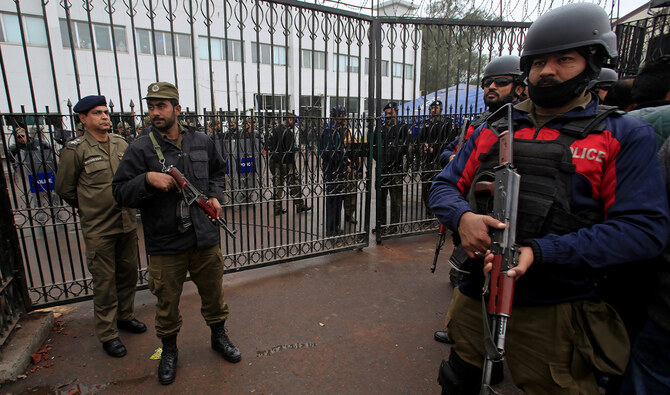
ISLAMABAD: Pakistan’s most populous Punjab province has put security on “high alert” and ordered intelligence-based search-and-sweep operations across the region, a police spokesperson said on Sunday, amid surge in militant attacks in the neighboring Khyber Pakhtunkhwa (KP) province in the country’s northwest.
Pakistan has witnessed a surge in militant violence in its KP and Balochistan provinces that border Afghanistan, including a twin suicide bombing that killed 18 people in KP’s Bannu district on March 4.
The attacks have prompted provincial authorities in Punjab to carry out intelligence-based operations and mock exercises to thwart any untoward incident in the eastern Pakistani province.
“During the last 24 hours, 436 search and sweep operations were conducted, along with eight mock exercises across Punjab,” Punjab police spokesperson Mubasher Hussain told Arab News, adding that 38 proclaimed offenders and 123 other suspects were arrested during these operations.
According to the 2025 Global Terrorism Index (GTI), Pakistan is now the world’s second-most affected country by militant violence, with deaths rising 45 percent to 1,081 in 2024.
The 12th annual GTI report, published by Australian-based think tank Institute for Economics and Peace, ranked 163 countries in 2024, covering 99.7 percent of the world’s population and analyzing the impact of militant activities worldwide. Pakistan is second only to West African country Burkina Faso on the list.
Officials in Islamabad accuse Afghanistan of harboring anti-Pakistan groups that launch cross-border attacks in Pakistan’s western regions. Kabul denies the allegation and insists Pakistan’s security is an internal matter of Islamabad.
The Punjab police spokesperson said the search-and-sweep operations are part of measures to combat militants and criminal elements.
“Authorities have recovered 2 Kalashnikovs, 12 rifles, 20 handguns, and hundreds of bullets from the arrested suspects,” he added.


![]()

Pakistan’s Punjab puts security on ‘high alert’ amid surge in militant attacks in northwest
Short Url
https://arab.news/2tx4z
Pakistan’s Punjab puts security on ‘high alert’ amid surge in militant attacks in northwest
- Pakistan is the world’s second-most affected country by militancy, according to Global Terrorism Index 2025
- Pakistan accuses Afghanistan of sheltering militant groups attacking its western regions, Kabul denies this
Latest updates


© 2026 SAUDI RESEARCH & PUBLISHING COMPANY, All Rights Reserved And subject to Terms of Use Agreement.