

Bangladeshi businesses seek closer ties with UAE on skills development, trade

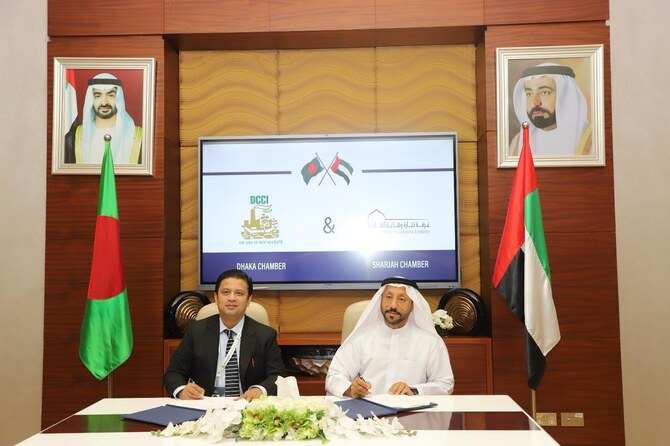
President of the Dhaka Chamber of Commerce and Industry, Taskeen Ahmed, left, signs a memorandum of understanding with the Sharjah Chamber of Commerce and Industry in Sharjah, UAE on Feb. 27, 2025. (DCCI)
Short Url
Updated 09 March 2025
Follow

Bangladeshi businesses seek closer ties with UAE on skills development, trade

  • Dhaka Chamber of Commerce and Industry recently signed MoUs with Dubai, Sharjah chambers
  • Bangladeshi private sectors see UAE as ‘major gateway’ to Middle East, North Africa

Dhaka: Bangladeshi businesses are seeking closer ties with the UAE on skills development, trade and investments, the Dhaka Chamber of Commerce and Industry said on Sunday after it signed agreements with its Emirati counterparts to strengthen economic cooperation.

The UAE is Bangladesh’s largest trading partner in the Middle East, with their bilateral trade volume valued at around $2 billion in 2024.

The Gulf state — home to about 1.2 million Bangladeshi expats — is also Bangladesh’s fifth-largest foreign investor.

DCCI President Taskeen Ahmed led a 29-member business delegation to the UAE last month, where he signed preliminary agreements with the Dubai Chambers and the Sharjah Chamber of Commerce and Industry to boost trade and investments between their two countries.

Bangladeshi businesses are eyeing cooperation in a number of key areas, including trade and market access, energy and financial sectors, tourism and hospitality, infrastructure and logistics, Ahmed said.

“Closer trade relations between Bangladesh and the UAE present a significant opportunity to strengthen our economic landscape across multiple sectors. I firmly believe that enhanced trade ties with the UAE can be a game-changer for Bangladesh,” he told Arab News.

“The UAE serves as a major gateway to the Middle East, North Africa, and beyond. Expanding our trade partnership will create greater market access for Bangladeshi products.”

The Dhaka Chamber is also seeking stronger collaboration in technology and skills development.

“The UAE is highly advanced in digital infrastructure, logistics, and financial services. Stronger collaboration can facilitate knowledge transfer and capacity-building, helping Bangladeshi industries adopt global best practices, enhance productivity, and become more competitive,” Ahmed added.

Under the newly signed memoranda of understanding, DCCI is set to collaborate with its Emirati counterparts “to promote bilateral trade, investment matchmaking and joint economic discussions,” with activities focused on exchanging trade delegations and strengthening business networking platforms.

“To further boost collaboration, Bangladesh aims to activate the Bangladesh-UAE Business Council, focusing on trade finance, private equity, and expanding Islamic finance,” Ahmed said.

Business leaders from the two countries are also involved in discussions to set up training centers “to improve the skill set of Bangladeshi workers” who are seeking employment in the UAE, while a direct shipping route between Chattogram and Dubai is being discussed to enhance trade efficiency.

“I believe that this mutual cooperation will enhance the value of our national bilateral relations … These initiatives will further deepen the economic and trade relationship between Bangladesh and the UAE following the MoU signing.”


EU eyes migration clampdown with push on deportations, visas

Updated 5 sec ago
Follow

EU eyes migration clampdown with push on deportations, visas

  • Irregular arrivals in the 27-nation bloc were down by more than a quarter in 2025
  • “The priority is clear: bringing illegal arrival numbers down and keeping them down,” Brunner said

BRUSSELS: The European Union on Thursday laid out plans to overhaul its visa system and step up deportations as part of a five-year migration strategy that cements a hardening line on the hot-button issue.
Irregular arrivals in the 27-nation bloc were down by more than a quarter in 2025, according to the EU’s border agency — but political pressure to act remains high.
“The priority is clear: bringing illegal arrival numbers down and keeping them down,” Magnus Brunner, the EU’s commissioner for migration, said.
The strategy unveiled Thursday stressed the need to boost deportations of failed asylum-seekers among the bloc’s priorities.
“Abuse gives migration a bad name — it undermines public trust and ultimately takes away from our ability to provide protection and undercuts our drive to attract talent,” said Brunner.
The European Parliament is currently examining a legal text put forward by the European Commission allowing for so-called “return hubs” to be set up outside the EU’s borders.
Criticized by rights groups, the proposal also envisages harsher penalties for migrants who refuse to leave European territory, including longer periods of detention.
European governments are under pressure to take a tougher stance amid a souring of public opinion on migration that has fueled a rightward shift across the bloc.

- ‘Flawed’ approach -

The strategy also mentioned reinforcing an “assertive migration diplomacy” to persuade third countries to help stop migrants from reaching Europe and take back their nationals with no right to stay.
Brussels recently struck or is negotiating deals with Northern African countries including Tunisia, Mauritania, Egypt and Morocco, whereby it gets help controlling migration flows in return for aid and investments.
Amnesty International criticized the EU’s approach as “flawed.”
It “only heightens its dependence on third countries to manage migration, while making it complicit in any rights violations that may result,” said Olivia Sundberg Diez, a policy analyst with the human rights group.
Brussels also put forward a brand-new visa strategy, with the stated objective of using the granting of access to EU territory to certain nationals as a diplomatic means to foster its policy goals.
It’s “one of the strongest tools in our hands,” said a commission source.
In particular, the EU wants to sanction countries that refuse to take back their nationals by restricting the issuance of visas, while easing procedures to attract skilled workers.
The commission is expected to present a plan for reform by the end of the year.