

Bangladeshi businesses seek closer ties with UAE on skills development, trade

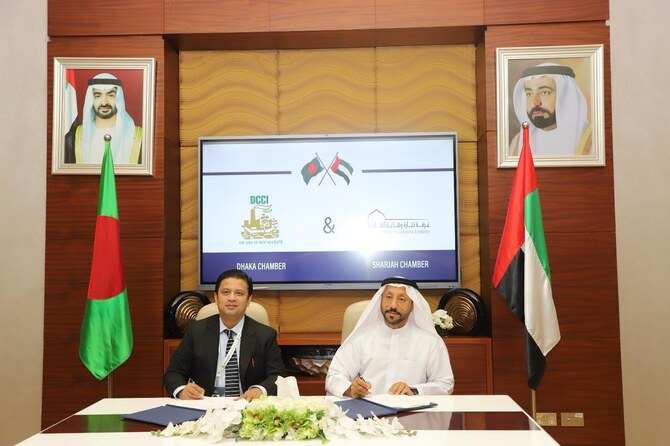
President of the Dhaka Chamber of Commerce and Industry, Taskeen Ahmed, left, signs a memorandum of understanding with the Sharjah Chamber of Commerce and Industry in Sharjah, UAE on Feb. 27, 2025. (DCCI)
Short Url
Updated 09 March 2025
Follow

Bangladeshi businesses seek closer ties with UAE on skills development, trade

  • Dhaka Chamber of Commerce and Industry recently signed MoUs with Dubai, Sharjah chambers
  • Bangladeshi private sectors see UAE as ‘major gateway’ to Middle East, North Africa

Dhaka: Bangladeshi businesses are seeking closer ties with the UAE on skills development, trade and investments, the Dhaka Chamber of Commerce and Industry said on Sunday after it signed agreements with its Emirati counterparts to strengthen economic cooperation.

The UAE is Bangladesh’s largest trading partner in the Middle East, with their bilateral trade volume valued at around $2 billion in 2024.

The Gulf state — home to about 1.2 million Bangladeshi expats — is also Bangladesh’s fifth-largest foreign investor.

DCCI President Taskeen Ahmed led a 29-member business delegation to the UAE last month, where he signed preliminary agreements with the Dubai Chambers and the Sharjah Chamber of Commerce and Industry to boost trade and investments between their two countries.

Bangladeshi businesses are eyeing cooperation in a number of key areas, including trade and market access, energy and financial sectors, tourism and hospitality, infrastructure and logistics, Ahmed said.

“Closer trade relations between Bangladesh and the UAE present a significant opportunity to strengthen our economic landscape across multiple sectors. I firmly believe that enhanced trade ties with the UAE can be a game-changer for Bangladesh,” he told Arab News.

“The UAE serves as a major gateway to the Middle East, North Africa, and beyond. Expanding our trade partnership will create greater market access for Bangladeshi products.”

The Dhaka Chamber is also seeking stronger collaboration in technology and skills development.

“The UAE is highly advanced in digital infrastructure, logistics, and financial services. Stronger collaboration can facilitate knowledge transfer and capacity-building, helping Bangladeshi industries adopt global best practices, enhance productivity, and become more competitive,” Ahmed added.

Under the newly signed memoranda of understanding, DCCI is set to collaborate with its Emirati counterparts “to promote bilateral trade, investment matchmaking and joint economic discussions,” with activities focused on exchanging trade delegations and strengthening business networking platforms.

“To further boost collaboration, Bangladesh aims to activate the Bangladesh-UAE Business Council, focusing on trade finance, private equity, and expanding Islamic finance,” Ahmed said.

Business leaders from the two countries are also involved in discussions to set up training centers “to improve the skill set of Bangladeshi workers” who are seeking employment in the UAE, while a direct shipping route between Chattogram and Dubai is being discussed to enhance trade efficiency.

“I believe that this mutual cooperation will enhance the value of our national bilateral relations … These initiatives will further deepen the economic and trade relationship between Bangladesh and the UAE following the MoU signing.”


130 kidnapped Nigerian schoolchildren freed: government

Freed school children are seen during a reception at the Governor's office in Minna on December 8, 2025. (AFP)
Updated 5 sec ago
Follow

130 kidnapped Nigerian schoolchildren freed: government

  • The religiously diverse African country of 230 million people is the scene of myriad conflicts that have killed both Christians and Muslims

ABUJA: Nigerian authorities have secured the release of 130 kidnapped schoolchildren taken by gunmen from a Catholic school in November, a presidential spokesman said Sunday, after 100 were freed earlier this month.
“Another 130 abducted Niger state pupils released, none left in captivity,” Sunday Dare said in a post on X, accompanied by a photo of smiling children.
In late November, hundreds of students and staff were kidnapped from St. Mary’s co-educational boarding school in north-central Niger state.
The attack came as the country buckled under a wave of mass abductions reminiscent of the infamous 2014 Boko Haram kidnapping of schoolgirls in Chibok.
The west African country suffers from multiple interlinked security concerns, from jihadists in the northeast to armed “bandit” gangs in the northwest.
A UN source told AFP that “the remaining set of girls/secondary school students will be taken to Minna,” the capital of Niger state, on Tuesday.
The exact number of those kidnapped, and those who remain in captivity, has been unclear since the attack on the school, located in the rural hamlet of Papiri.
The Christian Association of Nigeria (CAN) said 315 students and staff were kidnapped.
Some 50 escaped immediately afterwards, and on December 7 the government secured the release of around 100.
That would leave about 165 thought to remain in captivity.
But a statement from President Bola Tinubu at the time put the remaining people being held at 115.

- Spate of mass kidnappings -

It has not been made public who seized the children from their boarding school, or how the government secured their release.
Though kidnappings for ransom are a common way for criminals and armed groups to make quick cash, a spate of mass abductions in November put an uncomfortable spotlight on Nigeria’s already grim security situation.
Assailants across the country kidnapped two dozen Muslim schoolgirls, 38 church worshippers and a bride and her bridesmaids, with farmers, women and children also taken hostage.
The kidnappings came as Nigeria faces a diplomatic offensive from the United States, where President Donald Trump has alleged that there were mass killings of Christians that amounted to a “genocide.”
The Nigerian government and independent analysts reject that framing, which has long been used by the Christian right in the United States and Europe.
The religiously diverse African country of 230 million people is the scene of myriad conflicts that have killed both Christians and Muslims.