

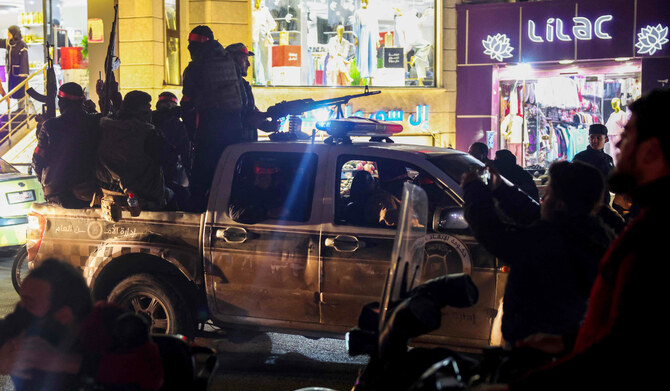

BEIRUT, Lebanon: Syria’s transitional authorities face a daunting task maintaining security in the ethnically and religiously diverse country, with challenges erupting across its territory to security forces still dominated by former Islamist rebels.
With heavy clashes taking place in the Alawite-dominated coast, ongoing negotiations with the Kurds in the northeast, and tensions swirling around the Druze and Israeli intervention in the south, the challenges for the fledgling government are piling up.
The worst violence since the December overthrow of Bashar Assad erupted on Syria’s Mediterranean coast this week, following clashes between the new authorities and forces loyal to the toppled government.
According to the Syrian Observatory for Human Rights, more than 500 people, including 311 Alawite civilians, have been killed.
The region is a bastion of the Alawite minority, to which Assad and his family belong.
The religious minority makes up around nine percent of the Syrian population, but was heavily represented in military and security institutions during the Assads’ five-decade rule.
The region has been gripped by fears of reprisals against Alawites for the family’s brutal rule, which included widespread torture and disappearances.
Aron Lund of the Century International think tank said the violence was “a bad omen.”
The new government, led by interim President Ahmed Al-Sharaa, lacks the tools, incentives and local base of support to engage with disgruntled Alawites, he said.
“All they have is repressive power, and a lot of that... is made up of jihadist zealots who think Alawites are enemies of God.”
When anti-government forces launch attacks, “these groups go roaming the Alawite villages, but those villages are full of vulnerable civilians,” he added.
Since coming to power, Sharaa has emphasized that his government would respect minorities, but those “talking points do not seem to have filtered out far into the ex-rebel factions that are now supposed to function as Syria’s army and police,” Lund said.
Much of Syria’s north and northeast is controlled by a semi-autonomous Kurdish administration whose armed groups have retained their weapons.
Sharaa has demanded that all groups give up their arms and be integrated into Syria’s new army, and has rejected autonomy for the Kurds.
Negotiations between the two sides have so far yielded no agreement, while pro-Turkiye factions have clashed with Kurdish forces since November.
The Kurdish-dominated, US-backed Syrian Democratic Forces (SDF) played a key role in rolling back the territorial conquests of the Daesh group, allowing the Kurds to take control of vast areas, including many of Syria’s oil fields.
“As long as US troops remain in the northeast, the SDF will not disband,” political analyst Fabrice Balanche told AFP, referring to a contingent of soldiers deployed in Syria by Washington to counter the Islamic State.
“The Kurds would accept the return of Syria’s civil administration — health services, education... but not the military forces of Hayat Tahrir Al-Sham,” he added, referring to Sharaa’s Islamist militant group that led the overthrow of Assad.
“They want to maintain their autonomy in governance,” he added.
“The Arabs, who represent 60 percent of the population of the territories under Kurdish administration, are reportedly growing increasingly resistant to SDF authority since Sharaa came to power,” Balanche said.
The Druze, who practice an offshoot of Shiite Islam, account for three percent of the Syrian population and are heavily concentrated in the southern province of Sweida.
Having largely remained on the sidelines of Syria’s civil war, Druze forces focused on defending their territory against attack and largely avoided conscription into the Syrian armed forces.
Two important Druze armed groups recently expressed their willingness to join a unified national army but are yet to hand over their weapons.
Syria’s powerful neighbor Israel has sought to involve itself in the area, in particular after clashes in the mostly Druze and Christian Damascus suburb of Jaramana.
Israel Katz, the Israeli defense minister, warned Syria not “to harm the Druze,” who also live in Lebanon, Israel and the Israeli-occupied Golan Heights.
Israeli Prime Minister Benjamin Netanyahu has demanded that southern Syria be completely demilitarised, while Israeli forces have repeatedly bombed Syria and moved into a UN-patrolled buffer zone on the Golan Heights.
Druze leaders immediately rejected Katz’s warning and declared their loyalty to a united Syria. Sharaa also attacked the statement and called for Israel to withdraw from Syrian territory.
Charles Lister, a Syria expert at the Middle East Institute, said on X that, so far, Israel’s efforts had “pushed the Druze closer to Damascus.”


