

DR Congo offers bounty for arrest of M23 leaders

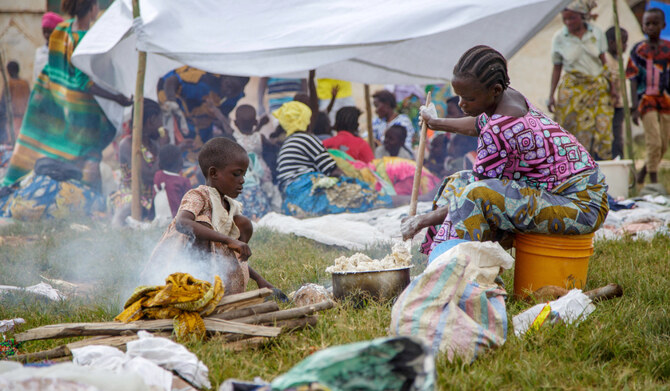
Displaced people prepare a meal near a temporary shelter in Burundi after fleeing from clashes between M23 rebels and the armed forces of the Democratic Republic of Congo. (Reuters)
Short Url
Updated 08 March 2025
Follow

DR Congo offers bounty for arrest of M23 leaders

  • The M23, which, according to UN experts, is backed by some 4,000 Rwandan soldiers, resumed its fight against the government in Kinshasa in 2021 and has since seized swaths of territory in North Kivu, which borders Rwanda

KINSHASA: Authorities in the Democratic Republic of Congo are offering a $5-million reward for help in arresting leaders of the M23 group that recently captured two major northern towns, the Justice Ministry announced.
“A reward of $5 million is offered to any person who helps arrest the convicts Corneille Nangaa, Bertrand Bisimwa and Sultani Makenga,” the ministry said in a statement.
Nangaa, a leader in the River Congo Alliance, or AFC, a military-political coalition to which the M23 belongs, is a former president of the DRC’s electoral commission.
Bisimwa and Makenga are, respectively, the president and military chief of the M23.
Tried in absentia in Kinshasa, all three men were convicted and sentenced to death in August 2024.
DRC authorities are also offering a bounty of $4 million for any information leading to the arrest of the three men’s “accomplices on the run” and “other sought individuals,” the statement said.
The M23, which, according to UN experts, is backed by some 4,000 Rwandan soldiers, resumed its fight against the government in Kinshasa in 2021 and has since seized swaths of territory in North Kivu, which borders Rwanda.
A lightning offensive in recent weeks has captured the provincial capital, Goma, and Bukavu, the main cities in the neighboring province of South Kivu.
The DRC’s mineral-rich east has been ravaged for three decades by conflict and atrocities.
According to the Financial Times, the US is in exploratory talks with the DRC over a deal that would give Washington access to critical minerals in the country.
Congo approached the US last month, proposing a deal that would offer exploration rights to the US in exchange for support for the government of President Felix Tshisekedi, the newspaper reported, citing public documents.
Security sources said on Friday at least 35 people were killed when pro-government militia attacked a village in the restive eastern Democratic Republic of Congo,
The attack happened at about 3 a.m. on Thursday in the village of Tambi, in the Masisi area of North Kivu province controlled by the Rwanda-backed M23 armed group.
A security source said that at least 35 people were killed in the attack, while local sources and an eyewitness put the death toll at more than 40.
A community leader and a medical source said villagers had recently returned to the area after having fled fighting between the M23 and the Congolese army and local militia.
“The militia went to attack Tambi where residents had started to return ... they opened fire and civilians were killed,” said one community leader, who said 43 people died.
“They put some victims in a church and then shot them. Those who were in the fields were killed there.”
The community leader, a local health worker, and a local resident said another group of civilians sought refuge in a house and died when the militia set it on fire.
“We counted 47 bodies in the morning,” the resident said, adding that they were buried in a communal grave.
Some of the victims were unable to be identified because of their burns, he added.


France demands EU-Mercosur trade pact signing be put off

Updated 6 sec ago
Follow

France demands EU-Mercosur trade pact signing be put off

  • “France asks that the deadlines be pushed back to continue work on getting the legitimate measures of protection for our European agriculture,” said the statement

PARIS, France: France on Sunday urged the European Union to postpone the deadlines set for signing a free trade agreement with South American bloc Mercosur, rejecting the deal in its current form.
In a statement from Prime Minister Sebastien Lecornu’s office, Paris said the conditions were not in place for EU member states to vote on the agreement.
“France asks that the deadlines be pushed back to continue work on getting the legitimate measures of protection for our European agriculture,” said the statement.
European Commission President Ursula von der Leyen is due in Brazil on Monday for talks to finalize the landmark pact with the Mercosur bloc, which includes Brazil, Argentina, Uruguay, and Paraguay.
But Brussels first has to get the approval of the EU member states over the coming week.
“Given a Mercosur summit is announced for December 20 (Saturday), it is clear in this context that the conditions have not been met for any vote (by states) on authorizing the signing of the agreement,” said the statement from Paris.
Earlier Sunday, in an interview published in the Germany financial daily Handelsblatt, France’s Finance Minister Roland Lescure made France’s objections clear.
“As it stands, the treaty is simply not acceptable,” he said.
Securing robust and effective safeguard clauses was one of the three key conditions France set before giving its blessing to the agreement, he added.
The other key points were requiring the same production standards faced by EU farmers and establishing “import controls.”
“Until we have obtained assurances on these three points, France will not accept the agreement,” said Lescure.
European nations are poised to vote on the trade agreement between Tuesday and Friday, according to EU sources.
The European Parliament votes Tuesday on safeguards to reassure farmers — particularly those in France — who are fiercely opposed to the treaty.
If approved, the EU-Mercosur agreement would create a common market of 722 million people.
It is intended to allow the EU to export more cars, machinery, wine, and other goods, and will also facilitate the entry into the European Union of beef, poultry, sugar, honey, and other products.
Farmers in France and some other European countries say it will create unfair competition due to less stringent standards, which they fear could destabilize already fragile European food sectors.