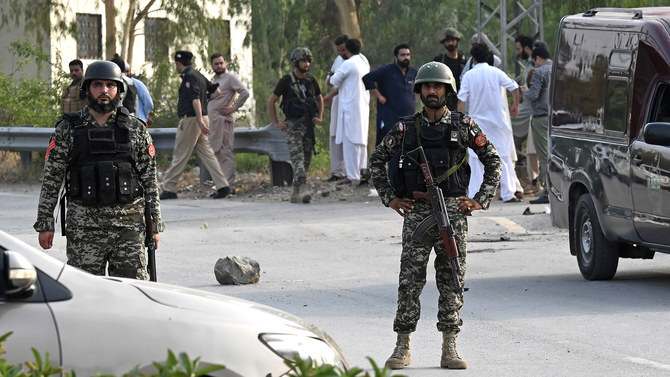
Pakistani security forces kill three militants in intelligence-based operation in northwest

In this file photo, taken on July 18, 2023, Pakistani security personnel stand guard at the Hayatabad area of Peshawar. (AFP/File)
Short Url
Updated 09 March 2025
Follow

Pakistani security forces kill three militants in intelligence-based operation in northwest

  • The operation in Tank came just days after a twin suicide bombing in Bannu this week
  • Military’s media wing says weapons and ammunition were recovered from the slain militants

KARACHI: Pakistani security forces killed three militants in an intelligence-based operation in the northwestern Tank district on Saturday, the military’s media wing, Inter-Services Public Relations (ISPR), said in a statement.
The operation in Khyber Pakhtunkhwa province occurred days after a twin suicide bombing killed at least 18 people in nearby Bannu. The region has experienced increased militant violence since a ceasefire between the government and the banned Tehreek-e-Taliban Pakistan (TTP) collapsed in late 2022.
Pakistan refers to TTP fighters as “khawarij,” a term historically describing an extremist sect in early Islam known for rebelling against authority and declaring other Muslims apostates.
“On 08 March 2025, Security Forces conducted an intelligence-based operation in Tank District on reported presence of khawarij,” the ISPR said. “During the conduct of operation, own troops effectively engaged the khawarij location, as a result of which, three khawarij were sent to hell.”
The military recovered weapons and ammunition from the slain militants, who were allegedly involved in numerous attacks against security forces and civilians.
The ISPR informed a “sanitization operation” was underway to eliminate any remaining militants in the area, expressing the resolve of the security forces to eradicate extremist violence from the country.


Pakistan sends vessels to Saudi, UAE ports to secure crude supplies amid regional crisis

Updated 5 sec ago
Follow

Pakistan sends vessels to Saudi, UAE ports to secure crude supplies amid regional crisis

  • The development comes as countries scramble to secure energy supplies amid US-Israeli strikes on Iran and Tehran’s counterattacks
  • If Islamabad arranges, Aramco has assured a large crude carrier can be loaded at Yanbu and stationed near Pakistan, minister says

ISLAMABAD: Pakistan has sent vessels to ports in Saudi Arabia and the United Arab Emirates to secure crude oil supplies, the Pakistani petroleum minister said late Friday, as tensions in the Middle East continue to threaten global energy flows.

Global oil markets have been rattled since the United States and Israeli began pounding Iran last week, prompting retaliatory strikes from Tehran across the region. The conflict has raised fears of disruptions in energy supplies, particularly through the Strait of Hormuz, and pushed petroleum prices.

Pakistani Petroleum Minister Ali Pervaiz Malik and others said Islamabad was monitoring international energy markets and domestic supply conditions as they announced a hike of Rs55 ($0.20) per liter in petrol and diesel prices, promising to bring down the prices as soon as the conflict is resolved.

Describing the situation as “extraordinary,” Malik said they did not know how long the Middle East crisis would last and it was important to stretch Pakistan’s available petroleum reserves as much as they could to ensure a steady supply to consumers during the crisis.

“At the regional and global level, you can clearly see that countries are scrambling to secure energy supplies. Pakistan is also part of this effort because a significant portion of our energy supplies comes through the Strait of Hormuz,” he said, adding that Prime Minister Shehbaz Sharif has engaged the Saudi government to secure alternative sources.

“With the help of the Foreign Office, two Pakistan National Shipping Corporation (PNSC) vessels are currently on their way, one toward Yanbu port and the other toward Fujairah port, to bring crude oil from outside the Hormuz region in order to meet Pakistan’s energy needs.”

In addition, he said, Aramco had assured that if Pakistan arranged, a Very Large Crude Carrier (VLCC) can be loaded at Yanbu and stationed near the Pakistani waters.

“From there, PNSC (Pakistan National Shipping Corporation) feeder vessels will ensure a continuous supply of crude oil to our refineries, so that even during this difficult phase Pakistan’s energy requirements continue to be met,” Malik shared.

The statement came as long queues of vehicles were seen outside petrol stations nationwide as Islamabad moved to raise petroleum prices to keep the supplies in check.

Pakistan, which relies heavily on imported fuel to meet its energy needs, is particularly vulnerable to global oil price shocks that can quickly feed into inflation and pressure the country’s external accounts.

Officials at Friday’s presser said Pakistan, which reviews petroleum prices fortnightly, will be considering them more frequently, potentially on a weekly basis, and any reduction in global oil prices would be passed on to consumers.

Finance Minister Aurangzeb said a high-level government committee formed by PM Sharif had been meeting daily to review developments in global petroleum markets and their potential impact on Pakistan’s economy.

“Pakistan currently maintains adequate energy stocks and macroeconomic stability,” Aurangzeb said, adding that the government’s response was based on preparedness rather than panic.