

UK government cuts funding for Islamophobia reporting service 

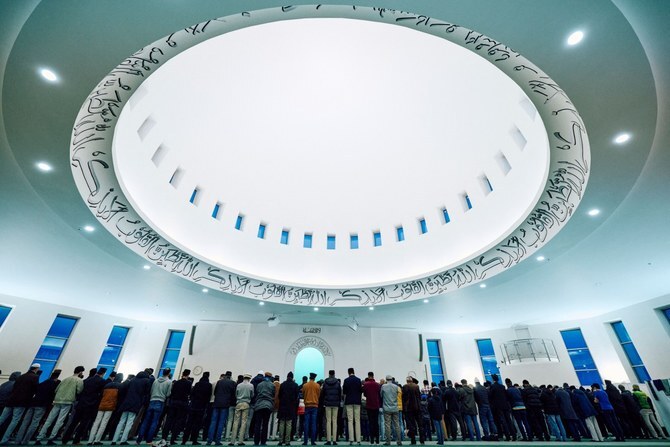
Baitul Futuh Mosque in Morden, south west London. Police said Islamophobia reporting service Tell Mama has been “invaluable” for monitoring community cohesion. (AFP/File)
Short Url
Updated 10 March 2025
Follow

UK government cuts funding for Islamophobia reporting service 

  • Tell Mama, founded in 2012, provides ‘invaluable’ data, police sources tell The Guardian
  • The organization, which received 10,700 reports of Islamophobia last year, faces closure

LONDON: The UK government is ending funding for Islamophobia reporting service Tell Mama, The Guardian reported on Saturday.

The project, founded in 2012, is now facing closure weeks after it reported a record number of anti-Muslim hate incidents across the country.

Since its launch, Tell Mama has been wholly funded by the Ministry of Housing, Communities and Local Government.

The ministry told Tell Mama that no grant would be provided by the end of March, without providing alternative arrangements.

Data provided by the service to police under a 2015 sharing agreement has been “invaluable” for monitoring community cohesion and responding to threats, police sources told The Guardian.

Tell Mama received 10,700 reports of Islamophobia last year, with 9,600 being verified. Muslims were the most targeted group in hate attacks in the year ending March 2024, according to police figures. They made up 38 percent of victims nationwide.

Tell Mama’s founder Fiyaz Mughal said its resources were being cut while “the far right and ­populists across Europe are growing significantly. There are going to be more individuals targeted, we know that in the current environment, and where are they going to go?

“This is an injustice at a time where I have never seen anti-Muslim rhetoric become so mainstream.”

Tell Mama provides a crucial point of contact for vulnerable people who often feel unable to contact the police, Mughal said.

“I’m not aware of any other organisation that can do this work and even if a new agency tried, it would take them 10 to 15 years to reach where Tell Mama is,” he added.

On Feb. 28, the government announced a new working group on anti-Muslim hatred that will create a new definition of Islamophobia and “support a wider stream of work to tackle the unacceptable incidents of anti-Muslim hatred.”

But Mughal accused the government of “saying one thing and doing another,” adding: “Labour talks a lot about countering Islamophobia but they are cutting the only project doing anything on a national scale — supporting victims, working with numerous police forces and supporting prosecutions.”

The National Police Chiefs’ Council said Tell Mama’s contributions “have allowed for the effective analysis of community tensions and informed actions to reduce such tensions.”

A spokesperson for the ministry responsible for the cut said: “Religious and racial hatred has absolutely no place in our society, and we will not tolerate Islamophobia in any form.

“This year we have made up to £1 million ($1.29 million) of funding available to Tell Mama to provide support for victims of Islamophobia, and we will set out our approach to future funding in due course.”


World copper rush promises new riches for Zambia

Updated 15 February 2026
Follow

World copper rush promises new riches for Zambia

CAPE TOWN: Five years after becoming Africa’s first Covid-era debt defaulter, Zambia is seeing a dramatic turnaround in fortunes as major powers vie for access to its vast reserves of copper.
Surging demand from the artificial intelligence, green energy and defense sectors has exponentially boosted demand for the workhorse metal that underpins power grids, data centers and electric vehicles.
The scramble for copper exposes geopolitical rivalries as industrial heavyweights — including China, the United States, Canada, Europe, India and Gulf states — compete to secure supplies.
“We have the investors back,” President Hakainde Hichilema told delegates at the African Mining Indaba conference on Monday, saying that more than $12 billion had flowed into the sector since 2022.
The politically stable country is Africa’s second-largest copper producer, after the conflict-ridden Democratic Republic of Congo, and the world’s eighth, according to the US Geological Survey.
The metal, needed for solar panels and wind turbines, generates about 15 percent of Zambia’s GDP and more than 70 percent of export earnings.
Output rose eight percent last year to more than 890,000 metric tons and the government aims to triple production within a decade.
Mining is driving growth that is forecast by the International Monetary Fund to reach 5.2 percent in 2025 and 5.8 percent this year, which places Zambia among the continent’s faster-growing economies.
“The seeds are sprouting and the harvest is coming,” Hichilema said, touting a planned nationwide geological survey to map untapped deposits.
But the rapid expansion of the heavily polluting industry has also led to warnings about risks to local communities and concerns of “pit-to-port” extraction, in which raw copper is shipped directly abroad with little domestic refining.

’Dramatic new chapter’

“We need to be aware of the potential for history to repeat itself,” said Daniel Litvin, founder of the Resource Resolutions group that promotes sustainable development, referring to the colonial-era scramble for Africa’s resources.
There is a risk that elites will be enriched at the expense of the broader population, while “narratives of partnership” offered by major powers can mask underlying self-interest, he said.
Chinese firms have long dominated the sector in Zambia and control major stakes in key mines and smelters, cementing Beijing’s early-mover advantage.
Another major player is Canada’s First Quantum Minerals, Zambia’s largest corporate taxpayer.
Investors from India and the Gulf are expanding their footprint, and the United States is returning to the market after largely pulling out decades ago.
Washington, which has been stockpiling copper, this month launched a $12 billion “Project Vault” public-private initiative to secure critical minerals, part of an effort to reduce reliance on China.
In September, the US Trade and Development Agency announced a $1.4 million grant to a Metalex Commodities subsidiary, Metalex Africa, to expand operations in Zambia.
“We are at the beginning of what is going to unfold to be a dramatic new chapter in the way that the free world sources and trades in critical minerals,” US energy secretary adviser Mike Kopp said at Mining Indaba.
Sweeping US tariffs introduced last year helped send copper prices soaring to record highs, as companies rushed to buy both semi-finished and refined stocks.

Cost of rush

“The risk is that this great power competition becomes a race to secure supply on terms that serve markets and not the people in producer countries,” said Deprose Muchena, a program director at the Open Society Foundation.
Despite its mineral wealth, more than 70 percent of Zambia’s 21 million people live in poverty, according to the World Bank.
“The world is waking up to Zambia’s copper. But Zambia has been living with copper and its consequences for a century,” Muchena told AFP.
Environmental damage caused by mining has long plagued Zambia’s copper belt.
In February 2025, a burst tailings dam at a Chinese-owned mine near Kitwe, about 285 kilometers (180 miles) north of Lusaka, spilled millions of liters of acidic waste.
Toxins entered a tributary feeding the Kafue, Zambia’s longest river and a major source of drinking water. Zambian farmers have filed an $80 billion lawsuit.
“Whether this boom is different depends on whether governance, rights, and community agency are at the center, not just supply chain security,” Muchena said.