On International Women’s Day, PM says empowerment ‘imperative’ for Pakistan’s progress

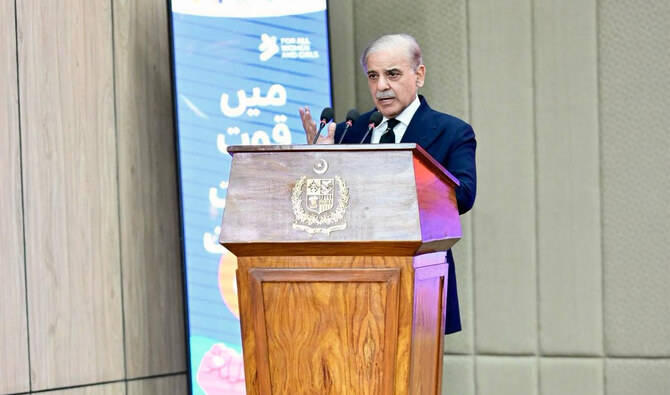
Prime Minister Shehbaz Sharif addresses the International Women’s Day ceremony in Islamabad, Pakistan, on March 8, 2025. (PID)
Short Url
Updated 08 March 2025
Follow

On International Women’s Day, PM says empowerment ‘imperative’ for Pakistan’s progress

  • Shehbaz Sharif’s statement comes on International Women’s Day, which highlights issues such as gender equality, reproductive rights and violence
  • Women’s rights activists are also scheduled to gather in major cities across Pakistan to demonstrate their support for women as part of the ‘Aurat March’

ISLAMABAD: Prime Minister Shehbaz Sharif on Saturday said that empowering women was no longer an option, it was an “imperative” for the prosperity of Pakistan, promising to advance women’s rights through concerted government efforts.
Sharif said this on the International Women’s Day, celebrated annually as a focal point in the women’s rights movement by focusing on issues such as gender equality, reproductive rights, and violence and abuse against women.
In Pakistan, women march in major cities on this day to highlight the issues facing them, including harassment, bonded labor, domestic violence, and lack of representation, work and education opportunities.
In his message, Sharif said they were celebrating the strength and luminosity of women who were redefining possibilities from classrooms to boardrooms, and from fields to frontlines, to shape a bright future of the nation.
“This year’s theme, ‘For ALL Women and Girls: Rights. Equality. Empowerment,’ is a call to action, reminding us of our shared responsibility to create a society where women thrive and contribute meaningfully,” the prime minister said.
“Empowering women is no longer an option; it is now an imperative for the prosperity and progress of Pakistan. When we invest in women’s education, health, and economic independence, we uplift not just individuals but generations.”
In Pakistan, just 21 percent of women are in the workforce and less than 20 percent of girls in rural areas are enrolled in secondary school, according to the United Nations. Only 12 women were directly elected to parliament out of 266 seats in last year’s election.
Much of Pakistani society operates under a strict code of “honor,” with women beholden to their male relatives over choices around education, employment and who they can marry. Hundreds of women are killed by men in Pakistan every year for allegedly breaching this code.
Sharif said Pakistan’s journey toward true gender equality was far from over.
“On this day, let us reaffirm our collective resolve to intensify our efforts to further advance respect for women’s rights and build a Pakistan where every woman’s potential is realized and every daughter’s dream is within her reach,” he said.
Women’s rights activists are also scheduled to gather in major cities across Pakistan on Saturday to demonstrate their support for women as part of the ‘Aurat March.’ The march is seen by critics as supporting elitist and Western values in the Muslim country, with organizers accused of disrespecting religious and cultural sensitivities.
In previous years, Aurat March organizers have had to battle in the courts for permission to hold demonstrations, while doctored images of banners held up by women have circulated online leading to harassment and death threats.
In 2020, groups of hard-line men turned up in vans and hurled stones at women participating in the Aurat March in Islamabad.


Pakistan accuses India of manipulating Indus waters, warns of risks to regional peace

Updated 58 min 57 sec ago
Follow

Pakistan accuses India of manipulating Indus waters, warns of risks to regional peace

  • India announced in April it was putting the Indus Waters Treaty in abeyance over a gun attack in disputed Kashmir it blamed on Pakistan
  • Islamabad says it has witnessed ‘unusual, abrupt variations’ in the flow of Chenab river, accusing New Delhi of ‘material breaches’ of treaty

ISLAMABAD: Pakistan on Friday accused India of manipulating flows of Indus waters in violation of a 1960 water-sharing treaty, warning that unilateral actions over the transboundary waters could heighten tensions and pose risks to regional peace.

The Indus Waters Treaty (IWT), mediated by the World Bank, divides control of the Indus basin rivers between the two nuclear-armed neighbors. India said in April it was holding the treaty “in abeyance” after a gun attack in Indian-administered Kashmir killed more than 26 tourists. New Delhi blamed the assault on Pakistan, Islamabad denied it.

The treaty grants Pakistan rights to the Indus basin’s western rivers — Indus, Jhelum, and Chenab — for irrigation, drinking, and non-consumptive uses like hydropower, while India controls the eastern rivers — Ravi, Beas, and Sutlej — for unrestricted use but must not significantly alter their flow. India can use the western rivers for limited purposes such as power generation and irrigation, without storing or diverting large volumes, according to the agreement.

Speaking to foreign envoys in Islamabad, Pakistani Deputy Prime Minister Ishaq Dar accused New Delhi of “material breaches” of the IWT that may have consequences for regional stability, citing “unusual, abrupt variations” in the flow of Chenab river from April 30 to May 21 and from Dec. 7 to Dec. 15.

“These variations in water flows are of extreme concern for Pakistan as they point to unilateral release of water by India into River Chenab. India has released this water without any prior notification or any data- or information-sharing with Pakistan as required under the treaty,” he said.

“India’s most recent action clearly exemplifies the weaponization of water to which Pakistan has been consistently drawing attention of the international community.”

There was no immediate response from New Delhi to the statement.

Dar said this water “manipulation” occurs at a critical time in Pakistan’s agricultural cycle and directly threatens the lives and livelihoods as well as food and economic security of its citizens.

He shared that Indian actions prompted Indus Water Commissioner Mehar Ali Shah to write a letter to his Indian counterpart, seeking clarification on the matter as provided under the Indus Waters Treaty.

“We expect India to respond to the queries raised by Pakistan’s Indus water commissioner, refrain from any unilateral manipulation of river flows, and fulfill all its obligations in letter and spirit under the Indus Waters Treaty provisions,” the Pakistani deputy premier said.

Dar also accused India of consistently trying to undermine the IWT by building various dams, including Kishenganga and Ratle hydropower projects, which he said sets “a very dangerous precedent.”

“Alarmingly, India is now subverting the treaty’s own dispute resolution mechanism by refusing to participate in the Court of Arbitration and neutral expert proceedings. India is pursuing a deliberate strategy to sabotage the well-established arbitration process under the treaty provisions,” he said.

The South Asian neighbors have been arguing over hydroelectric projects on the shared Indus river system for decades, with Pakistan complaining that India’s planned hydropower dams will cut its flows.

In August, the International Court of Arbitration rendered an award on issues of general interpretation of the IWT, explaining the designed criteria for the new run-of-river hydropower projects to be constructed by India on the western rivers of Chenab, Jhelum and Indus, which Islamabad said vindicated its stance.

In its findings, the Court of Arbitration declared that India shall “let flow” the waters of the western rivers for Pakistan’s unrestricted use. In that connection, the specified exceptions for generation of hydro-electric plants must conform strictly to the requirements laid down in the Treaty, rather than to what India might consider an “ideal” or “best practices approach,” according to the Pakistani foreign office.

“Pakistan would like to reiterate that Indus Waters Treaty is a binding legal instrument that has made an invaluable contribution to peace and stability of South Asia,” Dar said.

“Its violation, on the one hand, threatens the inviolability of international treaties and on the other, it poses serious risks to regional peace and security, principles of good neighborhood, and norms that govern inter-state relations.”