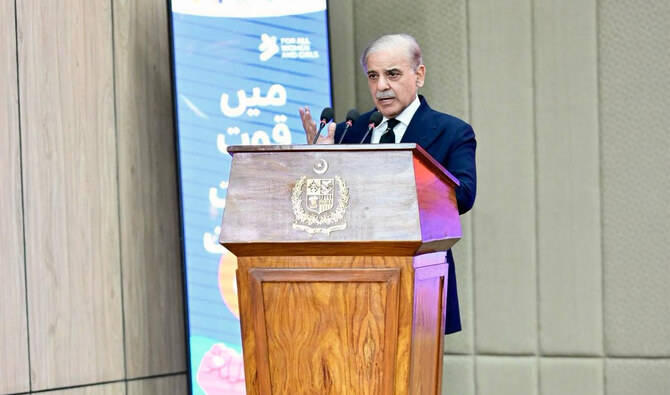
ISLAMABAD: Prime Minister Shehbaz Sharif on Saturday said that empowering women was no longer an option, it was an “imperative” for the prosperity of Pakistan, promising to advance women’s rights through concerted government efforts.
Sharif said this on the International Women’s Day, celebrated annually as a focal point in the women’s rights movement by focusing on issues such as gender equality, reproductive rights, and violence and abuse against women.
In Pakistan, women march in major cities on this day to highlight the issues facing them, including harassment, bonded labor, domestic violence, and lack of representation, work and education opportunities.
In his message, Sharif said they were celebrating the strength and luminosity of women who were redefining possibilities from classrooms to boardrooms, and from fields to frontlines, to shape a bright future of the nation.
“This year’s theme, ‘For ALL Women and Girls: Rights. Equality. Empowerment,’ is a call to action, reminding us of our shared responsibility to create a society where women thrive and contribute meaningfully,” the prime minister said.
“Empowering women is no longer an option; it is now an imperative for the prosperity and progress of Pakistan. When we invest in women’s education, health, and economic independence, we uplift not just individuals but generations.”
In Pakistan, just 21 percent of women are in the workforce and less than 20 percent of girls in rural areas are enrolled in secondary school, according to the United Nations. Only 12 women were directly elected to parliament out of 266 seats in last year’s election.
Much of Pakistani society operates under a strict code of “honor,” with women beholden to their male relatives over choices around education, employment and who they can marry. Hundreds of women are killed by men in Pakistan every year for allegedly breaching this code.
Sharif said Pakistan’s journey toward true gender equality was far from over.
“On this day, let us reaffirm our collective resolve to intensify our efforts to further advance respect for women’s rights and build a Pakistan where every woman’s potential is realized and every daughter’s dream is within her reach,” he said.
Women’s rights activists are also scheduled to gather in major cities across Pakistan on Saturday to demonstrate their support for women as part of the ‘Aurat March.’ The march is seen by critics as supporting elitist and Western values in the Muslim country, with organizers accused of disrespecting religious and cultural sensitivities.
In previous years, Aurat March organizers have had to battle in the courts for permission to hold demonstrations, while doctored images of banners held up by women have circulated online leading to harassment and death threats.
In 2020, groups of hard-line men turned up in vans and hurled stones at women participating in the Aurat March in Islamabad.


![]()

On International Women’s Day, PM says empowerment ‘imperative’ for Pakistan’s progress
Short Url
https://arab.news/nv35p
On International Women’s Day, PM says empowerment ‘imperative’ for Pakistan’s progress
- Shehbaz Sharif’s statement comes on International Women’s Day, which highlights issues such as gender equality, reproductive rights and violence
- Women’s rights activists are also scheduled to gather in major cities across Pakistan to demonstrate their support for women as part of the ‘Aurat March’


Latest updates


© 2026 SAUDI RESEARCH & PUBLISHING COMPANY, All Rights Reserved And subject to Terms of Use Agreement.