


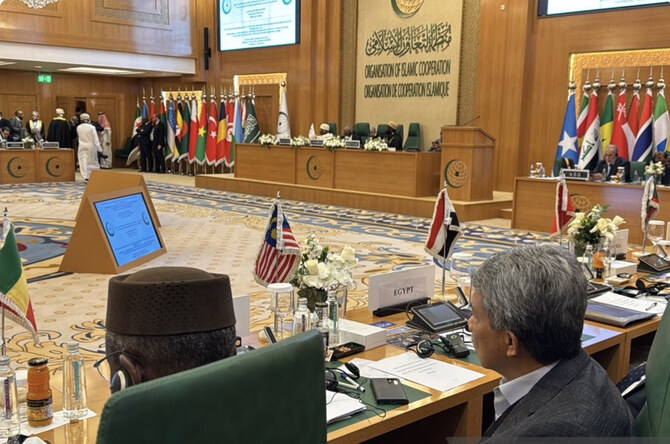

JEDDAH: The Organization of Islamic Cooperation on Friday endorsed an Arab League counter-proposal to US President Donald Trump’s controversial plan to take over Gaza and displace its residents, two ministers have said.
The decision by the 57-member grouping came at an emergency meeting in Jeddah, Saudi Arabia, three days after the Arab League ratified the plan at a summit in Cairo.
The Egyptian-crafted alternative to Trump’s widely condemned takeover proposes to rebuild the Gaza Strip under the future administration of the Palestinian Authority.
“The emergency ministerial meeting of the Organization of Islamic Cooperation adopted the Egyptian plan, which has now become an Arab-Islamic plan,” Egyptian Foreign Minister Badr Abdelatty said, in comments echoed by his Sudanese counterpart.
“It is certainly a very positive thing,” Abdelatty said.
Trump triggered global outrage by suggesting the US “take over” Gaza and turn it into the “Riviera of the Middle East,” while forcing its Palestinian inhabitants to relocate to Egypt or Jordan.
Cameroonian Foreign Minister Lejeune Mbella, chairman of the Council of Foreign Ministers, said the meeting was called in light of “new developments in the Palestinian-Israeli conflict, including calls for the displacement of Palestinians.”
He urged the full implementation of the agreement with a view to reaching a final solution to the conflict via a “concerted and multilateral approach.”
Mbella stressed, however, that “this approach can only be applicable and relevant within the framework of the two-state solution, with Israel and Palestine living side by side within internationally recognized borders, thus ensuring comprehensive peace in the Middle East.”
Mamadou Tangara, the foreign minister of Gambia — the current Chair of the Islamic Summit — slammed plans to displace Palestinians from the Gaza Strip as “provocative, brutal and inhumane,” and also uncalled for considering that positive steps are being looked into to end the Palestinian-Israeli conflict following the recently reached ceasefire agreement.
“Now is the time for the international community to exert more concerted efforts to establish a comprehensive and lasting ceasefire that will lead to the full withdrawal of Israel from the occupied Palestinian territories, reiterating that the two-state solution is a prerequisite for stability and peace in the Middle East,” he said.
Tangara expressed deep concern over the recent passage of laws by the Israeli parliament banning the work of the United Nations Relief and Works Agency for Palestine Refugees (UNRWA), which is in complete contravention of the UN Charter and international law.
OIC Secretary General Hissein Ibrahim Taha affirmed his support for the reconstruction plan for the Gaza Strip, while adhering to the right of the Palestinian people to remain in their land.
He called for more concerted efforts “to achieve a sustainable ceasefire, the complete withdrawal of the occupation forces, the delivery of humanitarian aid, helping the displaced to return to their homes, enabling the Palestinian government to assume its duties, preserving the unity of the Palestinian territory.”
Gaza trust fund
At Tuesday’s summit in Cairo, leaders of the Arab League also announced a trust fund to pay for Gaza’s reconstruction and urged the international community to back it.
“The next step is for the plan to become an international plan through adoption by the European Union and international parties such as Japan, Russia, China and others,” Abdelatty said.
“This is what we will seek and we have contact with all parties, including the American party.”
However, the counter-proposal does not outline a role for Hamas, which controls Gaza, and was rejected by both the United States and Israel.
The plan “does not meet the expectations” of Washington, State Department spokeswoman Tammy Bruce told reporters on Thursday.
Trump’s Middle East envoy Steve Witkoff gave a more positive reaction, calling it a “good-faith first step from the Egyptians.”
Rabha Seif Allam, of the Al-Ahram Center for Political and Strategic Studies in Cairo, said Egypt was seeking “broad support” for its proposal.
“This is an attempt to build a broad coalition that refuses the displacement” of Palestinians from Gaza, she said.
Trump’s plan has already united Arab countries in opposition, with Saudi Arabia also hosting Arab leaders two weeks ago to discuss alternatives.
During Friday's meeting, the OIC also readmitted Syria, which was suspended in 2012 early in the civil war under Bashar Assad, following the long-time ruler’s toppling in December.
“This decision represents an important step toward Syria’s return to the regional and international communities as a free and just state,” a Syrian foreign ministry statement said.
(With AFP & SPA)


