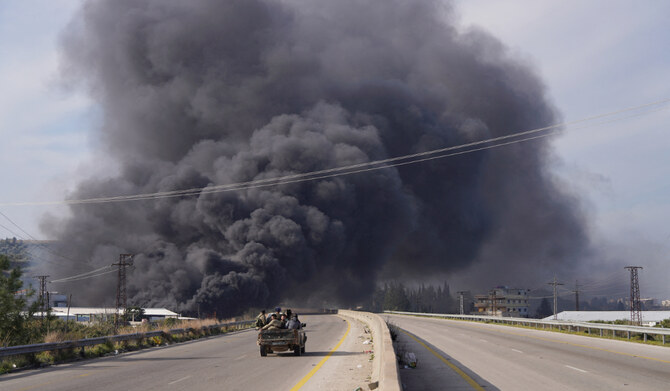


BEIRUT: Fighters siding with Syria’s new government stormed several villages near the country’s coast, killing dozens of men in response to recent attacks on government security forces by loyalists of ousted President Bashar Assad, a war monitor said.
The village assaults erupted Thursday and continued Friday. Ongoing clashes between the two sides have marked the worst violence since Assad’s government was toppled in early December by insurgent groups led by the Islamist group Hayat Tahrir Al-Sham. The new government has pledged to unite Syria after 14 years of civil war.
More than 200 people have been killed since the fighting broke out, according to the Britain-based Syrian Observatory for Human Rights. In addition to around 140 killed in apparent revenge attacks in the villages, the dead include at least 50 members of Syria’s government forces and 45 fighters loyal to Assad. The civil war that has been raging in Syria since March 2011 has left more than half a million people dead and millions displaced.
The most recent clashes began when government forces tried to detain a wanted person near the coastal city of Jableh on Thursday and were ambushed by Assad loyalists, according to the Britain-based Syrian Observatory for Human Rights.
On Thursday and Friday, gunmen loyal to the new government stormed the villages of Sheer, Mukhtariyeh and Haffah near the coast, killing 69 men but harming no women, according to the observatory.
“They killed every man they encountered,” said observatory chief Rami Abdurrahman.
Beirut-based Al-Mayadeen TV also reported the attacks on the three villages, saying that more than 30 men were killed in the village of Mukhtariyeh alone.
Another 60 people were killed in the town of Baniyas, including women and children, the observatory said.
Syrian authorities did not publish a death toll, but Syria’s state news agency SANA quoted an unidentified security official as saying that numerous people went to the coast seeking revenge for recent attacks on government security forces. The official said the actions “led to some individual violations and we are working on stop them.”
Interim President Ahmad Al-Sharaa in a video statement called on armed groups affiliated with the former government to hand over their weapons and for those loyal to the new government to avoid attacking civilians or abusing prisoners.
“When we compromise our ethics, we reduce ourselves to the same level as our enemy,” he said. “The remnants of the fallen regime are looking for a provocation that will lead to violations behind which they can seek refuge.”
Coastal towns still under the control of Assad loyalists
Overnight, Damascus sent reinforcements to the coastal cities of Latakia and Tartus and nearby villages that are home to Assad’s minority Alawite sect and make up his longtime base of support. A curfew remained in effect in Latakia and other coastal areas.
Under Assad, Alawites held top posts in the army and security agencies. The new government has blamed his loyalists for attacks against the country’s new security forces over the past several weeks. There also have been some attacks against Alawites in recent weeks, though the new government says it won’t allow collective punishment or sectarian vengeance.
As of Friday, the observatory said, Jableh and the coastal town of Baniyas were still under the control of Assad loyalists, along with other Alawite villages nearby and Assad’s hometown of Qardaha, in the mountains overlooking Latakia.
One Qardaha resident told The Associated Press in a text message that government forces were firing with heavy machine guns in the town’s residential areas. Another said people had not been able to leave their homes since Thursday afternoon because of the intensity of the shooting. Both spoke on condition of anonymity for fear of retribution.
The fighting could stoke more sectarian tensions
Gregory Waters, an associate fellow with the Middle East Institute who has researched Syria’s coastal areas, said he doesn’t expect the flareup to escalate into sustained fighting between the two sides. However, he said he was concerned it could stoke cycles of violence between different civilian communities living along the coast.
Also, any violations by the security forces sent from Damascus would leave young Alawite men more fearful of the new government — and more prone to take up arms, Waters said.
In Damascus, a crowd gathered in the rain at Umayyad Square to show support for the new government.
“We’ve had enough of long periods of wars and tragedies,” said retiree Mazen Abdelmajeed. He blamed the violence on remnants of the former regime and said Syria’s unity must be preserved.
“No one wants a civil war to happen,” he said. “We’re not against any of the components of the Syrian people. … We’re all one Syrian people.”
Qutaiba Idlbi, a research fellow at the Atlantic Council think tank, said that apart from the danger of sectarian escalation, the violence had laid bare a “big security challenge for the government in terms of potentially its inability to address multiple security threats on multiple fronts across the country.” Armed groups opposed to the new authorities may take note, he said.
Syrian people ask Russia for help
Scores of people gathered Friday outside the main Russian air base in Syria near Jableh to ask Moscow for protection. Russia joined Syria’s conflict in 2015, siding with Assad, although it has since established links with the new government. Assad has been living in Moscow since leaving Syria in December.
Russia’s foreign ministry said in a written statement that Moscow is “closely coordinating efforts with foreign partners in the interests of a speedy de-escalation of the situation.”
“We reaffirm our principled position in support of the sovereignty, unity and territorial integrity of the Syrian Arab Republic,” the statement said. “We expect that all states that have influence on the situation in Syria will contribute to its normalization.”
A warning from Turkiye
Turkiye, which backed the insurgents when Assad was still in power, warned on Friday that the current fighting poses a serious threat to the new government.
“Intensive efforts are underway to establish security and stability in Syria,” Turkish Foreign Ministry spokesperson Oncu Keceli said in a post on X. “At this critical juncture, the targeting of security forces could undermine the efforts to lead Syria into the future in unity and solidarity.”