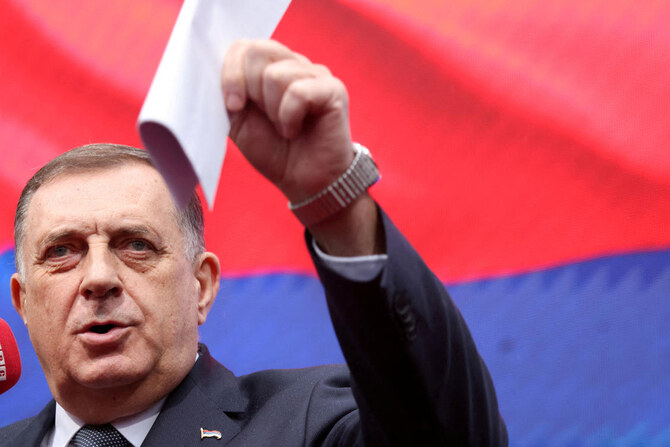
SARAJEVO: Bosnian Serb leader Milorad Dodik on Friday called on ethnic Serbs to quit the federal police force and courts and join the government of the deeply divided country’s Serb statelet.
The call follows a series of moves that risk pushing Bosnia into greater uncertainty a week after Dodik was convicted for defying an international envoy charged with overseeing the Balkan country’s peace accords.
“We have ensured them a job, while preserving their legal status, ranks, and positions. They will receive the same salary, or even a higher salary than they had,” said Dodik, who is the president of Bosnia’s Serb statelet Republika Srpska (RS).
Dodik later added there were no plans for violent escalation but insisted that the RS had “the ability to defend itself, and we will do that.”
Earlier this week, Dodik signed a raft of bills into law that banned the central police and judiciary from his statelet.
Dodik pushed the legislation through the RS parliament last week, after he was sentenced to a year in prison and banned from office for six years for refusing to comply with decisions made by Christian Schmidt — the international envoy charged with overseeing Bosnia’s peace accords.
The legislation has escalated tensions in Bosnia and is proving to be a key test for its fragile, post-war institutions.
Dodik later said he planned to ignore a summons from Bosnia’s chief prosecutor who is investigating Dodik for allegedly undermining the constitution.
Since the end of Bosnia’s inter-ethnic war in the 1990s, the country has consisted of two autonomous halves — the Serb-dominated RS and a Muslim-Croat statelet.
The two are linked by weak central institutions, while each has its own government and parliament.
The high representative holds vast powers in Bosnia — including the ability to effectively fire political leaders and strip them of power.
Dodik’s conviction last week was linked to his role pushing through two laws in 2023 previously annulled by the high representative Schmidt.
The legislation refused to recognize decisions made by the high representative and Bosnia’s constitutional court in the RS.
This followed months of tensions, as Dodik engaged in a bitter feud with Schmidt.
For years, Dodik has pursued a relentless separatist agenda that has put him on a collision course with Bosnia’s institutions.
The RS president has repeatedly threatened to pull the Serb statelet out of Bosnia’s central institutions — including its army, judiciary and tax system, which has led to sanctions from the United States.


![]()

Bosnian Serb leader Dodik asks Serbs to quit federal police, judiciary
Short Url
https://arab.news/2pkzg
Bosnian Serb leader Dodik asks Serbs to quit federal police, judiciary
- The call follows a series of moves that risk pushing Bosnia into greater uncertainty
- “We have ensured them a job, while preserving their legal status, ranks, and positions,” said Dodik


Latest updates






© 2026 SAUDI RESEARCH & PUBLISHING COMPANY, All Rights Reserved And subject to Terms of Use Agreement.