

Scholars at Makkah conference call for unity among Muslims

1 / 3
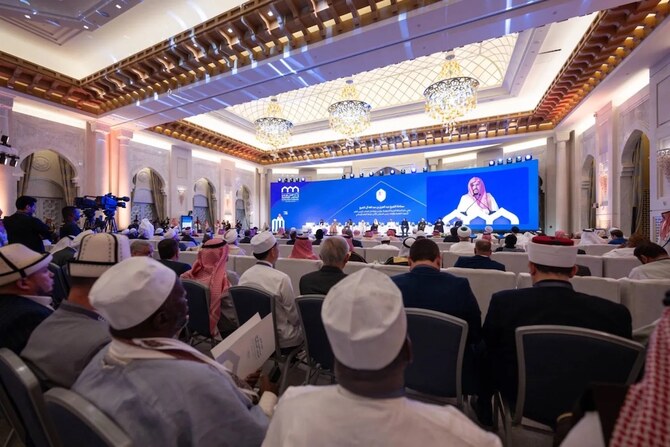
The conference opened on Thursday under the patronage of King Salman. (Supplied)
2 / 3
The conference opened on Thursday under the patronage of King Salman. (Supplied)
3 / 3
The conference opened on Thursday under the patronage of King Salman. (Supplied)
Short Url
Updated 07 March 2025
Follow

Scholars at Makkah conference call for unity among Muslims

  • Muslim leaders of various sects from 90 countries present
  • Grand Mufti Sheikh Abdulaziz Al-Asheikh urges compassion

MAKKAH: Participants at the second “Building Bridges Between Islamic Schools of Thought” conference in Makkah have called for unity among Muslims globally.

The conference opened on Thursday under the patronage of King Salman, bringing together Muslim leaders of various sects from more than 90 countries.

The event, organized by the Muslim World League, is being held under the theme “Towards an effective Islamic alliance.”

The conference opened with several sessions addressing developments in Palestine, Sudan and Syria, as well as issues concerning Muslim minorities around the world.

The participants include senior muftis, scholars, intellectuals and representatives from Islamic councils across different sects and denominations.

Saudi Arabia’s Grand Mufti Sheikh Abdulaziz Al-Asheikh, in his opening remarks, stressed the critical responsibility of Islamic scholars to “elevate the voice of wisdom” to ensure Muslim unity.

His remarks, read by Dr. Fahd Al-Majed, secretary-general of the Council of Senior Scholars, called for reason to prevail over division.

He stressed that “our obligation, in pursuit of compassion for Muslims and their collective unity, is to fortify relationships, establish mutual trust, and strengthen the essential ties of brotherhood.”

“During a time when uncertainties proliferate and debates grow heated, faith’s wisdom emerges to direct both intellect and sentiment toward proper understanding.

“We must reject extremism, factionalism, and capricious thinking in favor of evidence-based truth and conscious guidance within Islam’s framework.

“The challenges and hardships facing the Islamic world should serve as catalysts for unification rather than opportunities for blame, projection, or division.”

The grand mufti added that the event was taking place in “Saudi Arabia, a blessed land that serves as the pulsing heart of the Muslim world and consistently upholds its responsibilities.

“The Kingdom stands as a vanguard in matters of Muslim unity, solidarity, and collective aspirations, exercising its leadership through effective mechanisms that bring together diverse voices, consolidate ranks, and harmonize efforts and positions.”

The MWL’s chief Mohammad bin Abdulkarim Al-Issa said the conference extends the groundwork laid by the document produced after the inaugural meeting last Ramadan.

Al-Issa noted that differences and diversity are natural but require proper management. “When awareness is heightened and intentions are noble, diversity follows a sound path,” he said.

He warned warning that negative doctrinal debates have historically harmed both perpetrators and the broader Muslim community.

He emphasized that genuine unity, coexistence and solidarity do not require complete agreement but rather mutual understanding and respect.

“While dialogue represents an essential and worthwhile endeavor championed by the wise, it has remained largely static for decades without progressing to the crucial next phase of practical implementation and constructive action.

“This advancement is particularly vital now that we have established our foundation — the broad Islamic commonality that brings us together today and authenticates our identity as true adherents to Islam’s name and principles.”

He explained that the conference will launch practical initiatives based on the “Building Bridges” document.

“The initiative, which has received formal endorsement from Organization of Islamic Cooperation member states, now moves to the implementation phase,” he said.


Rebuilding lives: Saudi initiative gives fresh hope to amputees

Updated 08 December 2025
Follow

Rebuilding lives: Saudi initiative gives fresh hope to amputees

  • Baitureh Health Association has provided life-changing support to more than 1,000 people
  • Prosthetic limbs can cost up to $76,000

MAKKAH: The Baitureh Health Association for the Care of Amputees has quickly become one of Saudi Arabia’s most impactful humanitarian initiatives, transforming support for people with lost limbs.

Established in 2020, the association deals with people’s physical, psychological and social needs and fills a long-standing gap in the national health system.

CEO Badr bin Alyan told Arab News that the initiative was created in response to a growing need, driven by amputations linked to accidents, blood disorders, occupational injuries and other causes.

Its operations were “based on service integration rather than fragmentation, enabling beneficiaries to return to their lives with confidence, ability and independence,” he said.

This holistic process covers everything from initial evaluations to psychological and physical rehabilitation, family support, prosthetic fitting and ongoing maintenance.

Its psychological support programs include group sessions led by certified mentors who have undergone similar experiences, as well as field visits to support patients before and after amputation.

More than 1,000 people across the Kingdom have so far benefitted from the association’s work, about 10 percent of them children, whom Alyan said were “the most sensitive and the most in need of intensive psychological and family support.”

Its specialist programs for children — My First Step and Therapeutic Entertainment — help young people adapt to prosthetics, overcome trauma and build confidence in a safe and supportive setting.

The association has completed more than 300 prosthetic fittings, including silicone cosmetic limbs, mechanical, hydraulic, electronic and 3D-printed models. 

Alyan said the type of prosthetic selected depended on a number of factors, such as age, lifestyle, type of amputation, activity level and psychological readiness.

Children also have to undergo frequent adjustments to their new limbs to account for their growth.

Each prosthetic cost between SR20,000 ($5,300) and SR285,000, Alyan said.

The association funds its work through sponsorships, community contributions and strategic partnerships.

Despite its success, Alyan said there were still challenges to be faced, including the lack of a consolidated base for the provision of psychological support and therapy services and prosthetics development and maintenance.

There was also a shortage of local experts, he said.

In response, the association set up a rehabilitation center, which Alyan said would help to localize prosthetics manufacturing, reduce costs and accelerate fitting processes and create opportunities for local experts to develop their knowledge and experience.

But providing prosthetics was only part of the association’s work, he said.

“Rebuilding a human life is the deeper goal.”