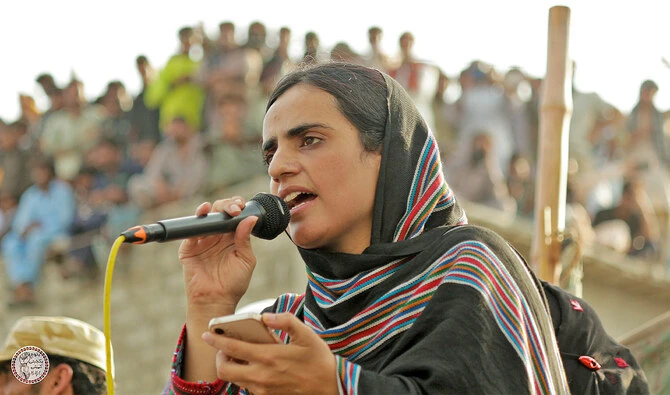
- Dr. Mahrang Baloch is a leading rights activist for the ethnic Baloch minority in Pakistan
- She leads the Baloch Yakjehti Committee human rights movement based in Balochistan
ISLAMABAD: Dr. Mahrang Baloch, a leading rights activist for the ethnic Baloch minority in Pakistan’s southwestern Balochistan province, has said she has been nominated for the Nobel Peace Prize, the most prestigious prize in the world that recognizes peace efforts.
Baloch leads the Baloch Yakjehti Committee (BYC), a human rights movement based in Balochistan that has led protests and sit-ins in the province, and organized marches to the federal capital, Islamabad, against alleged enforced disappearances, extrajudicial killings, and other human rights abuses. The government and military, which has a huge presence in the rugged, impoverished region bordering Afghanistan and Iran, deny involvement.
Baloch became an activist after her father’s abduction and eventual death in 2011 at the hands of what she says were state authorities, who deny the allegations.
“Media personnel have been reaching out to me about this news, and I can confirm that it is true,’ Baloch wrote on X in response to a tweet about her being nominated for the Nobel Peace Prize.
“I am deeply honored by this nomination, but it is not about me. It is about the thousands of Baloch who have been forcibly disappeared and the families demanding justice. The fight for human rights in Balochistan must not be ignored by global civil society and civilized nations.”
Nobel prize nominations are strictly kept a secret but several Norwegian parliamentarians and other academics are privileged to publicly announce their preferred candidates each year to raise publicity both for the nominee and the nominator.
Baloch insurgent groups have been fighting for a separate homeland for decades to win a larger share of benefits for the resource-rich Balochistan province. The military has long run intelligence-based operations against insurgent groups, who have escalated attacks in recent months on the military and nationals from longtime ally China, which is building key projects in the region, including a port at Gwadar.
Balochistan has also been plagued by enforced disappearances and extrajudicial killings for decades. Families say men are picked up by security forces, disappear often for years, and are sometimes found dead, with no official explanation. Government and security officials deny involvement and say they are working for the uplift of the province through development projects.
International rights bodies like Amnesty International and Human Rights Watch as well as opposition political parties have also long highlighted enforced disappearances targeting students, activists, journalists and human rights defenders in Balochistan. The army says many of Balochistan’s so-called disappeared have links to separatists. Military spokesmen have also variously accused rights movements like the BYC of being “terrorist proxies.”
Last year, Baloch was stopped at the airport and barred from traveling to New York to attend an event in New York City in honor of her and 99 others recognized on the 2024 TIME100 Next list.
In July last year, she was part of the Baloch Raji Muchi sit-in in Gwadar, an event aimed at uniting the Baloch against rights abuses.
In 2023, Baloch led the Baloch Long March, journeying by foot with hundreds of others from the city of Turbat in Balochistan to Islamabad to protest human rights violations and enforced disappearances.